Sunday, February 10, 2013

Elizabethan Quote of the Day: Elizabeth's Physician Shares Sensitive Information

"If the King marries her, I guarantee ten children; and no one in the world knows her constitution better than I do."

Queen Elizabeth I's physician made this bold claim to the French ambassador in 1566, when the French King Charles IX was considering marrying the Tudor queen. 

A portrait of King Charles IX of France, circa 1572 in the Palace of Versailles. By or after Francois Clouet. Picture acquired through Wikimedia Commons. Image public domain.

The marriage, had it gone through, would have certainly been a disaster; Charles IX, along with his mother Catherine de Medicis, would eventually permit the massacre of the French Protestant's, known as Huguenots, which began with the St. Bartholomew's Day Massacre in 1572. When he died without legitimate issue, Charles IX was succeeded by his brother, who became King Henri III.
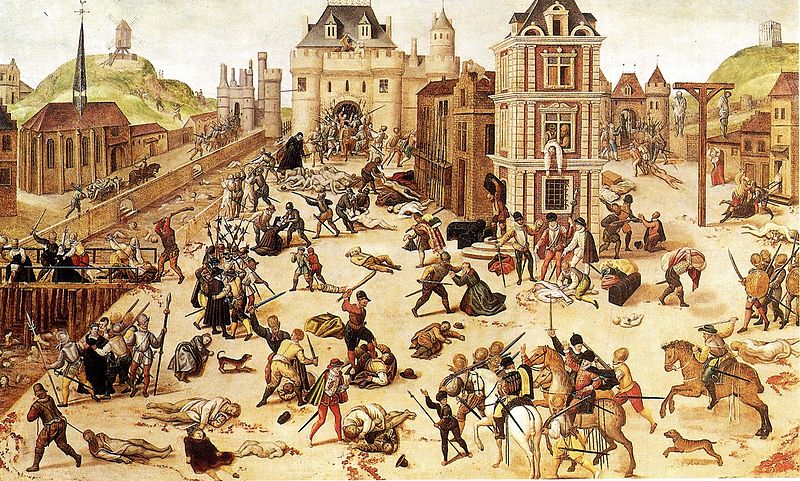
The St. Bartholomew's Day Massacre by Francois Dubois, circa 1572-84. Picture acquired through Wikimedia Commons. Image public domain.

Queen Elizabeth understood that her body was not her own; it belonged to the state and to her people. In fact, she allowed herself to be routinely examined well into her 40's to prove that she was still able to bear children. Yet imagine what Elizabeth would say if she knew that her physician's words concerning her fertility were being read hundreds of years later!


Saturday, February 9, 2013

Elizabethan Quote of the Day: Elizabeth Speaks on Marriage and Children

"And therefore I say again, I will marry as soon as I can conveniently, if God take not him away with whom I mind to marry, or myself, or else some other great let happen. I can say no more, except the party were present. And I hope to have children, otherwise I would never marry." 

(Quote taken from Elizabeth I and her Parliaments 1559-1581, by J.E. Neale).


A portrait of Queen Elizabeth I from 1570. By Hans Eworth. Picture acquired through Wikimedia Commons. Image public domain.

Queen Elizabeth I said this in a speech delivered in 1566 to a delegation made up of both houses of Parliament. The members of Parliament were pressing the Queen to declare her intentions concerning the proposed marriage between herself and the Archduke Charles of Austria. 

A portrait of Archduke Charles (and his dog!) from 1569. Unknown artist. Picture acquired through Wikimedia Commons. Image public domain.

Of course, Queen Elizabeth I never married Archduke Charles, or anyone else for that matter. Though Elizabeth did not marry for a variety of reasons, evidence from her life suggests that she may have wanted children of her own; she was always kind to the children she would meet while on progress, she helped support her godsons at university and found husbands or court positions for the younger women (some of them god-daughters) charged to her care, and she held genuine affection for the children of her cousins, Katherine Carey-Knollys and Henry Carey, Baron Hunsdon.

A portrait of Eleanor Verney, Mrs. William Palmer circa 1590. Eleanor Verney-Palmer was a god-daughter of Queen Elizabeth I. Attributed to William Segar. Parham Park. Picture acquired through Wikimedia Commons. Image public domain.

Archduke Charles later sought the hand of Elizabeth's cousin and rival, Mary, Queen of Scots, but eventually wed Maria Anna of Bavaria, with whom he had twelve children.

A portrait of Archduchess Maria Anna of Austria from 1577. By Cornelis Vermeyen. Picture acquired through Wikimedia Commons. Image public domain.


Friday, February 8, 2013

On This Day in Elizabethan History: The Execution of Mary Queen of Scots


'Mary, Queen of Scots being led to execution', by Laslett John Pott, 1871. Image courtesy of Marilee Cody.

On this day in Elizabethan history in 1587, Mary Stuart, the former Queen of Scots, was executed at Fotheringhay Castle in Northamptonshire. After being implicated in the Babington Plot the previous year, Mary Stuart was tried and found guilty of treason. Mary and her co-conspirators had planned to have Queen Elizabeth I killed, and with the help of a Spanish army and disgruntled English Catholics, place Mary on the throne. (You can read more about the Babington plot, the trial, and the conviction, as well as Elizabeth's reaction, here.)

A Babington Plot letter. Image from Barb Alexander's (the TudorTutor) Pinterest page.

On February 7th, Mary Stuart had learned of her fate via Sir Amyas Paulet, who informed her that she would be executed almost immediately on the following day. A pious Catholic to the end, Mary spent her last night on earth in prayer. When Mary Stuart mounted the scaffold that had been erected within the Great Hall of Fotheringhay Castle, she forgave her executioner for taking her life, as was customary. It was recorded that she uttered to him, "I forgive you with all my heart, for now, I hope, you shall make an end to all my troubles." (quoted in Guy, 7)

In a last act of defiance, Mary Stuart's servants removed her overdress, revealing her undergarments, all in crimson red, the color of a Catholic martyr. After being blindfolded by one of her attendants, Mary knelt before the block and placed her head in the groove intended for her neck. With outstretched arms, she recited in Latin the phrase, "Into thy hands, oh Lord, I commend my spirit."

Despite Mary's willing involvement in the Babington Plot, one cannot help but be outraged by her grisly end; it took not one, but three strokes of the executioner's axe to remove the Scottish Queen's head from her body. To make matters worse, when Mary's severed head had been held aloft and the executioner cried, "Behold the head of a traitor, God save the Queen!", another horrid scene occurred; Mary's hair was revealed to be merely a wig, when her head tumbled to the floor, revealing her natural grey hair, and leaving the curled wig in the executioners grasp. One of Mary's little terriers, who had been hiding under her voluminous skirts revealed himself, but would not leave his deceased owners body. Mary's loyal pet, who one could argue was more loyal to her than any of her own friends and relations, had to be forcibly removed. 

A 1613-14 depiction by an unknown Dutch artist of the execution of Mary Stuart, Queen of Scots. Image acquired through Wikimedia Commons. Image public domain.

Though there are articles of clothing in existence that different institutions claim were worn by Mary, Queen of Scots at her death (a certain chemise comes to mind) these claims are likely dubious. There were strict orders to destroy all of the material goods associated with Mary's execution, including the scaffold and the block, to prevent them from being fashioned into relics by Catholic adherents. A 1613/14 depiction of the execution shows the Queen of Scot's clothing being burnt in the background.

This Chemise shown at Coughton Court is purported to have been worn by Mary, Queen of Scots at her execution; this is almost certainly false, but the myth still prevails. Image from Erika Christine via Wendy Price on Pinterest.

When Queen Elizabeth learned that it had taken not one, but three strokes of the axe to remove Mary's head from her body, she flew into an uncontrollable rage, followed by a deep depression. 

A copy of Mary Stuart's death mask, on display at Falklands Palace. Picture acquired through Wikimedia Commons. Image public domain.

Despite Mary Stuart's last will and testament, she was not buried in France, the land where she had been carefree and happy in her youth. Her body was embalmed and placed in a lead coffin to await burial, which did not come until July of that year. Mary was first buried at Peterborough Cathedral, and later interred in Westminster Abbey by her son James VI, who became James I of England. 

The marble tomb effigy of Mary Stuart, Queen of Scots in Westminster Abbey. Mary's tomb provocatively lies in a chamber directly across from the final resting place of her great rival, Queen Elizabeth I. Picture acquired through Wikimedia Commons, shared for public use by Kim Traynor.

In a case of historical irony, the Scottish Stuarts succeeded to the throne of England, despite Henry VIII banning the Scottish Tudor line from the English succession. The marriage arranged by Henry VII between his eldest daughter Margaret Tudor and James IV gave birth to a dynasty that the Virgin Queen would select to succeed the illustrious Tudors upon her death. The Tudors had reigned successfully for almost 100 years, after decades of dynastic struggle and strife in England during the series of conflicts posthumously known as the 'Wars of the Roses'.

The family tree of James VI/James I of Scotland and England. Image acquired through Wikimedia Commons. Image public domain.


Sources:
Guy, John. My Heart is my Own: The Life of Mary Queen of Scots. London: Fourth Estate, 2004. Print.

Monday, February 4, 2013

Elizabethan Fact of the Day: The 39 Articles of Faith

The frontispiece for the 1569 Bishop's Bible, drawn by an unknown artist. Picture acquired through Wikimedia Commons. Image public domain.

In February of 1563, the "39 Articles of Faith", the doctrinal foundation of the present-day Anglican Church, were finally agreed upon.

To learn more about religious policy in England under Queen Elizabeth I, please see our article here.

Elizabeth I's Bishop's Bible. Folger Shakespeare Library. Image public domain.

Friday, February 1, 2013

On This Day in Elizabethan History: Elizabeth I signs Mary Stuart's Death Warrant

The Babington Plot letter from Anthony Babington. Image from Barb Alexander's Pinterest page.


On this day in Elizabethan history in 1587, after much deliberation, Queen Elizabeth I signed the warrant for her cousin, Mary Stuart's execution. Mary, the former Queen of Scots had been found guilty of treason back in October of the previous year. To learn more about Mary Stuart's involvement in the elaborate Babington Plot, which led to her still-controversial conviction of treason, please visit out article here.

Also, please share your questions and comments below. Do you think Mary, Queen of Scots was guilty of plotting against Queen Elizabeth's life? Do you question the validity of the treason charge? Was Walsingham's method of obtaining proof of Mary Stuart's guilt ingenious or entrapment? I would love to hear your opinions, since this is still a historical event that Tudor-philes are passionate about.