Showing posts with label Protestant. Show all posts

Friday, October 17, 2014

1551: Anne, Duchess of Somerset is Imprisoned in the Tower

Portrait of Anne Stanhope, Duchess of Somerset and wife of the Lord Protector. National Trust, Petworth House; supplied by The Public Catalogue Foundation. Image via Lisby1 on Flickr.

On this day in 1551, Anne Stanhope, Duchess of Somerset and her husband Edward, the Lord Protector, were sent to the Tower of London. It had been decided by King Edward VI and his Privy Council that his uncle, the Protector, was no longer acting in the Crown's best interests, but in his own. Anne was equally unpopular; in previous years, her public disrespect of the beloved Dowager Queen Katherine Parr (who had died in 1548) had earned her many enemies. The couple had previously been imprisoned in 1549. Anne, though an extremely proud and outspoken woman, was by no means as dangerous as her husband. Since she had not been directly involved in any of his political decisions, she was released shortly thereafter; Edward had been released in January of 1550. 

However, after their arrest in October of 1551, Edward would never experience freedom again. He was executed for treason on January 22nd, 1552 at the Tower of London; Anne was released the following year.


A 16th century portrait of Edward Seymour, Lord Protector of England, shown wearing his chain of office. Picture acquired through Wikimedia Commons. Image public domain. 

When Edward VI came to the throne after the death of his father, King Henry VIII, his uncle, Edward Seymour, Duke of Somerset, brother of the late Queen Jane Seymour, was entrusted to help govern during the boy-king's minority. His wife, Anne Stanhope, was thus elevated to an equally lofty position at court. Anne, who had previously been present at the wedding of King Henry VIII and Katherine Parr on July 12, 1543 (Martienssen, 153-154), became the sister-in-law of the widowed Queen of England when Katherine married Edward Seymour's dashing-but-dastardly brother Thomas, Admiral Seymour.

In theory, Anne and Katherine should have been great friends, or at least allies. Both were heavily involved in the Protestant reform movement in England, so much so that both selflessly put their own lives at risk to aid those who were persecuted for their beliefs during the reign of Henry VIII; but Anne's personality did not lend itself to making new friends. Anne was known in court circles as a lady with little discretion, despite her pedigree. Katherine Parr, on the other hand, had the good sense of knowing when to keep quiet; it hand saved her life on at least one occasion during her marriage to Henry VIII.

Anne did not exactly roll out the welcome mat for Katherine when she joined the family. Anne presumptuously claimed that by her marrying again, Katherine was forfeiting her title and rights as Queen Dowager, instead becoming merely the wife of an admiral (Martienssen, 231). It was recorded that the Duchess of Somerset said of her sister-in-law, "If Master Admiral (Thomas Seymour) teach his wife no better manners, I am she that will!" (Fraser, 402)

Dowager Katherine won this debate, however, as she called upon the terms of The Third Act of Succession of King Henry VIII to settle the score. The document stated that, beyond a shadow of a doubt, Queen Dowager Katherine Parr would have precedence above all other ladies in England. And, the Duchess of Somerset not only came behind Katherine Parr, but also the Lady Mary, the Lady Elizabeth, and Henry VIII's fourth wife, Anne of Cleves, who had remained in England after the annulment of their marriage as a wealthy property owner and satellite member of the royal family. History shows us that Katherine Parr was not an easy woman to anger, so her patience must have been tried significantly to refer to Anne Stanhope as, "that Hell" (Fraser, 403). In fact. Anne earned a lot of colorful nicknames during her lifetime, including "stirrer of heresy" from Spanish Ambassador Eustace Chapuys. 

For all of the negative aspects of Anne Stanhope's character, one cannot deny that she was quite an amazing woman. For one thing, she was a devoted wife and mother, who educated her children well. Some of her daughters grew up to become accomplished literary figures of the Elizabethan era. And the same tenacity and ferociousness that Anne wielded at court was equally applied to moving forward the Protestant religion in England, even at great personal risk to herself and her family. You can read more about the formidable Anne Stanhope, Duchess of Somerset in our BeingBess biography of her here.

Sources

Fraser, Antonia. The Wives of Henry VIII. Vintage, 1993. Print.

Martienssen, Anthony. Queen Katherine Parr. McGraw-Hill, 1974. Print. 

Monday, February 4, 2013

Elizabethan Fact of the Day: The 39 Articles of Faith

The frontispiece for the 1569 Bishop's Bible, drawn by an unknown artist. Picture acquired through Wikimedia Commons. Image public domain.

In February of 1563, the "39 Articles of Faith", the doctrinal foundation of the present-day Anglican Church, were finally agreed upon.

To learn more about religious policy in England under Queen Elizabeth I, please see our article here.

Elizabeth I's Bishop's Bible. Folger Shakespeare Library. Image public domain.

Wednesday, September 5, 2012

September 5th, 1548: The Death of Katherine Parr

The tomb of Katherine Parr in St. Mary's Chapel, Sudeley Castle. Photo shared for public use by Lara E. Eakins of TudorHistory.org.

On this day in Tudor history, 1548, the Dowager Queen Katherine Parr died from “childbed fever”, or puerperal sepsis, at her home of Sudeley Castle. With her final breaths, Katherine Parr voiced her disappointment in her husband, Thomas Seymour, for all the pain he had caused her. Thomas had been inappropriate with his wife's stepdaughter, Elizabeth Tudor (Plowden, 100-101). 

Henry VIII's sixth and final wife was laid to rest on the grounds of Sudeley Castle in St. Mary's Chapel.

An exterior view of Sudeley Castle. Picture acquired through Wikimedia Commons. Image public domain.

After being widowed just one year before, upon the death of her third husband, King Henry VIII, Katherine had seized her chance at happiness by marrying Thomas Seymour. Thomas had been pursuing Katherine before she had caught King Henry's eye (Porter, 284-291). Thomas Seymour was also the uncle of Katherine's stepson, the boy-king Edward VI.

The Jersey Portrait. The sitter was formally thought to be Jane Grey, but has now been identified as Katherine Parr. Picture acquired through Flickr courtesy of Inor19.


Katherine and Thomas's courtship appears to have been a passionate one, but their marriage suffered when Thomas became fixated on Katherine's young stepdaughter, Elizabeth Tudor (Porter, 307-315). Elizabeth was in their care, living under their roof. Thomas abused his ward by behaving inappropriately with her. 

Katherine Parr, although a highly educated and perceptive woman, was conflicted as to how to handle the situation. Torn between her husband and the stepchild she regarded as her own daughter, Katherine began participating in her husband's escapades. Who knows how she rationalized her involvement to herself; perhaps she believed it would bring her closer to her husband, or perhaps she thought it would help her to keep an eye on the behavior.

When Katherine became pregnant, she became far less tolerant of her husband interest in Elizabeth, and she had the Princess sent away (Porter, 313-314). Still, Elizabeth and Katherine were not on bad terms, and they wrote to one another during their separation (Porter, 315-316). Upon learning of her stepmother's death, Elizabeth was devastated. Despite the betrayal she had experienced in Katherine Parr's care, she would never forget that this was the woman who had treated her like she was her own child. She had loved her, interceded for her with her father, and given her with the best of educations (Plowden, 75, 93). Just a few years before (1545), the Princess Elizabeth had given her stepmother her own translation of The Mirror of the Sinful Soul, by Margaret of Navarre. This present was intended to show off her academic skills, which she had acquired thanks to the tutors provided to her by her stepmother. The cover was embroidered in her own hand, and included Katherine Parr's initials, "KP" in the center.

Elizabeth Tudor's translation of The Mirror of the Sinful Soul, given by her to her stepmother, Katherine Parr in 1545. Elizabeth hand-embroidered the cover, including the Dowager Queen's initials, "KP" in the center. Picture acquired through Wikimedia Commons. Image public domain.

Katherine herself was quite the role model for the young Elizabeth in matters of education, government,and religion. Katherine was an author, and she earned the distinction of becoming the first English Queen to have a work of literature published under her own name. Just one year after her wedding to Henry VIII, the mature and accomplished Katherine was entrusted to be regent of England for three months.  Finally, Katherine was a champion for church reform, even though it nearly cost her her life (Porter, 225-267).

Prayers and Meditations, a book authored by Queen Katherine Parr. This copy was perhaps written in her own hand. Picture acquired through Wikimedia Commons. Image public domain.

Sadly, the fate of Queen Katherine Parr's only biological child, Mary Seymour, is unknown. While she lived for a time in the care of Katherine Parr's friend, Katherine Willoughby, she disappears from the records and probably did not live into adulthood.

A portrait of Queen Katherine Parr, circa 1545. Picture acquired through Flickr courtesy of Inor19. Image public domain.
In Other Katherine Parr News...
This Sunday, September 9th, marks the grande finale of the year-long celebrations at Sudeley Castle for the Katherine Parr Quincentenary. The Quincentenary marks the 500th anniversary of the birth of Katherine Parr, the 6th and final wife of King Henry VIII.

An exterior view of a knot garden at Sudeley Castle. Picture acquired through Wikimedia Commons. Image public domain.

Sudeley Castle has undertaken a remarkable historical challenge: re-creating the funeral of England's Queen Dowager from 1548. The event, which is sold out, asks guests to participate, rather than mereley spectate, by having them portray actual funeral guests.This re-enactment, led by eminent Tudor historian Dr. David Starkey, truly is "living history" at its finest!

A close-up of the tomb of Queen Katherine Parr in St.Mary's Chapel, Sudeley Castle. Photo shared for public use by Lara E. Eakins of TudorHistory.org.

Sources

Porter, Linda. Katherine the Queen. New York: St. Martin's Press, 2010. Print.

Plowden, Alison. The Young Elizabeth. Gloucestershire: The History Press, 2011. Print.

Tuesday, July 3, 2012

Elizabethan Fact of the Day: Elizabeth Visits Oxford on Progress in 1566

During Queen Elizabeth I's summer progress in 1566, she chose to visit the University of Oxford. The university and the student's were eager to impress the Queen, who had honored them with her visit. So, they prepared a showcase of Oxford talent, where Queen Elizabeth and her courtiers were entertained with debates and plays. 

Portrait of Queen Elizabeth I, c.1590 that hangs in the Hall of Jesus College, Oxford University. Queen Elizabeth founded the school on June 27th, 1571. Jesus College was the first Protestant college to be founded at the university. Elizabeth originally intended Jesus College to be an academic institution for Anglican clergymen. These men would help to enforce her Elizabethan Religious Settlement (please see my article: Religious Policy under Elizabeth I). Picture acquired through Wikimedia Commons. Image public domain.

Queen Elizabeth supported education in many ways throughout her reign; one of the ways in which she showed her support to higher education was by making frequent visits to universities. Queen Elizabeth even helped to pay for some of her god-children's schooling. This is generous, considering she had more than one-hundred in her lifetime! We know that Elizabeth greatly valued her own education; while she believed God had preserved her through many dangers in order to assume the position of Queen of England, it was Elizabeth's education and intellectual ability that can be largely credited for creating the consummate stateswoman we study to this day. (For an assessment of Elizabeth's political aptitude by scholar Garrett Mattingly, click here.)

One of Queen Elizabeth's godchildren was the writer John Harrington; he attended Eton and King's College, Cambridge. The Queen helped to fund his education. Some of Queen Elizabeth and John Harrington's correspondences have survived, and they were published by his descendent under the title Nugae Antique.

Interestingly, John Harrington holds the prestige of being the inventor of the first flushing toilet in England in 1596. He describes this invention, which he originally installed in his house at Kelston in his work, A New Discourse of a Stale Subject, Called the Metamorphosis of Ajax. He also installed the flushing toilet for his royal godmother at Richmond Palace.  

Sources

Doran, Susan. The Tudor Chronicles 1485-1603. London: Quercus, 2008. Print.

Kinghorn, Jonathan."A Privvie in Perfection: Sir John Harrington's Water Closet." Bath History.

Monday, April 16, 2012

On This Day in Elizabethan History: The Death of Anne Stanhope, Duchess of Somerset

On This Day in Elizabethan History, Anne Stanhope, Duchess of Somerset, died in 1587. She is buried in Westminster Abbey. Anne was the second wife of Edward VI's uncle, the Lord Protector Edward Seymour, Duke of Somerset. Anne is most famous for her pride; her prestige as the Duchess of Somerset and the wife of one of the most powerful men in England led her to publicly declare precedence (without merit) over the Queen Dowager, Katherine Parr. Anne was, according to one Spaniard residing in London, "more presumptuous than Lucifer" (Fraser, 235). But Stanhope was no devil; she was also a reformer and a loyal wife...


Anne Stanhope, Duchess of Somerset's tomb and effigy at Westminster Abbey. The inscription says: "A Princesse descended of noble lignage, beinge daughter of the worthie knight Sir Edward Stanhope, by Elizabeth his wyfe, that was daughter of Sir Foulke Burgchier Lord Fitzwarin, from whom our moderne Erles of Bathe are spronge. Sonne was he hunto William Lord Fitzwarin, that was brother to Henry Erle of Essex and Jhon lord Berners; whom William theire sire, sometyme Erle of Eu in Normandy, begat on Anne the sole heire of Thomas of Woodstocke, Duke of Gloucester, younger sonne to the mighty prince Kinge Edward the Third, and of his wyfe Aleanoure coheire unto the tenth Humfrey de Bohun that was Erle of Hereford, Essex, and Northampton, High Constable of England." Picture acquired through Wikimedia Commons. Image public domain.

 Anne was born probably in 1497 in Suffolk to Sir Edward Stanhope and Elizabeth Bourchier. She had two elder-half brothers through her father's first marriage, Richard and Michael. One could argue that Anne's self-important nature had its root in her impressive ancestry: she was descended on her mother's side from Thomas of Woodstock, who was the youngest son of Edward III and his wife Philippa of Hainault (Martienssen, 125). 

A 14th century drawing of the coronation of Philippa of Hainault, the Queen Consort of Edward III. Picture acquired through Wikimedia Commons. Image public domain.

Anne enjoyed the privilege of being educated in her youth; she came to court in 1511 after the death of her father (Emerson, 214). She would soon become known for her tendency to voice her strong opinions.


A detail of a portrait of Anne Stanhope, wife of the Lord Protector and the Duchess of Somerset. Picture acquired through Wikimedia Commons. Image public domain.

 Somewhere between 1534 and 1535, Anne married Edward Seymour. It is said that she caught Edward's eye around 1520 when she was a maid of honour at court (Emerson, 214). Anne and Edward were equally matched in ambition and self-importance. By the time of Anne's marriage to Edward, King Henry VIII was already showing favor to Edward's younger sister, Jane Seymour, even though he was still married to Anne Boleyn. Anne must have surmised that either her new sister-in-laws relationship would bring great opportunities for her and her husband, or disastrous consequences.

By 1536, Jane Seymour had become the third wife of Henry VIII. As Henry had previously done for Anne Boleyn and her relations, the Seymour's were all promoted to new titles and high-ranking offices. Edward became Viscount Beauchamp, and in October of 1537, he enjoyed the distinction of becoming the Earl of Hertford. And long after the death of Jane Seymour in 1537, Edward was elevated to the title of the Duke of Somerset in 1547. As was customary, his wife became the Duchess of Somerset.


A detail of a portrait of Edward Seymour. The resemblance to his sister, brother, and eldest son is particularly noticeable in this representation. Picture acquired through Wikimedia Commons. Image public domain.


Anne and Edward were incredibly successful in creating little Seymour's; together they had ten children! One of these children, also called Edward, would secretly marry Lady Katherine Grey, who was in line for the throne of England; both were reprimanded by Elizabeth I for marrying without her permission. Three of Anne's daughters, another Jane Seymour, (who was the sole witness at her brother Edward and Katherine Grey's marriage) Anne (later Countess of Warwick) and Margaret Seymour would be celebrated in the 16th century for their writing. The three co-authored a compendium of 103 Latin verses for the tomb of Margaret Valois, Queen of Navarre (herself an author; she wrote The Mirror of The Sinful Soul). Anne Stanhope valued her education, and she afforded her own daughter's the same opportunities.


Edward Seymour, Edward and Anne's second child (their first, a son also named Edward, and of whom Queen Jane Seymour was godmother, had died when he was a toddler). Edward married Katherine Grey, a claimant to the throne, without Elizabeth I's knowledge. Both were imprisoned as a result. They had two sons, both of whom were declared illegitimate. Picture acquired through Wikimedia Commons. Image public domain.

 Anne Stanhope made a name for herself in court circles as one who spoke her mind, often at the expense of others feelings. She was still an intimate at court by the time Henry VIII married his final wife, Queen Katherine Parr. Anne was even present at their wedding on July 12, 1543 (Martienssen, 153-154). When Edward VI came to the throne after the death of his father, his uncle Edward Seymour was appointed to govern in the boy-king's minority. Anne became sister-in-law with the former Queen of England when Katherine Parr married Edward Seymour's brother, Thomas.


A miniature, probably of Queen Katherine Parr. Picture acquired through Wikimedia Commons. Image public domain.

 Anne did not exactly welcome Katherine to the family; it would appear that The Duchess of Somerset could not bare the thought of sharing the spotlight with another accomplished woman. Anne claimed that by Katherine Parr marrying again, Katherine was forfeiting her title and powers as Queen Dowager, instead becoming merely the wife of an Admiral (Martienssen, 231). It was recorded that the Duchess of Somerset said of her sister-in-law, "If Master Admiral (Thomas Seymour) teach his wife no better manners, I am she that will!" (Fraser, 402).

Katherine won this debate, however, as she called upon the terms of The Third Succession Act to settle the score; this document stated that, beyond a shadow of a doubt, Queen Dowager Katherine Parr would have precedence above all the other ladies in England. The Duchess of Somerset not only came behind Katherine Parr, but also the Lady Mary, the Lady Elizabeth, and Henry VIII's fourth wife, Anna of Cleves, who had remained in England, and was referred to as "the king's sister". History shows us that Katherine Parr was not an easy woman to anger, so her patience must have been tried significantly to cause her to start referring to Anne Stanhope as "that Hell" (Fraser, 403).  

In theory, Katherine Parr and Anne Stanhope could have been great friends; both were heavily involved in the Protestant reform movement, so much so that both put their own lives at risk to aid those who were persecuted for their beliefs. While no one should ever turn to the Showtime series The Tudors as gospel, the plot line of Anne Stanhope* sending aid to Anne Askew, who was burned at the stake as a heretic, was absolutely true. Both Parr and Stanhope were friends of Askew, and they were both profoundly affected by the nature of her death. Stephen Gardiner, one of my least favorite people in Tudor history, attempted to get Anne Askew to implicate the Queen and the Duchess of Somerset as fellow heretics, but she would not give in. Eustace Chapuys called Stanhope a "stirrer of heresy" for her promotion of reform. (*It should be mentioned that the character of the Duchess of Somerset in the show is a conglomeration of the real Anne Stanhope and Edward Seymour's first wife, Catherine Filliol, whom he divorced on grounds of her adultery.)

Anne's treatment of the beloved Queen Dowager had started to aggravate and alienate other courtiers. To make matter's worse, her husband Edward had grown exceedingly power hungry, and his wielding of absolute authority in England was unpopular. The Privy Council challenged him on his behavior, and he and his wife were sent to the Tower in October of 1549. Anne, though an irritant, was by no means as politically dangerous as her husband, and due to her distance from his professional missteps, she was released shortly thereafter (Loades, 150). After cooling his heels in prison, Edward was released in January of 1550.


A 16th century portrait detail of the Lord Protector of England, Edward Seymour, wearing his chain of office. Picture acquired through Wikimedia Commons. Image public domain.

 According to the Imperial Ambassador, the Duchess of Somerset had been working overtime on her husband's behalf, visiting the new chief advisor to the king, John Dudley, the Earl of Warwick (and father to Robert and Ambrose Dudley). She was petitioning him to allow her husband to rejoin the Privy Council after his brief disgrace. The plan worked, and as soon Somerset was back on the council, the Dudley's and Seymour's were arranging a marriage between Anne Seymour (the aforementioned writer) and John Dudley (jr).

Unfortunately, Somerset's freedom was to be short-lived, as he was arrested again in October of 1551, on charges that he had been conspiring against Warwick, now the Earl of Northumberland. Northumberland, like Seymour, was ambitious to a fault, and when he saw his opportunity to rid himself of another power-player, he took it. The Duchess of Somerset must have been frustrated when all her negotiating (or as she might have seen it, 'condesceding to') Dudley had come to naught, as she was also imprisoned, again, along with her husband.

On December 1st of that same year, Somerset was convicted of the charges against him, and  sentenced to death, and on January 22nd, 1552, the young King Edward VI's uncle was beheaded. His other uncle would soon share the same fate. The Duchess was not released from the Tower until May 3 of 1553 (Loades, 188-190). One can only imagine how she managed to bare the confinement and humiliation of her family's fall from power.

After Mary Tudor came to the throne and the Earl of Northumberland was executed for his role in a coup d'etat, the Duchess of Somerset was allowed to rummage through the personal belongings of the Dudley's to take whatever she wanted. This must have brought her great satisfaction!

A portrait of Queen Mary I early in her reign. Picture acquired through Wikimedia Commons. Image public domain. Picture acquired through Wikimedia Commons. Image public domain.

Anne Stanhope was made of strong stuff; she had endured the public backlash for her unfriendly behavior toward Katherine Parr, survived two stints in the Tower of London, and the public disgrace and execution of her husband. Anne gradually put herself back into society. She would marry for a second time to the former steward of her and her late husband, Francis Newdigate. This marriage was presumably for love, since she already had mothered ten children and because Newdigate was her social inferior (something that Stanhope typically paid great attention to!) Newdigate and Anne were likely already friends, or at least acquaintances, given their close proximity in earlier years.

In 1560, Queen Elizabeth I granted the manor of Chelsea to Stanhope for life, and granted "the widow of the Protector" an annuity for the payment of her household. Not much of Anne and her second husband's marriage is known, but in 1570 they were prosecuted for failing to pay rent on the property for ten years (History of the County of Middlesex, pages 108-115). Francis died shortly before his wife, in 1581. Anne lived the remainder of her life away from court, in Shelford, Nottinghamshire. On the 14th of July in 1586 she completed her will; it was later published in it's entirety in The Gentleman's Magazine issue from April of 1845, on page 371. In addition to being buried at Westminster, there is a memorial for Anne in St. Peter and St. Paul's Church in Shelford.

A detail from The Clopton Portrait of Queen Elizabeth I, circa 1560-65. Picture acquired through Wikimedia Commons. Image public domain.

Had Anne lived just one year more, she would have witnessed one of the greatest triumphs in English history...the defeat of the Spanish Armada.

Sources:

Emerson, Kathy Lynn. Wives and Daughters: The Women of the Sixteenth Century.Whitston Publishing Company, 1984. Print.

Fraser, Antonia. The Wives of Henry VIII. Vintage, 1993. Print.

Martienssen, Anthony. Queen Katherine Parr. McGraw-Hill, 1974. Print. 

Loades, David. John Dudley, the Duke of Northumberland 1504-1553. Oxford University Press, 1996. Print.

"Landownership: Chelsea manor", in A History of the County of Middlesex: Volume 12: Chelsea (2004), pages 108-115, at http://www.british-history.ac.uk/report.aspx?compid=28701

Friday, April 6, 2012

Elizabethan Fact of the Day: Easter in Elizabethan Times


Happy Easter!
If you celebrate Easter, we wish you a happy day filled with friends, family, and faith.


And because I never miss an opportunity to tie anything to Queen Elizabeth I, I would like to share with you some information on the Elizabethan Easter....

The celebration of Easter is the most important feast day in the calender of the Elizabethan Church, also known as the Anglican church. Just like today, Easter was a "floating" holiday in the 16th century, and could occur on a Sunday in either March or April.

By the time Elizabeth was on the throne, Easter resided on the first Sunday after the first full moon that occurred on or after March 21st. This means that Easter could fall anywhere between March 22nd and April 25th during Elizabeth's reign (Wagner, 93-94).

Proceeding the actual feast day of Easter was 40 days of Lent, a period of fasting and abstinence from a variety of forms of merriment. Lent was, and still is intended as a time for reflection of Christ's sacrifice on the cross for our sins. Lent begins on Ash Wednesday, and concludes with the week before Easter, appropriately titled "Easter Week" or "Holy Week". Easter Week begins on Palm Sunday. Holy Week concludes with Maundy Thursday, Good Friday and Holy Saturday, all of which were observed retaining some Catholic traditions (Wagner, 94). Queen Elizabeth I herself continued the royal tradition of having a Maundy Thursday rendezvous with the common people, and the annual event was commemorated in the miniature below:


An Elizabethan Maundy, a miniature of Queen Elizabeth observing the tradition of a Maundy with the common people. The miniature is by Elizabethan female court painter Leevina Teerlinc. Picture acquired through Wikimedia Commons. Image public domain.

The Easter Sunday service was one of the three times in a year that Anglican church-goers took communion; the others were Christmas and Whitsun. Whitsun was the feast of Pentecost, which fell in either May or June. After attending church, the Elizabethans would partake in extravagant feasting celebrations.

Since we know that by Queen Elizabeth's reign Easter had acquired some secular customs, the Elizabethans, like modern Christians, were celebrating with decorated eggs and other pagan-derived symbols from ancient Anglo-Saxon culture (Wagner, 94). Though we can say with surety that the Queen herself probably did not participate in any sort of an egg-hunt!

Sources: 

Wagner, John A. The Historical Dictionary of the Elizabethan World. Print.

(Pages 93-94.)


For further reading on Elizabethan religious customs, please see: 

Bonfires and Bells: National Memory and the Protestant Calender in Elizabethan and Stuart England by David Cressy

ALSO: On this Day in Elizabethan History, Sir Francis Walsingham, Queen Elizabeth I's spymaster died in 1590. But because this year this weekend is Easter Weekend, and every year ever-after April 6th will be the death of Sir Francis Walsingham, we will write a mini-bio on him and his achievements next year!

A detail of a 16th century portrait of Sir Francis Walsingham, whom Queen Elizabeth called her "moor", due to his swarthy complexion. Picture acquired through Wikimedia Commons. Image public domain.

In the meantime, to learn more about Walsingham's life and work, please read:

Her Majesty's Spymaster: Elizabeth I, Sir Francis Walsingham, and the Birth of Modern Espionage by Stephen Budiansky.

Mr. Budiansky is an author who specializes in military and intelligence history. We own this book and highly recommend it!

Tuesday, March 13, 2012

Religious Policy Under Elizabeth I

Upon succeeding to the throne of England in 1558,  Queen Elizabeth immediately set to work devising the Church Settlement that progressed through Parliament to be passed in 1559. Of course, the religious policy saw opposition from the Marian bishops who remained in office, but it still passed. The Church Settlement allowed Elizabeth's subjects to honor their own religious convictions privately, provided that they demonstrate their loyalty to Queen and Country by outwardly conforming. This meant that subjects were required to attend an Elizabethan church service weekly, and those who refused to do so were fined 1 shilling per a week.


The Coronation Portrait of Queen Elizabeth I, depicted at the age of 25. Thought to be a 17th century copy from a lost original. Picture acquired through Wikimedia Commons. Image public domain.

Outward conformity from both sides, Protestant and Catholic, helped Elizabeth's subjects to see themselves for the first time unified as English, rather than divided into religious factions.  It certainly helped that the Church of England's services retained elements of the old Catholic faith, while adopting some of the reforms of the Protestant movement. One of the tools used to rectify the Queen's subjects of any Christian affiliation was the Book of Common Prayer. The Book of Common Prayer was revised in 1559 in an attempt to appease as many English subjects as possible. For example, for the Service of Holy Communion, the Book of Prayer contains this phrasing to be spoken:

"The Body of our Lord Jesus Christ which was given for thee, preserve thy body and soul unto everlasting life; Take and eat this in remembrance that Christ died for thee, and feed on him in thy heart by faith with thanksgiving."

The first statement comes from the 1549 Prayer Book and would have been acceptable to Catholics who believe that the bread is transformed into the flesh of Christ by the miracle of transubstantiation. The second phrasing comes from the 1552 Prayer Book and would have been deemed acceptable to the English Protestants who believed that the taking of the bread is an act of memorial to the Last Supper, making the bread symbolically the flesh of Christ, rather than literally. The issue of transubstantiation was a central issue of the English Reformation, hearkening back to Henry VIII's break with Rome to form the Church of England. People lost their lives in the Henrician and Marian regimes upholding their beliefs pertaining to this matter. Queen Elizabeth wished to avoid this conflict altogether, and careful consideration was taken in reforming the Book of Common Prayer early in her reign.

King Henry VIII of England, by Hans Holbein c. 1537. Elizabeth's father Henry VIII broke from Rome so that he could grant himself his own divorce from Catherine of Aragon, in order to marry Elizabeth's mother, Anne Boleyn. Picture acquired through Wikimedia Commons. Image public domain.
 Elizabethan bishops were required to subscribe to 3 Articles of Faith:

1. They must recognize the Queen as Supreme Governor of the Church.
2. They must subscribe to the Book of Common Prayer.
3. They must agree to the 39 Articles of Religion.

William Cecil, Lord Burghley, who was Queen Elizabeth's chief advisor and Lord Treasurer was well known by the Queen to have Puritan leanings. He took issue with the rigidness of belief to which Elizabeth's bishops were expected to subscribe, and in 1584 he wrote to Elizabeth I's 'model' bishop John Whitgift, who was Archbishop of Canterbury from 1583-1603. Burghley did not wish to see the Puritan clergy compelled to leave the church due to the 3 Articles of Faith they were required to uphold.  In Burghley's letter to Archbishop Whitgift, he said,

"...But I conclude according to my simple judgement, this kind of proceeding is too much savouring of the Romish Inquisition, and is rather a device to seek for offenders than to reform any." (Quoted in Statutes and Constitutional Documents 1558-1625, G.W. Prothero, Oxford University Press 1894.)

Those with Puritan convictions like Burghley found it difficult to swear that the Book of Common Prayer contained nothing in contradiction to the actual Word of God. Whitgift responded to Burghley's concerns saying that  the Church previous to Elizabeth had been suffering from a "lack of discipline" and that the structure the Elizabethan Church Settlement was providing would hold clergy to a higher standard (Palmer, 32).

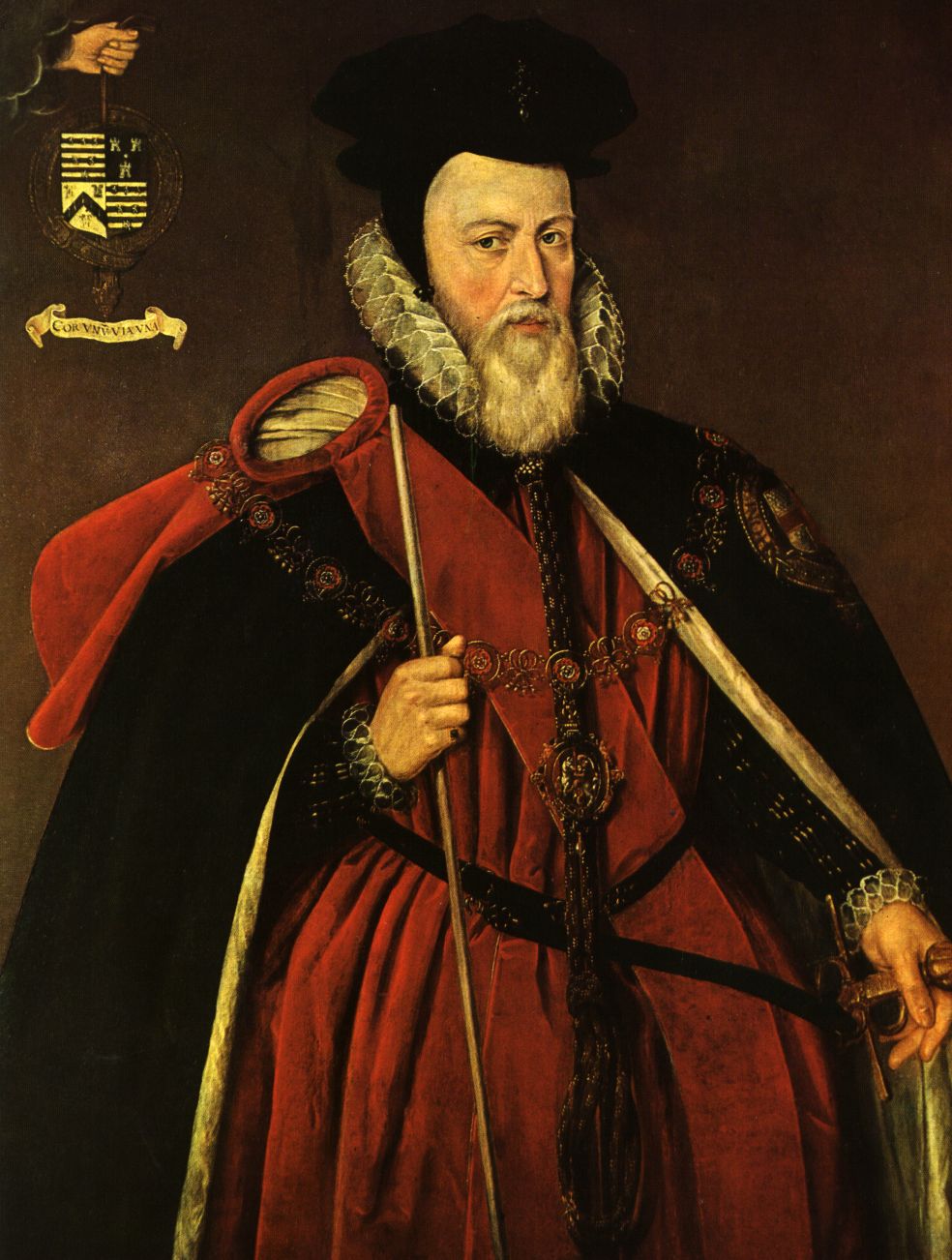
William Cecil, Lord Burghley (1520-1598), depicted in the robes of the Order of the Garter. Elizabeth made Cecil her chief Secretary of State in 1558. He was styled Lord Burghley in 1571, and in 1572 he was made Lord Treasurer, which was the position he held until his death. Elizabeth called this man who was her chief minister for 40 years her "spirit". Picture acquired through Wikimedia Commons. Image public domain.
 At all costs, Elizabeth wished to keep the peace; she really had no interest in rocking the boat on either side; this disappointed the extremist Catholics who were looking for a clear offense that they could use as cause to rise up against her, but it also disappointed  the Puritans and Presbyterians who had hoped that she would be the figurehead for a stricter Protestant church.  

Elizabeth I's Bishop's Bible from 1568. In the collection of the Folger Shakespeare Library. Picture acquired through Wikimedia Commons. Image public domain.

Elizabeth professed that she "wished not to open window's into men's souls", and she expected the same courtesy that she extended to her own subjects to be afforded to her as well. This is perhaps why the details of her own religious convictions remain somewhat of a mystery. Still, no one should doubt that Elizabeth herself was indeed religious; she had studied the Bible and other ancient texts of religion for many years, and she often professed how she believed God had preserved and guided her through the many trials and tribulations of her life to be crowned Queen of England. 

The frontispiece of Queen Elizabeth's prayerbook, showing her kneeling in reverence and prayer. Picture acquired through Wikimedia Commons. Image public domain.

William Camden (1551-1623) lived through Queen Elizabeth's reign, and as her contemporary he had access to original material (Palmer, 29).  He published his Annals of Queen Elizabeth in Latin in 1615, and he made a point to comment on the Queen's religious habits,

"(Queen Elizabeth was)...truly religious, who every day, as soon as she arose, spent sometime in prayers to God and afterwards also at set times in her Private Chapel; every Sunday and Holy day she went into her chapel ; neither was there ever any other prince present at God's service with greater devotion. The sermons in Lent attentively she heard being all in black, after the manner of old although she many times said that she had rather talk with God devoutly by prayer than hear others speak eloquently of God."

The frontispiece and title page of the 1675 edition of William Camden's Annals of Queen Elizabeth. Picture acquired through Wikimedia Commons. Image public domain.

This observation from Camden, published in the reign of Elizabeth's successor James I, shows that while Elizabeth gave nods to the Catholic way of worship (Attending church during Lent season in all black) she still professed and practiced perhaps the most important concept of Protestantism: the ability to converse directly with God rather than rely on the interpretation or intercession of the clergy to communicate with and understand God and His will.

While Queen Elizabeth adopted an extremely moderate religious policy that brought stability to her realm, it should be emphasized that extremism on either side was considered politically dangerous. Zealous Catholics as well as Puritans and Presbyterians were monitored and sometimes severely punished if they threatened the safety of Queen Elizabeth and her realm, or if their prophesying caused civil unrest.

Puritans took issue with Elizabeth's policy not continuing the work of her late brother Edward VI's regime. The Puritan's has hoped that Elizabeth Tudor would completely reform the Church of England, and rid it of  all vestments, icons, Latin verses and other trappings of the Catholic faith. While services continued to include Latin hymns and incense, Queen Elizabeth did promote the Protestant reform of raising the qualifications of the clergy: Elizabeth's bishops were supposed to be well-educated and Bible-literate; still, Elizabeth always remained wary that any religious study group could develop into cells of Presbyterian doctrine.

Detail of the allegorical work Edward VI and the Pope. Picture acquired through Wikimedia Commons. Image public domain.
Presbyterians, another Christian sect, were the biggest Protestant threat to the peace of Elizabeth's realm, since their rejection of the entire ecclesiastical hierarchy of bishops by implication took issue with the institution of royal supremacy (Palmer, 28).

Some ardent Catholics also gave Queen Elizabeth and her government reason to be cautious. A small number of Catholics in England welcomed militant Catholic priests and assassins from abroad who aimed to attack Queen Elizabeth with the blessing of the pope. When Elizabeth was excommunicated from the Roman Catholic faith (which she had never once been a part of), it was declared by the Bishop of Rome that anyone who saw the "English Jezebel" killed would not be committing murder but instead would be doing God's will, and would be welcomed into Paradise. Elizabeth's network of spy's and informants, led by her spymaster Sir Francis Walsingham, monitored the lives of  individuals associated with this Catholic movement closely.

Detail of a portrait of Sir Franics Walsingham (1536-1589). Walsingham succeeded Burghley as Secretary of State in 1573. He acted as Ambassador to Scotland, France and the Netherlands, while acting as Queen Elizabeth I's "spymaster". It was Walsingham's network that uncovered the Mary, the so-called Queen of Scot's treachery and the Babington Plot. Picture acquired through Wikimedia Commons. Image public domain.

Queen Elizabeth had watched from afar with great concern the religious wars which were tearing apart the kingdom's on the Continent. When she became Queen she wisely decided to occupy herself with healing the religious tension in England as best as she could in order to prevent her nation from befalling a similar fate. While some Protestants and some Catholics took issue with aspects of Elizabeth's religious policy, most found it to be remarkably tolerable. If we compare Elizabeth's decisions pertaining to religion to those of her predecessors, contemporaries, and even her successor, it is very clear that her policy was the least oppressive. Queen Elizabeth really did make a conscience effort to appease the majority of her subjects by permitting them their religious convictions, so long as they remained loyal subjects. The Elizabethan Church Settlement would be one of the many ways in which Queen Elizabeth would improve the lives of her people.

Queen Elizabeth captured the matter of Christianity best when she said, "There is but one God, one Jesus Christ; all else is dispute over trifles."


The Great Seal of Queen Elizabeth I, from 1586. Designed by Nicholas Hilliard. Picture acquired through Wikimedia Commons. Image public domain.
Sources:

Palmer, Michael. Reputations: Elizabeth I. Bath Press, 1988. Print.

Prothero, G.W. Statutes and Constitutional Documents 1558-1625. Oxford University Press, 1894. Print.

Camden, William. The Annals of Queen Elizabeth. London, 1615. Electronic.

Sunday, December 25, 2011

On This Day in Elizabethan History: Queen Elizabeth's first Christmas as Queen.

First let me say, Happy Christmas to all who celebrate the holiday! I hope the new year finds all of my readers (of any faith) and their loved ones happy and healthy.

Today I would like to share with you a pivotal event that happened the very first Christmas after Elizabeth had been named Queen of England, after the death of her sister Mary.

On Christmas Day, 1558, Elizabeth gave her subjects her first real hint as to her religious inclinations and the religious traditions she would observe as queen.

Normally, the Archbishop of Canterbury would have held a mass on Christmas morning for the reigning monarch and their court, but this position was now vacant since Archbishop Reginald Pole had died the same day as Queen Mary. This was fitting, as Reginald was one of Mary Tudor's lifelong supporters, like his mother Margaret Pole before him; his perfectly timed passing suggested that he was following his queen from this life into the next.

A detail from a portrait of Cardinal Reginald Pole. Picture acquired through Wikimedia Commons. Image public domain.

Many of Mary's former clergy were wary of Elizabeth's religious beliefs. While she had never made any secret of her Protestant faith, it remained to be seen if her beliefs would lean more toward the Puritanical, like her brother's regime, or remain more moderate. Perhaps they feared, she would inhabit the same martyr like quality her sister had for her own faith, and exact revenge on the Catholic ministers who had sentenced Protestant "heretics" to death. Of course, none of the Catholic clergy and politicians fears would come to pass, but in the early months of Elizabeth's reign, they held their breath as they waited for the queen to shown her hand.

After the Archbishop of York boldly announced that he would not crown a "heretic" as  queen, there was only one clergyman willing to host a Christmas Day service for Elizabeth. He was Owen Oglethorpe, the Bishop of Carlisle.

Elizabeth, like her father, was prepared to maintain some of the "pomp & circumstance" of a Catholic service in an Anglican-style mass, but there was one element of the service she would not waver on, she told Oglethorpe in a message...

The Elevation of the Host was to be eliminated, since it implied the miracle of transubstantiation, (the belief that the bread and the wine was actually transformed into the body and blood of Christ, rather than just symbolically) actually occurred, which Protestants did not believe in.

Oglethorpe received the message, but he boldly chose to deny the queen's single order, and proceeded with his traditional service.

When the Bishop of Carlisle held the bread and wine up to the heavens to be transformed, Elizabeth was furious. From where she was seated in her chapel, she ordered him to cease and desist. When he ignored her and continued with the service as he saw fit, the queen rose and left the chapel, followed by her retinue.

The Clopton Portrait of Elizabeth I, c. 1558-1560 by an unknown artist. Picture acquired through Wikimedia Commons. Image public domain.

Two days later, Queen Elizabeth issued a proclamation decreeing that some parts of a religious service be said in the people's language of English; she also ordered all preaching and prophesying, on both the conservative and radical sides of the religious question, to stop until further notice. She hoped that this edict would temporarily prevent Catholics and Protestants from aggravating one another in a war of words which could eventually lead to violence.

The states new policy on religion was scheduled to be determined in the Parliamentary meeting in January, after the queen's coronation.

Source:

Weir, Alison. The Life of Elizabeth I. New York: Ballantine Books, 1999. Print.