Showing posts with label Elizabethan Quote of the Day. Show all posts

Friday, February 15, 2013

Elizabethan Quote of the Day: Concerning the Earl of Cumberland

A portrait of George Clifford, the Earl of Cumberland, wearing the Queen's glove on his hat, and proudly displaying his lance and tournament armor. By Nicholas Hilliard. Picture acquired through Wikimedia Commons. Image public domain.
 
"...This noble gentleman (George Clifford) by her majesties express commandment is yerely (without respect unto his age) personally present at these military exercises, there to see, survey, and as one most careful and skillful to direct them."

-from Honor Military and Civill, by William Segar.

George Clifford, the 3rd Earl of Cumberland, was one of the commanders of the fleet that drove off the Spanish Armada. He also served as Queen Elizabeth I's tournament champion for a time. When Queen Elizabeth I gave him her glove, the Earl of Cumberland wore it on his person forever-after, displaying it on the front of his hat.

A portrait of a portrait of George Clifford, the 3rd Earl of Cumberland, circa 1590, wearing Queen Elizabeth I's favor, a glove, on his hat. After Nicholas Hilliard. Image public domain through Creative Commons licensing, NPG, London.


Sunday, February 10, 2013

Elizabethan Quote of the Day: Elizabeth's Physician Shares Sensitive Information

"If the King marries her, I guarantee ten children; and no one in the world knows her constitution better than I do."

Queen Elizabeth I's physician made this bold claim to the French ambassador in 1566, when the French King Charles IX was considering marrying the Tudor queen. 

A portrait of King Charles IX of France, circa 1572 in the Palace of Versailles. By or after Francois Clouet. Picture acquired through Wikimedia Commons. Image public domain.

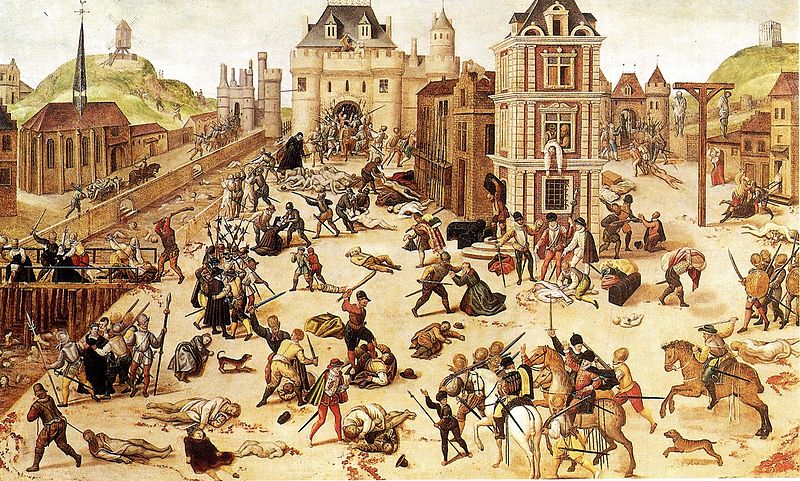
The marriage, had it gone through, would have certainly been a disaster; Charles IX, along with his mother Catherine de Medicis, would eventually permit the massacre of the French Protestant's, known as Huguenots, which began with the St. Bartholomew's Day Massacre in 1572. When he died without legitimate issue, Charles IX was succeeded by his brother, who became King Henri III.

The St. Bartholomew's Day Massacre by Francois Dubois, circa 1572-84. Picture acquired through Wikimedia Commons. Image public domain.

Queen Elizabeth understood that her body was not her own; it belonged to the state and to her people. In fact, she allowed herself to be routinely examined well into her 40's to prove that she was still able to bear children. Yet imagine what Elizabeth would say if she knew that her physician's words concerning her fertility were being read hundreds of years later!


Saturday, February 9, 2013

Elizabethan Quote of the Day: Elizabeth Speaks on Marriage and Children

"And therefore I say again, I will marry as soon as I can conveniently, if God take not him away with whom I mind to marry, or myself, or else some other great let happen. I can say no more, except the party were present. And I hope to have children, otherwise I would never marry." 

(Quote taken from Elizabeth I and her Parliaments 1559-1581, by J.E. Neale).


A portrait of Queen Elizabeth I from 1570. By Hans Eworth. Picture acquired through Wikimedia Commons. Image public domain.

Queen Elizabeth I said this in a speech delivered in 1566 to a delegation made up of both houses of Parliament. The members of Parliament were pressing the Queen to declare her intentions concerning the proposed marriage between herself and the Archduke Charles of Austria. 

A portrait of Archduke Charles (and his dog!) from 1569. Unknown artist. Picture acquired through Wikimedia Commons. Image public domain.

Of course, Queen Elizabeth I never married Archduke Charles, or anyone else for that matter. Though Elizabeth did not marry for a variety of reasons, evidence from her life suggests that she may have wanted children of her own; she was always kind to the children she would meet while on progress, she helped support her godsons at university and found husbands or court positions for the younger women (some of them god-daughters) charged to her care, and she held genuine affection for the children of her cousins, Katherine Carey-Knollys and Henry Carey, Baron Hunsdon.

A portrait of Eleanor Verney, Mrs. William Palmer circa 1590. Eleanor Verney-Palmer was a god-daughter of Queen Elizabeth I. Attributed to William Segar. Parham Park. Picture acquired through Wikimedia Commons. Image public domain.

Archduke Charles later sought the hand of Elizabeth's cousin and rival, Mary, Queen of Scots, but eventually wed Maria Anna of Bavaria, with whom he had twelve children.

A portrait of Archduchess Maria Anna of Austria from 1577. By Cornelis Vermeyen. Picture acquired through Wikimedia Commons. Image public domain.


Friday, August 24, 2012

Elizabethan Quote of the Day: "Affection is False!"-the Sordid Life of Mary Fitton

 "Affection? Affection is false!"-Queen Elizabeth I, 1600.
Queen Elizabeth I had long been observing the frivolous ways of one of her maids of honor, Mary Fitton, and she did not approve of what she saw. In June of 1600, Mary Fitton was leading a court masque entertainment for the wedding celebration of her fellow maid of honor, the Lady Anne Russell. Queen Elizabeth I attended the wedding festivities, and her arrival was famously captured in a painting by Robert Peake the Elder.

Queen Elizabeth Going in Procession to Blackfriars in 1601 by Robert Peake the Elder. This portrait depicts Queen Elizabeth I being carried by her maternal relatives in a litter, on her way to the wedding festivities of the Lady Anne Russell. The bride follows behind. You can read more about this painting, and the event it captures HERE.

Mary selected her mistress the Queen to take part in the dance, suggesting that Her Majesty should personify "affection" in the allegorical masque. When Elizabeth heard this, she scoffed, "Affection? Affection is false!"

Elizabeth was well aware of Fitton's reputation at court as a young woman who tempted even the most sensible of men, and she may have been giving her a public warning about the superficiality and fleeting nature of court liaisons. Also, Elizabeth's open skepticism to romance may have been informed by her own misadventures in love. In an case, Mary Fitton did not heed her mistress's warning, since she would go on to lead a life that defied societal expectations, becoming a mistress to a succession of powerful men at court.

A detail of a portrait of Mary Fitton, c. 1595, by an unknown artist. Picture acquired through Wikimedia Commons. Image public domain

Prior to the wedding of the Lady Anne Russell to Henry Somerset, later 1st Marquess of Worcester, Mary Fitton had entered the Queen's service just five years before. Mary's father, Sir Edward Fitton, had asked the Queen's kinsman and comptroller, Sir William Knollys, to recommend her and look out for her. Knollys, who was the son of Queen Elizabeth I's most beloved cousin and friend (or possible half-sister), Catherine Carey-Knollys, and her husband, Sir Francis Knollys, happily obliged. He told Sir Edward, "I will be as careful of her well doing as if I were her own true father." (Haynes, 44)

A 17th century engraving by Simon van de Passe of William Knollys, 1st Earl of Banbury. Picture acquired through Wikimedia Commons. Image public domain.

William Knollys's interest in his young charge was far from paternal, however. Though presently married to Dorothy Bray, Baroness Chandos, William fell in love (or lust) with Mary. William did not hide his interest in the young Mary from his peers, and he was lampooned throughout the court for his obsession (Haynes, 46).

Dorothy, the widow of Edmund Brydges, 2nd Baron Chandos, had five children of her own, but had been unable to provide her second husband with a child. Since Dorothy was more than 20 years her husband's senior, she may have been well past her child-bearing years. The 50-year-old William's infatuation with Mary may have been in part because of her youth, and thus her perceived ability to bear him a biological heir.

A portrait of a woman by John Bettes the younger, probably Dorothy Bray, Baroness Chandos c. 1578. Picture acquired through Wikimedia Commons. Image public domain.

When Dorothy Bray did die (in 1605) Mary still had no interest in the elderly William Fitton. He took another wife, Elizabeth Howard, the daughter of Thomas Howard, 1st Earl of Suffolk. Thus, William Fitton's second wife was the granddaughter of Thomas Howard, the 4th Duke of Norfolk, who had been executed for high treason against Queen Elizabeth I in 1572.

A portrait from 1598 of Thomas Howard in his robes for the Order of the Garter. He was later the 1st Earl of Suffolk. Picture acquired through Wikimedia Commons. Image public domain.

Mary Fitton left court briefly due to illness in 1599, returning in time to help lead the court entertainments for Lady Anne Russell's wedding. On this occasion, Mary was not only the subject of one of Queen Elizabeth's many witty, biting retorts; she also caught sight of the man who would change her life significantly: William Herbert, the eventual 3rd Earl of Pembroke.

A detail of a portrait by Daniel Mytens of William Herbert, 3rd Earl of Pembroke, 1625. Picture acquired through Wikimedia Commons. Image public domain.

William Herbert was the son and heir of one of the leading figures in Queen Elizabeth's court, Henry Herbert, the 2nd Earl of Pembroke and his literary wife, Mary Sidney-Herbert, Countess of Pembroke.

A miniature from around 1590 of Mary Sidney-Herbert, Countess of Pembroke. By Nicholas Hilliard. Picture acquired through Wikimedia Commons. Image public domain.

Eventually following in his mother's footsteps, William would become involved in the literary world, helping to fund the publication of Shakespeare's First Folio in 1623.

The frontispiece of Shakespeare's First Folio, published in 1623. Picture acquired through Wikimedia Commons. Image public domain.

But as a young, unmarried man of around 20 on the precipice of inheriting his Earldom, William took up with the slightly older Mary Fitton. Given her previous experience of being the object of affection for a much older man, Mary may have been taking control of her own happiness, either consciously or sub-consciously, by having an affair with a younger man. Mary became pregnant with William Herbert's child; she also was likely carrying something else: syphilis, which it is suspected William had.

When William admitted paternity of his illegitimate child in February of 1601, but refused to answer for his indiscretion by marrying his mistress, he was thrown into Fleet Prison by the Queen. This was not surprising, since just one year ago, a writer observed of William Herbert that, "I don't find any disposition at all in this gallant young lord to marry" (Furnivall, 3). A month later, aged about 23, Mary gave birth to a son who died almost immediately (Furnivall, 3). Some modern researchers have suggested that the infant's cause of death could have been congenital syphilis.

Mary Fitton and her former lover were banished from Queen Elizabeth's court for their transgressions. Elizabeth had always punished those ladies in her service who had compromised their chastity very harshly; she likewise punished the men who impregnated her ladies if they refused to marry them.

Still as obsessed as ever, Sir William Knollys offered himself to Mary Fitton once again, even though she was in disgrace. Mary seems to have abhorred the idea of stability and defied convention at all costs, since she spurned Knollys once again to have an affair with the married Vice Admiral Richard Leveson. Leveson's wife was the daughter of Lord High Admiral Charles Howard, a cousin to the Queen. When the Vice Admiral died in 1605 at the age of 35, he left Mary 100 pounds.

A statue of Sir Richard Leveson at St. Peter's church, Wolverhampton, by Hubert Le Sueur. This statue was originally part of a larger group in the chancel, now in the Lady Chapel. Picture acquired through Wikimedia Commons courtesy of Siwells53.

Still having no interest in marriage, Fitton began a liaison with Captain William Polwhele, and bore him a son. Mary's parents had understandably had quite enough of their daughter's serial dalliances. Mary's mother, Alice Halcroft-Fitton, wrote to her other daughter, Anne, the wife of John Newdigate, in great distress:

"such shame as never had a Cheshire woman, worse now than ever. Write no more to me of her." (quoted in Haynes, 49)

Captain William Polwhele and Mary did eventually get married, but Mary was widowed by 1610. Presumably to provide for the two children she had had with her late husband, and to attach some respectability to her own name, Mary got married for the last time to another captain.

In 1890, Thomas Taylor was the first to put forth the theory that Mary Fitton may have been the mysterious "Dark Lady" of Shakespeare's sonnets. This theory relies heavily on the assumption that William Herbert, 3rd Earl of Pembroke was Shakespeare's "fair youth", whom Shakespeare urges to marry, though there are other candidates. William and his brother Philip made up the "incomparable pair of bretheren" to whom Shakespeare's First Folio is dedicated.

According to the Folio editors, the Herbert brothers had "prosecuted both them and their author living with so much favor". Other parts of the dedication imply Shakespeare was close to the Pembroke's. Shakespeare's sonnets are dedicated to "the onlie begetter of these insuing sonnets, Mr. W.H." These initials, of course match those of William Herbert. But "W.H." could just as well be an encrypted reference to Henry Wriothesley, the Earl of Southampton (DNB, 227-28).

A full-length portrait of Henry Wriothesley,  the 3rd Earl of Southampton, painted between 1594-1600. Picture acquired through Wikimedia Commons. Image public domain.

Frank Harris also championed this theory in several of his books, as did A.L. Rowse.  Of course, since many Shakespeare scholars cannot even agree on whether Shakespeare really was Shakespeare, attempting to identify the subjects of his sonnets is almost futile. For all the evidence we have that suggests Mary Fitton was the Dark Lady, we have an equal amount of evidence that suggests she was not. One of the chief arguments against her is that the Dark Lady had to have been married to break her "bed-vow"(Furnivall, 5). Fitton was not married at the time of her affair with William Herbert.

Playwright George Bernard Shaw knew Thomas Taylor personally, and discussed his theory with him. Shaw was one of the first authors to build a strong case against Mary Fitton as the Dark Lady. Even so, he did use Fitton as the Dark Lady in a work of fiction!

While we will probably never know for sure who the Dark Lady was (and really, isn't it almost better that way?) we do know that Mary Fitton has been referenced in other Elizabethan poetry, and had at least one literary work dedicated to her. The comedic actor Will Kempe dedicated his account of his record breaking morris-dancing jig across the English countryside in 9 days to Mary; the work was entitled Nine Daises Wonder (Furnivall, 3). That being said, Kempe was so ill-acquainted with Mary that he painstakingly called her Anne Fitton in his dedication, confusing her first name with that of her married sister, Anne Newdigate! (Funivall, 3).

A woodcut of Elizabethan clown William Kempe dancing a jig across the English countryside. Picture acquired through Wikimedia Commons. Image public domain.

Whether Mary is the Dark Lady of Shakespeare's sonnets or not, she certainly led a bold and fascinating life!


Sources:

Haynes, Alan. Sex in Elizabethan England. Gloucestershire: Sutton Publishing Limited, 1997. Print.

"Herbert, William, third Earl of Pembroke, 1580-1630". Dictionary of National Biography. Retrieved 8-23-2012. Electronic.

Furnivall, Frederick James. "Shakespeare and Mary Fitton". Cornell University Library Database.  Retrieved 8-23-2012. Electronic.
"Earl of Banbury". Leigh Rayment's Peerage pages. Retrieved 08-22-2012. Electronic

Friday, March 2, 2012

Elizabethan Quote of The Day: England Called a "Paradise" for Women!

In 1592, Frederick, Duke of Wurttemberg (south-west Germany) was visiting England. The Duke had begun a correspondence with Queen Elizabeth I herself, and would continue to exchange letters with her for many years thereafter. Part of the reason the Duke was so cordial was because he aspired to be made a Knight of the Garter by the British crown. By 1597 his campaigning payed off, as he was indeed elected as a Knight of the Garter. 

A detail of a portrait of the unfortunate-looking Frederick I, Duke of Wurttemberg. Picture acquired through Wikimedia Commons. Image public domain.

During his visit to England, Duke Frederick recorded his observations, which are now in the Record Office and British Museum (England as Seen by Foreigners in the Days of Elizabeth and James the First, William Brenchley Rye). There is a particular excerpt from the Duke's papers that I have chosen to share with you today, concerning the lives of women in 16th century England:

"England is a paradise for women, a prison for servants, and a hell or purgatory for horses-for the females have great liberty and are almost like masters."

First things first: No matter where you looked in 16th century Europe, including the Duke's native Germany, it was a difficult livelihood to be a servant, so please do not think that England had an exceptionally cruel policy toward the hired help. In fact, there were far worse places to be in service!

Second, I find the horse observation peculiar, since the English have a longstanding history of being partial to horses. It is unclear to me what kind of horse the Duke is referring to; seeing as he mentions them in the same clause as the servant, I would assume he means work or draft horses, not riding palfreys or warhorses, the latter two of which were treated with great care.

But the important part of the excerpt here is the Duke's observation of English women. The British Isles have historically always has fairly liberated women, especially when you compare their lives to the lives of women in the medieval and early modern states on the Continent.

In the 16th century, Spaniards were shocked at the shorter length of the dresses worn by the women at court, which sometimes scandalously revealed a bit of ankle (say it isn't so!). And I have read letters and journals from ambassadors from many different countries who repeatedly remarked at the freedom in which noblewomen conducted their lives and involved themselves in court intrigue.

And the women of the rising middle/merchant class ran businesses, managed households, kept financial books, and negotiated business deals. Some women even apprenticed in their own trades and became their own masters, but this was also true of other countries, and the practice itself hearkened back to the medieval era. The lives of the pastoral country folk were not bad either, and many foreign observers chose to remark on the wealth and autonomy of the English farming class. 


The Hardwick Portrait of Queen Elizabeth I was completed in 1592, the same year that the Duke of Wurrtemberg made his observation of English women. The embroidery on the front of  Elizabeth's partlet was done by Bess of Hardwick, and the portrait itself hung in Hardwick Hall. Picture acquired through Wikimedia Commons. Image public domain.
While many would assume that it was Queen Elizabeth's influence as female monarch that improved the lives of women, this was actually not the case; the movement of Humanism, which had caught on like wildfire in England long before Elizabeth was even born, and eventually the Reformation, had championed the educating of women and girls in religion, the classics, history and more, which expanded their previous traditional education of music, dance, reading and writing. Nonetheless, having a brilliantly educated, authoritative queen on the throne certainly inspired the women around her, and you need not look far to discover the countless remarkable women that changed Elizabethan England for the better. Queen Elizabeth also undoubtedly proved to the men that served her that the 'fairer sex" was every bit as capable as their male counterparts in achieving complex thought and assuming leadership (though it did take a while for her Councillors to believe it, and even then some only saw Elizabeth I as the exception, rather than the rule for womankind.)


Queen Elizabeth I presiding over her Parliament, c. 1580-1600. Picture acquired through Wikimedia Commons. Image public domain.
  
As you have probably guessed, English women's history and the evolution of their roles through time is a special interest of mine, and I plan to write more on the subject in the future. But I think the Duke of Wurrtemberg's observation is a good placeholder for the time-being, don't you?

And by the way, it may be a point of interest to my readers that three years after the Duke recorded his thoughts on English women, his Ambassador Breuning was charged by Lord Burghley for appearing before Queen Elizabeth I drunk. He was required to give an explanation of his deplorable behavior and a formal apology to the queen! (Brenchley Rye, 8) And I will let you draw your own conclusions from that!

Source:

Brenchley Rye, William. England as Seen by Foreigners in the Days of Elizabeth and James the First. Print.

Monday, February 20, 2012

Elizabethan Quote of the Day: Elizabeth's "unruly horse"

"An unruly horse must be abated of his provender*, that he may be the easier and better managed."-Queen Elizabeth I, 1600.

Provender-fodder for livestock, originating in 13th century Middle English.

After a series of disappointing mismanagement's within his appointed office, and an unchecked ego, Robert Devereux, the Earl of Essex was due for a sharp reprimand, though his own inflated perception of himself did not allow him to see that the walls of his own design were closing in around him. His monopoly on sweet wines, which Elizabeth I had granted in 1590 for ten years, come up for review in 1600. After several years of giving her last favorite the benefit of the doubt, the queen had grown tired of Essex's behavior. The charismatic bravado that had once entertained her and made her feel carefree in her rare moments away from state business, had now grown to an intolerable, and dangerous level. 

A miniature portrait of the Earl of Essex, by Nicholas Hilliard. Picture acquired through Wikimedia Commons. Image public domain.

Elizabeth decided to put Essex in his place, saying the above quote before she revoked his monopoly on sweet wines. The "unruly horse", of course, is Essex, and the "provender" is his monopoly. This was a prudent decision of the queen's, not only to send a strong message to Essex about his pride, but also due to the fact that he had now amassed a financial debt somewhere around 16,000 pounds. I agree with David Loades, who in his book Elizabeth I: A Life supposes that Elizabeth did in fact know of Essex's money troubles when she revoked his monopoly, although we cannot ever know for sure (Loades, 277).


A 16th century portrait of Robert Devereux, the Earl of Essex. Essex was the son of  Lettice Knollys, who was one of the 14 children of Elizabeth I's beloved cousin Katherine Carey-Knollys. Lettice boldly married Elizabeth's confidante and only true romantic interest, Robert Dudley, the Earl of Leicester. When Leicester's biological son tragically died young, he adopted Devereux as his heir. Essex's great-grandmother was therefore Mary Boleyn, the sister of Elizabeth's mother, Queen Anne Boleyn. Picture acquired through Wikimedia Commons. Image public domain.

The month's ahead were to bring about the end of the Earl and some of his cronies, for their ill-planned and executed rebellion against the queen. While Essex would claim that his intent was not malicious, and that he only wanted to "free" the queen from her  ill-advisers, like Robert Cecil, whom he hated, his claim was transparent to those about him: Essex's Rebellion was a personal vendetta for a man with wounded pride, and not about alleged corrupt advisement of the queen. 

And anyone who knew Elizabeth, especially those intimates on her Privy Council, knew that know one could ever manipulate or influence the queen to do anything against her will! Elizabeth's judgement was always final, and the ax fell on Essex's head for his twice-fold treason: a personal and political betrayal.

Sources:

Loades, David. Elizabeth I: A Life. London: Continuum, 2006.

Wednesday, December 28, 2011

Elizabethan Quote of the Day: An Excerpt From "The Faerie Queen"

Today I would like to share with you an excerpt from one of the most famous literary works composed to honor Queen Elizabeth I, Edmund Spenser's The Faerie Queene. (Note: some of the contemporary spelling had been retained to preserve the authenticity of the verse)

A picture of Queen Elizabeth receiving foreign ambassadors, by Elizabeth's female court painter Leevina Teerlinc. In my opinion, Teerlinc has an Edward Gorey like style! The practice of painting the walls in the court rooms is sumptuously brought to life in the Helen Mirren HBO miniseries Elizabeth I.
"High above all a cloth of State was spred,
And a rich throne, as bright as sunny day,
On whiche sate most brave embellished
With  royall robes and gorgeous array,
A mayden queene, that shone as Titans ray,
In glistring gold, and peerelesse pretious stones
Yet her bright blazing beautie did assay
To dim the brightnesse of her glorius throne,
As envying her selfe, that too exceeding shone."

Monday, December 5, 2011

Elizabethan Quote of the Day: Elizabeth Holds Her Own Under Interrogation in 1549

When Elizabeth Tudor was interrogated during her brother Edward VI's brief reign, concerning the longstanding unscrupulous activity of Thomas Seymour, she eventually earned the respect of her interrogator. 

A detail from a portrait of King Edward VI, Elizabeth's brother. Picture acquired through Wikimedia Commons. Image public domain.

I have been reading a lot of the interesting contemporary accounts of Elizabeth's first time under suspicion, at the age of fifteen, long before her stay in the Tower under the reign of her sister, Queen Mary. Elizabeth's maturity, tenacity, and wit are remarkable given her stressful, and seemingly hopeless situation whilst being daily harassed by Sir Robert Tyrwhit. Tyrwhit was instructed to obtain an admission from the young princess of her supposed (but entirely unfounded) intent to secretly marry her brother's uncle, Thomas Seymour. Interestingly, and perhaps too close for comfort, Tyrwhit was related by marriage to Elizabeth's recently deceased stepmother, Queen Katherine Parr, through one of her husbands, before she married Henry VIII.

Portrait miniature of Thomas Seymour c.1545, from the workshop of Hans Holbein. Picture acquired through Wikimedia Commons. Image public domain.

While Tyrwhit was frustrated by Elizabeth's daily refusal to yield to his intimidation, he did come to respect her bravery, and her loyalty to her servants. One such excerpt, recorded on January 23rd, 1549, illustrates this point particularly well:
"I do assure your Grace, she hath a very good wit, and nothing is gotten of her but by great policy."
Elizabeth navigated Tyrwhit's attempts at entrapment effortlessly, partly because she was entirely innocent, but also because she was trying to protect her friends, Katherine Ashley and Thomas Parry. Elizabeth was herself an expert at deciphering the double-speak of Tudor politics, so she understood implicitly all of the tricks that Tyrwhit was using to try to confuse her; For instance, the presentation of a "confession" of guilt by Mistress Ashley-Elizabeth knew that falsified confessions were a favorite tactic of Tudor jailers, and would not be fooled.

A sketch by Holbein of Sir Thomas Parry c. 1538-1540. Picture acquired through Wikimedia Commons. Image public domain.

When Elizabeth made a carefully written statement about the nature of her relationship with Thomas Seymour, her lack of knowledge of his treasonous plots, and her ardent defense of her servants, she also included some statements for her own peace of mind. Elizabeth, who was keenly aware of the slander that was being circulated about her, and feared the unjust damage it would do to her reputation, implored the crown (her brother and his uncle the Lord Protector, Edward Seymour) to do the proper thing and defend her against such lies. Below, please see an excerpt from this remarkable document:

"Master Tyrwhit and others have told me that there goeth rumours abroad which be greatly against my honour and honesty (which above all other things I esteem), which be these; that I am in the Tower; and with child by my Lord Admiral. My lord, these are shameful slanders, for the which, besides the great desire I have to see the King's Majesty, I shall most heartily desire your lordship that I may show myself there as I am."

Alison Plowden analyzes Elizabeth's statement, saying:

"This famous letter, polite but businesslike...is by any standards a masterpiece of its kind. Elizabeth has wasted no paper on protestations of innocence or outraged modesty. She had defended herself and her servants against unwarrantable accusations with courage and dignity, and more than hinted that she would expect an apology." (Plowden, 111)

In conclusion, Elizabeth would declare,

"...My conscience beareth me witness which I would not for all earthly things offend in any thing; for I have a soul to save, as well as other folks have."

Wednesday, November 30, 2011

Elizabethan Quote of the Day: An Account of Queen Elizabeth from 1598

I recently came across a passage from Hentzner’s Travels, which captures in great detail a moment in time at Elizabeth’s court, toward the end of her reign. I have selected an excerpt, below, to share with you. While there are no portraits of Elizabeth as “old”-she had a fear of being perceived as such, and a monarch must never let her people think she was infirm or unfit to rule- this passage gives us the most accurate description of Elizabeth as a young mind, trapped in an elderly woman’s body. Presence was everything, and even at 65 with black teeth, she is still both beautiful and powerful.

Portrait Miniature of Queen Elizabeth I from 1590, by Nicholas Hilliard. Picture acquired through Wikimedia Commons. Image public domain.


"In the same hall were the archbishop of Canterbury, the bishop of London, a great number of counselors of state, officers of the crown, and gentlemen, who waited the Queen’s coming out; which she did from her own apartment when it was time to go to prayers, attended in the following manner: First went gentlemen, barons, earls, knights of the Garter, all richly dressed and bare-headed; next came the chancellor, bearing the seals in a red-silk purse, between two: one of which carried the royal scepter, the other the sword of state, in a red scabbard, studded with golden Fleurs de Lis, the point upwards: next came the Queen, in the sixty-fifth year of her age, as we were told, very majestic; her face oblong, fair, but wrinkled; her eyes small, yet black and pleasant; her nose a little hooked; her lips narrow, and her teeth black ( a defect the English seem subject to, from their too great use of sugar); she had in her ears two pearls, with very rich drops; she wore false hair, and that red; upon her head she had a small crown…Her bosom was uncovered, as all the English ladies have it till they marry; and she had on a necklace of exceeding fine jewels; her hands were very small, her fingers long, and her stature neither tall nor low; her air was stately, her manner of speaking mild and obliging. That day she was dressed in white silk, bordered with pearls of the size of beans, and over it a mantle of black silk, shot with silver threads; her train was very long, the end of it borne by a marchioness; instead of a chain, she had an oblong collar of gold and jewels. As she went along in all this state and magnificence, she spoke very graciously, first to one, then to another, whether foreign ministers, or those who attended for different reasons, in English, French and Italian.”
~From Hentzner’s Travels, 1598


            As you probably noticed, Elizabeth's dark, small eyes are mentioned, a trait she inherited from her mother. Her aquiline nose and wigs are also recorded. She would have been happy to know that her long fingers were being appreciated, as she was incredibly vain about them!

The Lord Chamberlain of England bears the Sword of State in front of Queen Elizabeth I. Picture acquired through Wikimedia Commons. Image public domain.

The sword mentioned by Hentzner being carried in front of the Queen in a red scabbard is the Sword of State, or bearings sword. We have one at the museum where I work; it possibly belonged in the retinue of Henry IV or Henry V of England. It is an impressive weapon, meant to symbolize martial power and majesty, standing over 5ft tall! One will always be taken seriously with a bearing sword carried in front of them!

Thursday, October 27, 2011

Elizabethan Quote of the Day: Elizabeth Reprimands Philip Sidney!

In 1580, Queen Elizabeth I reprimanded Sir Philip Sidney, the celebrated soldier/poet, for answering the Earl of Oxford’s insult with one of his own, thus perpetuating a feud. She said to Sidney of his behavior that... “the gentlemen’s neglect of the institution of nobility taught the peasant to insult upon both”.
Sir Philip Sidney