Showing posts with label Death of Robert Dudley. Show all posts

Friday, September 4, 2015

On This Day in Elizabethan History: The Death of Elizabeth's Love, The Earl of Leicester

"His last letter", in the National Archives in England. Picture acquired through Wikimedia Commons. Image public domain.

On this day in 1588, Queen Elizabeth I's longtime love and confidante, the man she called a "personage so dear unto us" in a letter to the Earl of Shrewsbury, Robert Dudley, the Earl of Leicester, died. Leicester had been ill for quite some time, and probably had been suffering from stomach cancer. Elizabeth was, by all accounts, devastated by his death, and kept the final letter he sent to her by her bed until her own death, where it was discovered in 1603. On it she had written, "His Last Letter". To learn more about how Elizabeth dealt with the passing of her favorite, please read our feature-length BeingBess article on the topic of Leicester's death. Also, for further reading on the complex relationship of Elizabeth and Leicester, we recommend the definitive dual biography 'Elizabeth & Leicester: Power, Passion, Politics', by historian Sarah Gristwood.

Thursday, September 4, 2014

On This Day in Elizabethan History: The Death of Elizabeth's "Eyes"

"His Last Letter"
  
"A personage so dear unto us."
-Queen Elizabeth describing the Earl of Leicester in a letter to the Earl of Shrewsbury in 1588, the year that he died.
 
 
On this day in Elizabethan history in 1588, Robert Dudley, the Earl of Leicester died. Queen Elizabeth I was inconsolable at the loss of her lifelong friend, the man whom she affectionatley called her "eyes". Whether their relationship was ever physically consummated or not is irrelevant; Leicester was the love of her life.

To learn about the Earl's last months with Queen Elizabeth, his final illness, and "His Last Letter", treasured by Queen Elizabeth until her own death in 1603, please view our feature-length article.

Wednesday, September 4, 2013

On This Day in Elizabethan History: Robert Dudley, Earl of Leicester dies.

A close-up photograph of the Earl of Leicester's tomb effigy at Warwick Church. Picture by Peternilleon and shared for public use via Wikimedia Commons.
 
 "A personage so dear unto us."
-Queen Elizabeth describing the Earl of Leicester in a letter to the Earl of Shrewsbury, 1588.
 
On this day in Elizabethan history in 1588, Robert Dudley, the Earl of Leicester died. While the Earl of Leicester had been unwell for quite some time, nobody expected his illness to be fatal, least of all Queen Elizabeth I (ODNB). 

To learn about the Earl's last months with Queen Elizabeth, his final illness, and "His Last Letter", treasured by Queen Elizabeth until her own death in 1603, please view our feature-length article HERE.

Monday, February 11, 2013

Elizabethan Fact of the Day: The Earl of Leicester's Clothing

A portrait of the Earl of Leicester by an unknown artist, circa 1575-80. Picture acquired through Wikimedia Commons. Image public domain.

Among his many other possessions, two cloaks and seven doublets belonging to the Earl of Leicester were appraised upon his death by the executors of his estate in 1588. These items of clothing were valued at a total of 545 pounds!

Tuesday, November 20, 2012

On This Day in Elizabethan History: The Death of Sir Christopher Hatton

A detail of a portrait of Sir Christopher Hatton, circa 1575. Image public domain through Creative Commons licensing, NPG, London.
On this day in Elizabethan history in 1591, Lord Chancellor Christopher Hatton, whom Queen Elizabeth affectionately called her "lids" and her "sheep", died in London at Ely Palace. The Queen herself had visited her ailing favorite on November 11th. A month after his passing, on December 16th, there was a state funeral for Hatton at the Old St. Paul's Cathedral. His monument, which stood at the altar, was described as "...an outrage to the susceptibilities of the devout but an object of marvel to London sightseers until the Great Fire of 1666 dethroned and destroyed it" (Deacon, 213).

Since Henry VII, the Tudors had favored promoting men in government based on merit rather than hereditary right. Christopher Hatton was a prime example of one of these "new men". The second son of a member of the Northamptonshire gentry, William Hatton, and his second wife Alice Saunders, Christopher became a leading figure in Queen Elizabeth's court.

Unlike most to join Queen Elizabeth's inner circle, Hatton was no academic. Though he was able to attend Oxford in the 1550's, he received no degree, and after being admitted to the Inner Temple (one of the four residences for learning common law and appointing barristers) in 1559, he was never actually called to the bar (Wagner, 145). So, even though Hatton took the traditional path to earn a career at court, he did not succeed in his academic endeavors, and it was therefore assumed that he earned his place through his skills at dancing. 

The handsome Hatton had first caught the Queen's eye when he performed a dance for her at the court masque given at the Inner Temple during the Christmas celebrations of 1561 (Wagner, 145). In just three years, Hatton had benefited from Queen Elizabeth's patronism, receiving court appointments and grants of land and money. Over time, Hatton honed his abilities as a politician, and Queen Elizabeth entrusted him with more responsibilities. In 1572, Queen Elizabeth made him captain of her Royal Guard. 1577 was an excellent year for Hatton, since he was both knighted and appointed to the Privy Council. He sat for Northamptonshire in several parliaments, and became the Queen's spokesman in the Commons. 

A portrait of Sir Christopher Hatton by an artist after Cornelius Ketel, circa 1585. Picture acquired through Wikimedia Commons. Image public domain.

Hatton was now in a position to become a patron himself; Edmund Spenser and Thomas Churchyard benefited from his support. Hatton was also one of the first courtiers to invest in Sir Francis Drake's attempt to circumnavigate the globe in 1577. In tribute, Drake's famous ship, the Golden Hind, was named after one of the heraldic emblems on Hatton's coat-of-arms (Wagner, 145).


A reproduction of Drake's Golden Hind. Photo acquired through Wikimedia Commons, shared for public use by Steve FE Cameron.

Hatton's rapid rise at court was somewhat stalled by his opposition to Queen Elizabeth's proposed marriage to Francis, Duke of Alencon, and his rivalry with another favorite of the Queen, Sir Walter Raleigh. Also, Hatton, along with most of the Queen's advisers, supported the idea of executing Mary Stuart, the former Queen of Scots, which earned him Elizabeth's displeasure (Wagner, 145). Hatton encouraged secretary William Davison to defy the Queen's orders and send Mary Stuart's signed execution warrant to Fotheringay, rather that retain it indefinitely, as she had instructed. After the Queen's wrath dissipated, Hatton was welcomed back into the royal fold.


A portrait of Mary, Queen of Scots, circa 1578. Attributed to Oultry. Picture acquired through Wikimedia Commons. Image public domain.

Like the Queen, Hatton was a religious moderate, and opposed any drastic actions taken against Puritans and Catholics. The Puritan's suspected him of being a secret Catholic, and a Puritan fanatic actually tried to assassinate him in 1573.

In 1587, Hatton earned his most distinguished position, becoming Lord Chancellor, which was the most important legal position in the land; this was quite the triumph for a man that never made the bar! In 1588, after Queen Elizabeth's world was turned upside-down by the death of her long-time friend and favorite, Robert Dudley, Earl of Leicester, someone needed to succeed to his many positions; Hatton became the next Chancellor of Oxford University and the High Steward of Cambridge University (Wagner, 145). For Queen Elizabeth to select Hatton as her beloved Leicester's successor signifies her placement of trust in his abilities, and her affection for him.

A miniature portrait of Sir Christopher Hatton, circa 1588-91. By Nicholas Hilliard. Hatton is shown with the seal of his office of Lord Chancellor on the table by his side. Picture acquired through Wikimedia Commons. Image public domain.

Sir Christopher Hatton succeeded in one way where Leicester had always failed Elizabeth; the consummate courtier, Hatton never married. However, it was rumored that he had married secretly, and perhaps fathered an illegitimate child. Hatton's nephew, Sir William Newport, inherited his estates upon his death. As a sign of respect, Newport adopted the surname Hatton. Also passing without issue, the Hatton estates passed to a second Christopher Hatton in 1597.

Sources

Wagner, John. A. "Hatton, Sir Christopher". The Historical Dictionary of the Elizabethan World. First ed. 2002. Print.

Deacon, Malcolm. The Courtier and the Queen. Northampton: Park Lane Publishing, 2008. Print.

Tuesday, September 4, 2012

On This Day in Elizabethan History: The Death of Robert Dudley, the Earl of Leicester

A portrait of Robert Dudley, Earl of Leicester from 1564, the same year Queen Elizabeth granted him his earldom. Picture acquired through Wikimedia Commons. Image public domain.

 "A personage so dear unto us."
-Queen Elizabeth describing the Earl of Leicester in a letter to the Earl of Shrewsbury, 1588.
 
On this day in Elizabethan history, 1588, Robert Dudley, the Earl of Leicester died. While the earl had been unwell for quite some time, nobody expected his illness to be fatal, least of all Queen Elizabeth (ODNB). 

Dudley's unexpected death occurred when he was on the road to "take the waters" in Buxton, Derbyshire. A few miles after stopping to write the Queen a letter at Rycote in Oxfordshire on August 29th, Leicester grew gravely ill and took shelter at the nearby manor of Cornbury. It is there that he died in the early morning hours of September 4th (Gristwood, 334).

Only a week earlier Leicester had bid the Queen farewell after she had ordered him to go on retreat and tend to his health. The letter that Leicester had sent her from Rycote became her most prized possession; on it she scrawled, "His last letter", and she kept it in a private box in her closet. The letter now resides in the National Archives.

"His last letter", in the National Archives in England. Picture acquired through Wikimedia Commons. Image public domain.

Leicester had been in physical anguish following his role as the Queen's Lieutenant General at Tilbury, a position that he had welcomed and a duty that he had been honored to fulfill. But  the work had been stressful none the less. Leicester had been in charge of between 12,000-17,000 men at Tilbury fort, and another 6,000 were under his command in Sandwich (Gristwood, 328). The Earl of Leicester had urged his Queen to visit her troops at Tilbury, writing to her that, "you shall comfort not only these thousands, but many more that shall hear of it" (quoted in Gristwood, 330).

Indeed, once a chaplain in Leicester's service recorded Queen Elizabeth's "excellent oration", which he wrote that she delivered dressed like an "armed Pallas", (Athena, Greek goddess of wisdom and war) the speech was printed and circulated throughout Europe within the week (Gristwood, 329-30). The English people were inspired by the Queen's Tilbury Speech, which they could now hold in their hands, and the rest of the world knew from the pamphlet that the English were not to be intimidated.

A painting of Queen Elizabeth at Tilbury, courtesy of Anniina Jokinen. Image public domain.

Leicester and Elizabeth's collaboration at Tilbury would be their last; yet their romantic and political partnership had spanned almost 30 years. Leicester was the Queen's emotional support, and sometimes her stand-in an state functions. Theirs was a bond unlike any other; it survived imprisonment, threat of execution, a mysterious death, rejections, indiscretions, marriage, and the threat of assassination and war.

A composite image of a pair of portrait miniatures of Queen Elizabeth I and Robert Dudley, Earl of Leicester. Painted c.1575, by Nicholas Hilliard. Picture acquired through Wikimedia Commons. Image public domain.

According to the antiquarian William Camden, (the author of the invaluable primary source, The Annals of Queen Elizabeth) after the defeat of the Spanish Armada, Queen Elizabeth was having papers drawn up to make Leicester the permanent Lieutenant Governor of England. Camden claimed that the Queen was only dissuaded from putting this plan into action by William Cecil, Lord Burghley and Sir Christopher Hatton.

A detail of a portrait of Sir Christopher Hatton, c.1575. Picture acquired through Wikimedia Commons. Image public domain.

Perhaps this was true; Camden was working from many primary sources now lost to us, and his work is largely accurate and free of the religious bias that permeated most works of the 16th and 17th century. Certainly Elizabeth was starting to think about what would happen to England upon her death, even if she refused to speak of the succession aloud.

The frontispiece and title-page of the 1575 edition of The Annals of Queen Elizabeth, by William Camden. Picture acquired through Wikimedia Commons. Image public domain.

Leicester dined every day in the Queen's apartments before he left for Buxton (Gristwood, 333). We can hope that Queen Elizabeth found comfort in her memories of their last days together, after she had recovered from the initial shock of Leicester's unexpected death.

A miniature of the Earl of Leicester, c.1572-76. By Hilliard. Picture acquired through Wikimedia Commons. Image public domain.

The Earl of Leicester's demise was probably caused by stomach cancer, which his persistent gastric symptoms seem to suggest, or complications caused by chronic malaria (Gristwood, 333-34). Malaria was rampant in England in the 16th century and had claimed the lives of many, including prominent members of the royal family, like Arthur Tudor. We do know that Leicester had complained of "the stone", which was a colloquialism for any intestinal problem (Gristwood, 334).

A miniature of Queen Elizabeth, c.1572-76. By Hilliard. Picture acquired through Wikimedia Commons. Image public domain.

 The juxtaposition of England's celebration over the defeat of the Spanish Armada, and the death of her oldest and dearest friend was almost too much for Queen Elizabeth to bear:

"Elizabeth was condemned to an extraordinary conjunction of public rejoicing and private agony. This was her own personal sorrow-it would be folly to try to damper the mood of he country-and against a background of the national victory celebrations she shut herself into her own chamber to grieve." (Gristwood, 334-365)

Many contemporary reports confirm that Queen Elizabeth locked herself away in her apartments. Sir Francis Walsingham lamented that he could not get the Queen to attend to state business at this time, "by reason that she will not suffer anybody to have access to her" (quoted in Gristwood, 335).

Sketch of Queen Elizabeth I from life. By Zuccaro, 1575.

This tells us how profound Queen Elizabeth's grief was. Here is a woman who relished her role in government and never shirked her public responsibilities because of her private feelings, save for this one instance. Elizabeth's life experiences had caused her to develop a hard, protective exterior, which rarely cracked to reveal signs of affection or vulnerability; Robert Dudley had always been the only exception.

Sketch of the Earl of Leicester from life. By Zuccaro, 1575.

Yet, however much the Queen of England mourned her "Sweet Robin", his death barely registered with the rest of England in comparison to the victory over Spain. The antiquarian John Stow, who himself admitted that he owed his career to Leicester, wrote: "All men, so far as they durst, rejoiced no less outwardly at his death than for the victory lately obtained against the Spaniard." 

Still, Robert Dudley, Earl of Leicester left this life having accomplished a great deal for Queen and Country, and should be remembered for it. I think William Camden's epitaph of the earl conveys many of the aspects of his character; this is fitting since the way the earl was thought of differed so greatly from person to person. 
"He was reputed a complete courtier, magnificent, liberal, a protector and benefactor of soldiers and scholars...very officious, and cunning toward his ill-willers; for a time much given to women...to say the truth, he was openly held to be in the rank of those which were worthy of praise, but the things which he secretly plotted displeased many."

We do not know how Robert's widow, Lettice Knollys dealt with the loss of her husband. Let it be said that we should not for a minute entertain the idea that she and her second-cousin, the Queen, would have commiserated over their mutual loss. Lettice's greatest testament to her husband may have been their joint tomb. Elizabeth's may have in fact been her relationship with Leicester's step-son, Essex.

The tomb of Robert Dudley, Earl of Leicester and his wife, Lettice Knollys in Beauchamp Chapel in the Collegiate Church of St.Mary, Warwickshire. Picture acquired through Wikimedia Commons. Image public domain.

Historian Sarah Gristwood explains the significance of Queen Elizabeth's relationship with the Earl of Essex:

"Perhaps it is to the years ahead (of Leicester's death) that we should look for Elizabeth's last (and almost disastrous) great loving gesture towards her lost companion to her relationship with Leicester's stepson and surrogate, Essex. Leicester had brought Essex to court as he himself began to tire and age, willing still to perform necessary duties, but unable any longer to flatter Elizabeth with the conviction he once has; unable to provide the energetic, exciting pageant of eager masculinity. Elizabeth obediently would follow his programme almost to her destruction; would try to believe Essex was another Leicester. The Queen's long, her extraordinary, indulgence towards Robert Devereux was her long lament for Robert Dudley."
(Gristwood, 337)

When Elizabeth whispered the name "Robert" on her deathbed in 1603, there can be no doubt to which earl she was referring.

A portrait of Robert Dudley, Earl of Leicester circa 1560-65. Attributed to Steven van der Muelen. Picture acquired through Wikimedia Commons. Image public domain.


Sources

Gristwood, Sarah. Elizabeth and Leicester: Power, Passion, Politics. New York: Viking, 2007. Print.

"Dudley, Robert, earl of Leicester (1532/3–1588)" Oxford Dictionary of National Biography online edition. Retrieved 09-02-2012

Tuesday, August 28, 2012

Recommended Article on Zuccaro's Portraits of Queen Elizabeth I and The Earl of Leicester

The ruins of "Leicester's Building" at Kenilworth Castle, Warwickshire. Photo shared for public use courtesy of Lara E. Eakins.

Christine Hartweg, the author of one of my favorite blogs, All Things Robert Dudley, has put together a wonderful piece on the companion portraits commissioned by Robert Dudley, the Earl of Leicester in 1575 of himself and Queen Elizabeth I. 

Leicester hired the Italian artist Zuccaro to paint from life two full-length portraits as part of his last, and most elaborate attempt to get the Queen to marry him. Unfortunately for posterity, only the rough chalk sketches of these magnificent portraits survive, residing in the collection of the British Museum, London.

A sketch of Queen Elizabeth I of England, drawn from life by Zuccaro in 1575. Picture acquired through Wikimedia Commons. Image public domain.
A sketch of Robert Dudley, the Earl of Leicester, drawn from life by Zuccaro in 1575. Picture acquired through Wikimedia Commons. Image public domain.

Ms. Hartweg has included wonderful details in her article, especially concerning the armor worn by Leicester in the sketches, and the fan held by the Queen, which was possibly a gift from Leicester himself. You can read her article, " Milord Lestre Favorito: The Zuccaro Drawings, 1575" HERE.

Thursday, May 3, 2012

Theatre Thursday: Shakespeare and Ovid

A modern interpretation, after the Roman style, of the poet Ovid. Picture acquired through Wikimedia Commons courtesy the artist, Aureola. Image public domain.

Shakespeare admired Ovid, (43 B.C.-17 A.D.) and he drew a great deal of inspiration from his body of work. Ovid's Metamorphoses was the work that Shakespeare appears to have studied the most; Metamorphoses was a collection of stories from the ancient Greek and Roman myths. The Elizabethan people regarded the knowledge and aesthetic of the classical world as a muse for art, theatre, literature, and even decorative etching on armor. 

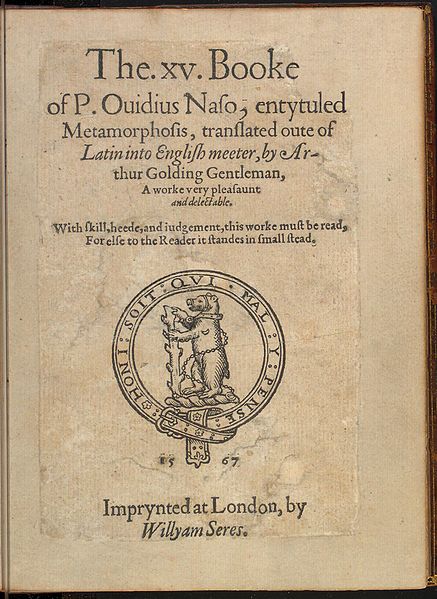
The frontispiece of a 1567 edition of Ovid's Metamorphoses, translated from Latin into English by "Arthur Golding, gentleman." This page also prominently displays the heraldic bear and ragged staff of Robert Dudley, the Earl of Leicester. I have been unable to confirm with certainty that this work was commissioned by him, but all evidence would suggest that it probably was. If anyone has more information on this, please comment or email me! Picture acquired through Wikimedia Commons. Image public domain.

Francis Meres was an Elizabethan author who received his M.A. at Oxford and wrote the Wits Treasury, which was a valuable compendium of information on Elizabethan poets. Wits Treasury is acknowledged in the Shakespeare circle as being the first account with  merit on on the early works of Shakespeare, even establishing some basic chronology of the publications of the works. Meres, who was well acquainted with Shakespeare's gift, compared the Bard's work to Ovid's, saying:

"The sweet witty soul of Ovid lives in mellifluous and honey-tongued Shakespeare."

Sources:  

Francis Meares, Alumni Cantabrigienses, (online edition) Cambridge University Press.

Sunday, September 4, 2011

On this Day in Elizabethan History:The Death of Elizabeth's "eyes", Robert Dudley, Earl of Leicester

On this day in Elizabethan history, September 4th, in 1588, not long after England's momentous victory against the Spanish Armada, Queen Elizabeth's I joy was eclipsed by the death of her oldest, dearest friend, Robert Dudley, the Earl of Leicester. Leicester was undoubtedly her true love.

The Earl of Leicester c. 1564. The portrait is attributed to Steven van der Meulen, but this has been disputed. Leicester's Coat of Arms is depicted twice in this portrait, surrounded by the Colar of the Order of St. Michael, and the Garter. Leicester received the Order of St. Michael in 1566, so it was certainly added to the portrait after it was initially completed. 


Robert Dudley had been sick for quite some time before he passed. In his final years of service to his queen, he was commander of the English forces in the Netherlands from 1585-1587, with a brief return home from fighting with the Dutch against Philip II (who else?) to support Elizabeth in the crisis concerning Mary Queen of Scots.

Dudley's tactics in the Netherlands were scrutinized by his enemies, but he had done his best given the complex situation at hand. Shortly after he returned to England, the Earl of Leicester served as Elizabeth's "Lieutenant General" at Tilbury.

"In the meantime, I leave my Lieutenant General in my stead, whom never a prince commanded a more noble or worthy subject..." (Excerpt from Queen Elizabeth's Tilbury Speech, 1588)

A sketch from life done by Zuccaro in 1575 of Queen Elizabeth I. This sketch is part of a pair; the Earl of Leicester was also sketched by Zuccaro in preparation for full-scale portraits for Leicester's Kenilworth celebrations. Picture acquired through Wikimedia Commons. Image public domain.

Robert Dudley, Earl of Leicester, sketched in his armor by Frederico Zuccaro in the spring of 1575. This sketch is part of a pair; Queen Elizabeth I was also sketched by Zuccaro in preparation for full-scale portraits for Leicester's Kenilworth celebrations.Picture acquired through Wikimedia Commons. Image public domain.


After the victory, the Queen recognized her dear friends rapid decline in health, and she urged him to retreat to the country, and drink the "healing waters" at Buxton, in Derbyshire. Leicester never arrived at his destination, prematurely dying at his estate in Oxfordshire.

Upon hearing the news, Queen Elizabeth was understandably beside herself, and she locked herself away in her apartments for days on end. The letter the Earl had written her only days before his death did not leave Elizabeth's side. She scrawled "His last letter" on the note, and kept it close in an ornate box beside her bed. It would remain in that place, holding an almost sacred value until her death 15 years later.

A scan of Leicester's last letter to the queen. You can see where Elizabeth I scrawled "His Last Letter" on what would be the exterior of the folded letter. Picture acquired through Wikimedia Commons. Image public domain.

His Last Letter


I most humbly beseech your Majesty to pardon your poor old servant to be thus bold in sending to know how my gracious lady doth, and what ease of her late pain she finds, being the chieftest thing in the world I doth pray for, for her to have good health and long life.
For my own poor case, I continue still you medicine and find that (it) amends much better than any other thing that hath been given me.
Thus hoping to find perfect cure at the bath, with the continuance of my wonted prayer for your Majesty's most happy preservation, I humbly kiss your foot.
From your old lodging at Rycote, this Thursday morning, ready to take on my journey, by your Majesty's most faithful and obedient servant,

R.Leicester (Leicester drew a pair of "eyes" over his name, alluding to the queen's nickname for him)

Even as I had writ thus much, I received your Majesty's token by young Tracey.
(Before the letter was set, Leicester had received a gift from his queen!)

Robert Dudley, the Earl of Leicester died the Queen's most trusted confidante and oldest friend. In addition to his devotion to his "Bess", Leicester was a avid reformer, who did much to financially and militarily aid Protestants at home and abroad. He also was an investor, a collector, and a patron of the arts, even establishing his own theatre company in 1559.

He was buried at Beauchamp Chapel at St. Mary's in Warwick, by his biological son, who died in early childhood.

R.I.P. Robert Dudley, Earl of Leicester. I have no doubt you and her Majesty are enjoying each others company where you are now, together!