Showing posts with label Catherine de Medicis. Show all posts

Sunday, February 10, 2013

Elizabethan Quote of the Day: Elizabeth's Physician Shares Sensitive Information

"If the King marries her, I guarantee ten children; and no one in the world knows her constitution better than I do."

Queen Elizabeth I's physician made this bold claim to the French ambassador in 1566, when the French King Charles IX was considering marrying the Tudor queen. 

A portrait of King Charles IX of France, circa 1572 in the Palace of Versailles. By or after Francois Clouet. Picture acquired through Wikimedia Commons. Image public domain.

The marriage, had it gone through, would have certainly been a disaster; Charles IX, along with his mother Catherine de Medicis, would eventually permit the massacre of the French Protestant's, known as Huguenots, which began with the St. Bartholomew's Day Massacre in 1572. When he died without legitimate issue, Charles IX was succeeded by his brother, who became King Henri III.
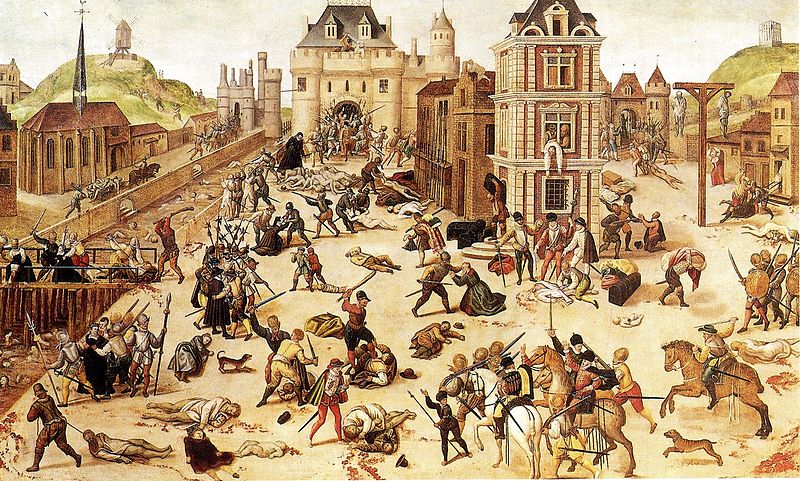
The St. Bartholomew's Day Massacre by Francois Dubois, circa 1572-84. Picture acquired through Wikimedia Commons. Image public domain.

Queen Elizabeth understood that her body was not her own; it belonged to the state and to her people. In fact, she allowed herself to be routinely examined well into her 40's to prove that she was still able to bear children. Yet imagine what Elizabeth would say if she knew that her physician's words concerning her fertility were being read hundreds of years later!


Saturday, January 5, 2013

On This Day in Elizabethan History: The Death of Catherine de Medicis

A miniature of Catherine de Medicis, attributed to Francois Clouet. Victoria and Albert Museum, London. Image public domain.

On this day in Elizabethan history, in 1589, Catherine de Medicis, dowager Queen of France, died at the age of 69. Catherine had been the consort of King Henri II of France; their marriage was an unhappy one, since Henri had carried on a life-long emotional and physical affair with the much-older Diane de Poitiers. On the 30th of June, 1559, Henri was wounded by a lance shard, in a tournament that was held to celebrate the marriage of his daughter, Elizabeth of Valois, to King Philip II of Spain. Henri died as a result on the 10th of July, 1559; Catherine banished Diane de Poitiers from court.

A 16th century German print of the fateful tournament between King Henri II and Gabriel Montgomery, Lord of Lorges, that led to Henri II's demise. Picture acquired through Wikimedia Commons. Image public domain.

After her husband died, Catherine de Medicis held considerable influence over her sons and French politics. Catherine's name will forever be associated with the infamous St. Bartholomew's Day Massacre, which began on the 23rd of August, the eve of the feast day of St. Bartholomew the Apostle. The massacre began with the assassinations of key leaders of the French Huguenot party (Protestants), and ended with mob violence by Roman Catholics against Huguenot civilians. While Catherine held great contempt for the French Protestants, and likely gave her consent to the massacre, she cannot be held solely accountable for this tragedy; the French Wars of Religion were a far more complex matter.

One Morning at the Gates of the Louvre, a 19th century painting by Edouard Debat-Ponsan, showing Catherine de Medicis surveying the bodies of dead Huguenots. Picture acquired through Wikimedia Commons. Image public domain.

In 1579, Catherine de Medicis and Henri II's youngest son, Francis, Duc d'Anjou, began courting Queen Elizabeth I of England. Elizabeth I seriously considered marrying the Duc d'Anjou, son of "the Jezebel of our age" (according to Sir Philip Sidney, in a letter to the Queen), but the marriage negotiations came to naught. In 1581, Queen Elizabeth bid the man she called her "frog" adieu forever. Catherine de Medicis died just eight years later, and was buried next to her husband, with whom she had had such a contentious marriage, at the Basilica of St. Denis.

The effigies of Catherine de Medicis and Henri II of France in the Basilica of St. Denis. Picture shared for public use by Myrabella on Wikimedia Commons. Image public domain.