Upon succeeding to the throne of England in 1558, Queen Elizabeth immediately set to work devising the Church Settlement that progressed through Parliament to be passed in 1559. Of course, the religious policy saw opposition from the Marian bishops who remained in office, but it still passed. The Church Settlement allowed Elizabeth's subjects to honor their own religious convictions privately, provided that they demonstrate their loyalty to Queen and Country by outwardly conforming. This meant that subjects were required to attend an Elizabethan church service weekly, and those who refused to do so were fined 1 shilling per a week.
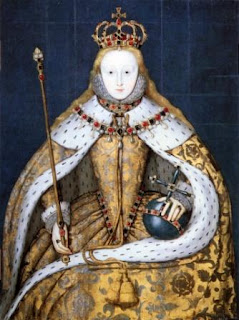 |
| The Coronation Portrait of Queen Elizabeth I, depicted at the age of 25. Thought to be a 17th century copy from a lost original. Picture acquired through Wikimedia Commons. Image public domain. |
Outward conformity from both sides, Protestant and Catholic, helped Elizabeth's subjects to see themselves for the first time unified as English, rather than divided into religious factions. It certainly helped that the Church of England's services retained elements of the old Catholic faith, while adopting some of the reforms of the Protestant movement. One of the tools used to rectify the Queen's subjects of any Christian affiliation was the Book of Common Prayer. The Book of Common Prayer was revised in 1559 in an attempt to appease as many English subjects as possible. For example, for the Service of Holy Communion, the Book of Prayer contains this phrasing to be spoken:
"The Body of our Lord Jesus Christ which was given for thee, preserve thy body and soul unto everlasting life; Take and eat this in remembrance that Christ died for thee, and feed on him in thy heart by faith with thanksgiving."
The first statement comes from the 1549 Prayer Book and would have been acceptable to Catholics who believe that the bread is transformed into the flesh of Christ by the miracle of transubstantiation. The second phrasing comes from the 1552 Prayer Book and would have been deemed acceptable to the English Protestants who believed that the taking of the bread is an act of memorial to the Last Supper, making the bread symbolically the flesh of Christ, rather than literally. The issue of transubstantiation was a central issue of the English Reformation, hearkening back to Henry VIII's break with Rome to form the Church of England. People lost their lives in the Henrician and Marian regimes upholding their beliefs pertaining to this matter. Queen Elizabeth wished to avoid this conflict altogether, and careful consideration was taken in reforming the Book of Common Prayer early in her reign.
 |
| King Henry VIII of England, by Hans Holbein c. 1537. Elizabeth's father Henry VIII broke from Rome so that he could grant himself his own divorce from Catherine of Aragon, in order to marry Elizabeth's mother, Anne Boleyn. Picture acquired through Wikimedia Commons. Image public domain. |
Elizabethan bishops were required to subscribe to 3 Articles of Faith:
1. They must recognize the Queen as Supreme Governor of the Church.
2. They must subscribe to the Book of Common Prayer.
3. They must agree to the 39 Articles of Religion.
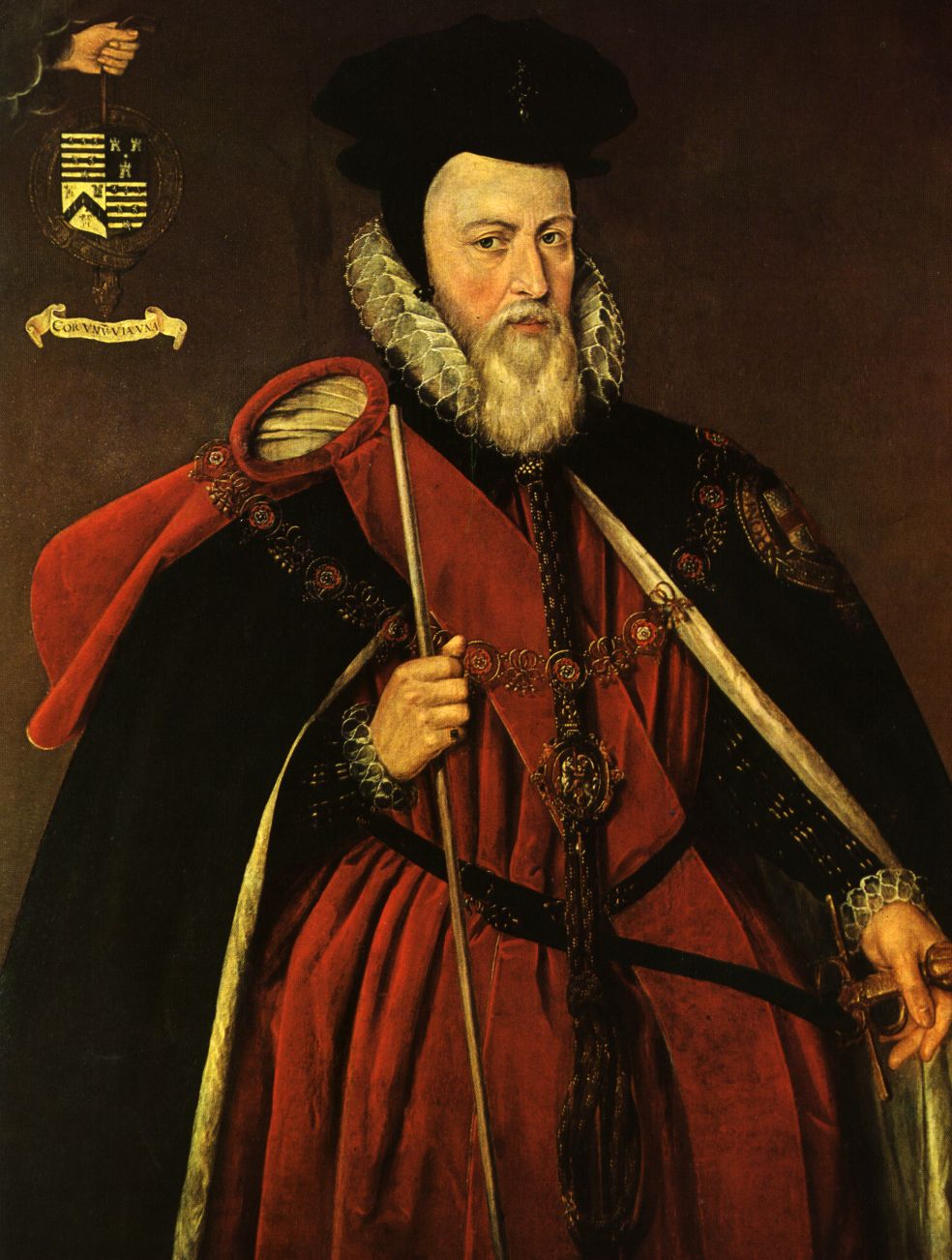
William Cecil, Lord Burghley, who was Queen Elizabeth's chief advisor and Lord Treasurer was well known by the Queen to have Puritan leanings. He took issue with the rigidness of belief to which Elizabeth's bishops were expected to subscribe, and in 1584 he wrote to Elizabeth I's 'model' bishop John Whitgift, who was Archbishop of Canterbury from 1583-1603. Burghley did not wish to see the Puritan clergy compelled to leave the church due to the 3 Articles of Faith they were required to uphold. In Burghley's letter to Archbishop Whitgift, he said,
"...But I conclude according to my simple judgement, this kind of proceeding is too much savouring of the Romish Inquisition, and is rather a device to seek for offenders than to reform any." (Quoted in Statutes and Constitutional Documents 1558-1625, G.W. Prothero, Oxford University Press 1894.)
Those with Puritan convictions like Burghley found it difficult to swear that the Book of Common Prayer contained nothing in contradiction to the actual Word of God. Whitgift responded to Burghley's concerns saying that the Church previous to Elizabeth had been suffering from a "lack of discipline" and that the structure the Elizabethan Church Settlement was providing would hold clergy to a higher standard (Palmer, 32).
 |
| William Cecil, Lord Burghley (1520-1598), depicted in the robes of the Order of the Garter. Elizabeth made Cecil her chief Secretary of State in 1558. He was styled Lord Burghley in 1571, and in 1572 he was made Lord Treasurer, which was the position he held until his death. Elizabeth called this man who was her chief minister for 40 years her "spirit". Picture acquired through Wikimedia Commons. Image public domain. |
At all costs, Elizabeth wished to keep the peace; she really had no interest in rocking the boat on either side; this disappointed the extremist Catholics who were looking for a clear offense that they could use as cause to rise up against her, but it also disappointed the Puritans and Presbyterians who had hoped that she would be the figurehead for a stricter Protestant church.
 |
| Elizabeth I's Bishop's Bible from 1568. In the collection of the Folger Shakespeare Library. Picture acquired through Wikimedia Commons. Image public domain. |
Elizabeth professed that she "wished not to open window's into men's souls", and she expected the same courtesy that she extended to her own subjects to be afforded to her as well. This is perhaps why the details of her own religious convictions remain somewhat of a mystery. Still, no one should doubt that Elizabeth herself was indeed religious; she had studied the Bible and other ancient texts of religion for many years, and she often professed how she believed God had preserved and guided her through the many trials and tribulations of her life to be crowned Queen of England.
 |
| The frontispiece of Queen Elizabeth's prayerbook, showing her kneeling in reverence and prayer. Picture acquired through Wikimedia Commons. Image public domain. |
William Camden (1551-1623) lived through Queen Elizabeth's reign, and as her contemporary he had access to original material (Palmer, 29). He published his Annals of Queen Elizabeth in Latin in 1615, and he made a point to comment on the Queen's religious habits,
"(Queen Elizabeth was)...truly religious, who every day, as soon as she arose, spent sometime in prayers to God and afterwards also at set times in her Private Chapel; every Sunday and Holy day she went into her chapel ; neither was there ever any other prince present at God's service with greater devotion. The sermons in Lent attentively she heard being all in black, after the manner of old although she many times said that she had rather talk with God devoutly by prayer than hear others speak eloquently of God."
 |
| The frontispiece and title page of the 1675 edition of William Camden's Annals of Queen Elizabeth. Picture acquired through Wikimedia Commons. Image public domain. |
This observation from Camden, published in the reign of Elizabeth's successor James I, shows that while Elizabeth gave nods to the Catholic way of worship (Attending church during Lent season in all black) she still professed and practiced perhaps the most important concept of Protestantism: the ability to converse directly with God rather than rely on the interpretation or intercession of the clergy to communicate with and understand God and His will.
While Queen Elizabeth adopted an extremely moderate religious policy that brought stability to her realm, it should be emphasized that extremism on either side was considered politically dangerous. Zealous Catholics as well as Puritans and Presbyterians were monitored and sometimes severely punished if they threatened the safety of Queen Elizabeth and her realm, or if their prophesying caused civil unrest.
Puritans took issue with Elizabeth's policy not continuing the work of her late brother Edward VI's regime. The Puritan's has hoped that Elizabeth Tudor would completely reform the Church of England, and rid it of all vestments, icons, Latin verses and other trappings of the Catholic faith. While services continued to include Latin hymns and incense, Queen Elizabeth did promote the Protestant reform of raising the qualifications of the clergy: Elizabeth's bishops were supposed to be well-educated and Bible-literate; still, Elizabeth always remained wary that any religious study group could develop into cells of Presbyterian doctrine.
 |
| Detail of the allegorical work Edward VI and the Pope. Picture acquired through Wikimedia Commons. Image public domain. |
Presbyterians, another Christian sect, were the biggest Protestant threat to the peace of Elizabeth's realm, since their rejection of the entire ecclesiastical hierarchy of bishops by implication took issue with the institution of royal supremacy (Palmer, 28).
Some ardent Catholics also gave Queen Elizabeth and her government reason to be cautious. A small number of Catholics in England welcomed militant Catholic priests and assassins from abroad who aimed to attack Queen Elizabeth with the blessing of the pope. When Elizabeth was excommunicated from the Roman Catholic faith (which she had never once been a part of), it was declared by the Bishop of Rome that anyone who saw the "English Jezebel" killed would not be committing murder but instead would be doing God's will, and would be welcomed into Paradise. Elizabeth's network of spy's and informants, led by her spymaster Sir Francis Walsingham, monitored the lives of individuals associated with this Catholic movement closely.
 |
| Detail of a portrait of Sir Franics Walsingham (1536-1589). Walsingham succeeded Burghley as Secretary of State in 1573. He acted as Ambassador to Scotland, France and the Netherlands, while acting as Queen Elizabeth I's "spymaster". It was Walsingham's network that uncovered the Mary, the so-called Queen of Scot's treachery and the Babington Plot. Picture acquired through Wikimedia Commons. Image public domain. |
Queen Elizabeth had watched from afar with great concern the religious wars which were tearing apart the kingdom's on the Continent. When she became Queen she wisely decided to occupy herself with healing the religious tension in England as best as she could in order to prevent her nation from befalling a similar fate. While some Protestants and some Catholics took issue with aspects of Elizabeth's religious policy, most found it to be remarkably tolerable. If we compare Elizabeth's decisions pertaining to religion to those of her predecessors, contemporaries, and even her successor, it is very clear that her policy was the least oppressive. Queen Elizabeth really did make a conscience effort to appease the majority of her subjects by permitting them their religious convictions, so long as they remained loyal subjects. The Elizabethan Church Settlement would be one of the many ways in which Queen Elizabeth would improve the lives of her people.
Queen Elizabeth captured the matter of Christianity best when she said, "There is but one God, one Jesus Christ; all else is dispute over trifles."
 |
| The Great Seal of Queen Elizabeth I, from 1586. Designed by Nicholas Hilliard. Picture acquired through Wikimedia Commons. Image public domain. |
Sources:
Palmer, Michael. Reputations: Elizabeth I. Bath Press, 1988. Print.
Prothero, G.W. Statutes and Constitutional Documents 1558-1625. Oxford University Press, 1894. Print.
Camden, William. The Annals of Queen Elizabeth. London, 1615. Electronic.