Showing posts with label Levina Teerlinc. Show all posts

Thursday, April 17, 2014

What was Easter like in Elizabethan times?

An Elizabethan Maundy, a miniature of Queen Elizabeth I observing the tradition of a Maundy Thursday with the common people. The miniature is most likely by Elizabethan female court painter Leevina Teerlinc. Picture acquired through Wikimedia Commons. Image public domain.

Happy Easter weekend to those who celebrate it!

You can find out how Easter was celebrated in Elizabethan England in our BeingBess article here.

Sunday, November 17, 2013

On This Day in Elizabethan History: The Accession of Elizabeth Tudor


The plaque under the tree reads, "This oak tree was planted by Her Majesty Queen Elizabeth II on the 11th July 1985, on the site of the original oak tree under which Her Majesty Queen Elizabeth I heard of her succession to the throne" at Hatfield House on November 17th, 1558. Picture shared for public use on Wikimedia Commons. Image public domain.


"The Queen is dead; long live the Queen!"

On this day in Elizabethan history in 1558, Queen Mary I died and Elizabeth Tudor was declared Queen of England. The last of the Tudor dynasty, Queen Elizabeth I would also become the most successful Tudor monarch. Her coronation would take place on January 15th, 1559.

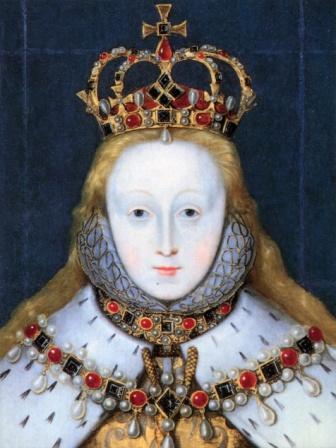
A coronation portrait miniature of Queen Elizabeth I, possibly by Levina Teerlinc. Picture acquired through Wikimedia Commons. Image public domain.

Read about Queen Elizabeth I's annual Accession Day celebrations here.

Friday, May 3, 2013

Bess to Impress: The Coronation Portrait

 
The Coronation Portrait of Queen Elizabeth I. Image public domain through Creative Commons licensing, NPG, London.

The Coronation Portrait of Queen Elizabeth I, now in the collection of  National Portrait Gallery, was painted somewhere around 1600, copied after a now-lost original. Elizabeth I succeeded to the throne of England in 1558 and was crowned in 1559 at the age of twenty-six. In addition to the official coronation portrait, there are several miniature versions, including one attributed to Levina Teerlinc.

A miniature version of The Coronation Portrait of Queen Elizabeth I. Picture acquired through Wikimedia Commons. Image public domain.

Unlike most Tudor and Elizabethan portraits, Queen Elizabeth I is depicted full-face in The Coronation Portrait; this is because the coinage and royal seals for the new regime were to be based off of this image. Her hair hangs loose about her shoulders, as was typical for a queen at her coronation. Elizabeth's heavy coronation robes are decorated with Tudor roses and fleur-de-lis. The fleur-de-lis, which is the heraldic emblem of France, represents the longstanding English claim to the French throne. According to the National Portrait Gallery, these elaborate robes were not custom-made for Queen Elizabeth, but were reused from the coronation of her sister, Queen Mary I just five years before, when England still had possession of its last French territory, Calais. Mary lost Calais in the final year of her reign.

A detail from a portrait of Queen Mary I. By Anthonis Mor, 1554. Picture acquired through Wikimedia Commons. Image public domain.

Queen Elizabeth I's cloak is trimmed in ermine, the fur that sumptuary law dictated was only to be worn by royalty. This is one of the reasons why Alison Weir and other historians have questioned the attribution of the portrait known as Mary Boleyn, as the sitter is wearing ermine, and Mary Boleyn was not of royal birth.

The identity of this portrait is in question, due in part to the sitter wearing a robe trimmed with ermine. Picture acquired through Wikimedia Commons. Image public domain.

In addition to projecting royal majesty in her portrait, Queen Elizabeth also embodies the standards of 16th century beauty. Queen Elizabeth is pale, as only people who had to work outdoors for a living had significant color in their skin. Elizabeth also has an unnaturally high hairline; she and other well-bred women plucked their hairlines to make their faces appear longer and thinner. Queen Elizabeth I would exaggerate these features as she aged in an effort to appear more youthful.

A detail of The Coronation Portrait of Queen Elizabeth I. Image public domain through Creative Commons licensing, NPG, London.

Sources:

Gittings, Clare. Portraits of Queen Elizabeth.  London: National Portrait Gallery Publications, 2003. 
     Print.

 
Weir, Alison. Mary Boleyn: The Mistress of Kings. New York: Ballantine Books, 2011. Print.

Thursday, May 2, 2013

Bess to Impress: The Clopton Portrait

The Clopton Portrait of Queen Elizabeth I. In the private collection of Mr. Peter James Hall. Picture acquired through Wikimedia Commons. Image public domain.

The Clopton Portrait of Queen Elizabeth I dates from early in her reign, circa 1560-65, before she reinvented herself as Gloriana. The portrait, by an unknown artist, is in the private collection of Mr. Peter James Hall, though there are other existent versions.

Another Clopton-esque portrait of Queen Elizabeth I by an unknown artist, circa 1560. Image public domain through Creative Commons licensing, NPG, London.

Queen Elizabeth I has purposefully donned the colors associated with a modest Protestant intellectual, black and white, in her portrait. In the system of heraldry, the tincture of black represents constancy, while the tincture of white/silver represents sincerity. Queen Elizabeth draws attention to her favorite feature, her hands, by wearing multiple rings and holding a book in her right hand and gloves in her left; Elizabeth had a fondness for fine gloves, several pairs of which have gone on display in recent years. 

An exquisite ceremonial pair of Queen Elizabeth I's gloves.

This portrait bares similarities to the portrait of Elizabeth as Princess from around 1546; In addition to being depicted with books again, Elizabeth's haunting gaze is very similar. The Clopton Portrait, painted before Queen Elizabeth's portraits included copious amounts of symbolism and her image became regulated, gives us a very good idea of what the young Queen of England actually looked like.

Other portraits of Queen Elizabeth I from this time include the following: 

A portrait of Queen Elizabeth I by an unknown artist, circa 1565. Picture acquired through Wikimedia Commons. Image public domain.

Recently discovered in 1994 when it went up for auction, this portrait of Queen Elizabeth was painted around 1565 by an unknown artist of the British School. The portrait, sold through Christie's, is now in a private collection. Interestingly, the entire portrait, including the frame, is painted on a single piece of wood (Cody). Once again, Queen Elizabeth I is shown holding a book; below her  hand on the frame is a verse that she purportedly spoke to a Marian priest when questioned about transubstantiation,

'Twas God the word that spake it,
He took the bread and brake it,
And what the word did make it,
That I believe and take it.

A miniature portrait of Queen Elizabeth I, circa 1560-65. Attributed to Levina Teerlinc. Picture acquired through Wikimedia Commons. Image public domain.

A miniature of Queen Elizabeth I, circa 1560-65. Attributed to Levina Teerlinc. Part of The Royal Collection.

Another miniature portrait of Queen Elizabeth I, circa 1560-65. Attributed to Levina Teerlinc. Picture acquired through Wikimedia Commons. Image public domain.

A miniature of Queen Elizabeth I, circa 1560-65. Attributed to Levina Teerlinc. Part of The Royal Collection.

Sources:

Sutherland-Harris, Ann, and Linda Nochlin. Women Artists: 1550-1950. Los Angeles: Museum
     
     Associates of the Los Angeles County Museum of Art, 1976. Print. 

 "Portraits of Queen Elizabeth." Marilee Cody. Web. 4 April. 2013.

Thursday, April 18, 2013

Bess to Impress: Princess Elizabeth, c.1546


Portrait of Princess Elizabeth Tudor, c.1546-47. Formally attributed to William Scrots. Picture acquired through Wikimedia Commons. Image public domain.


The first portrait to be featured in our Bess to Impress series is the captivating portrait of Princess Elizabeth Tudor, aged about 13. The portrait is thought to have been painted between 1546 and 1547, and was formally attributed to William Scrots. Scrots flourished from 1537-53. Part of The Royal Collection, this stunning portrait can be viewed at Her Majesty Queen Elizabeth II's residence of Windsor Castle.

This portrait was a gift from Elizabeth Tudor to her brother, Edward VI. Depending on which date you subscribe to, Edward was either still a prince or recently crowned King of England when he received the portrait. In a letter accompanying the gift, Elizabeth wrote of her desire to see her brother, of whom she was very fond. The young Elizabeth uses a self-deprecating tone when she writes about her own face, though she speaks well of her intellect. Indeed, Queen Elizabeth, though very vain, never thought of her face as her best feature; instead she drew attention to her long, slender fingers, (so aptly on display in this portrait) and her neck, hair, and tiny waist. When her face became permanently scarred due to her bout with smallpox early in her reign, Elizabeth then did even more to draw attention away from her changed visage, wearing heavy white makeup and large, jewel encrusted gowns.

A detail of Princess Elizabeth from the 1546-47 portrait. Picture acquired through Wikimedia Commons. Image public domain.

From a note accompanying the portrait, by the Princess Elizabeth to her brother, Edward VI:

'For the face, I grant, I might well blush to offer, but the mind I shall never be ashamed to present...when you shall look upon my picture you will witsafe to think that as you have but the outward shadow of the body before you, so my inward mind wisheth that the body itself were oftener in your presence.'

The young Princess, who had endured so much in her childhood and would suffer more injustice as a ward of her brother's uncle, Thomas Seymour, gazes back at the viewer intently, conveying with her eyes her wisdom beyond her years. I have discussed the portraits of Queen Elizabeth I with my dear friends Donna and Mia multiple times, and Donna and I are particularly moved by this portrait for the aforementioned reason. This portrait first resonated with me as a preteen when I was navigating a very dangerous childhood with my own father; seeing Elizabeth staring back at me from the pages of the Book Behind the Mask by Jane Resh Thomas, I immediately recognized a kindred spirit. It is a sober, haunting portrait which contrasts sharply with the glorious, triumphant portraits of Queen Elizabeth painted during her mid-to-late reign.

While not laden with symbolism like Elizabeth's portraits after she became Queen of England, this portrait displays a purposefully chosen accessory: books. The books emphasize Elizabeth's commitment to scholarly pursuits, a value that she shared with her brother, the portrait's recipient, and her piety. Perhaps it is a stretch to assume that the French style hood worn by Elizabeth Tudor is a nod to her mother, Anne Boleyn, (especially since the Princess Mary donned one in a portrait dated from about 1544) but given what we know about Elizabeth's defiant statement in the Whitehall Family Portrait, it is possible.

Other confirmed contemporary portraits of Princess Elizabeth from around this time include:

The Family of King Henry VIII, also known as The Whitehall family grouping, c. 1544. From left to right: A female fool, probably the wife of Will Sommers, Mary Tudor, Edward VI, King Henry VIII, Jane Seymour, and Elizabeth, followed by Will Sommers. Picture acquired through Wikimedia Commons. Image public domain.

The Family of King Henry VIII/The Whitehall Family Grouping, c.1543-1547. By an unknown artist, after Hans Holbein. Part of The Royal Collection, this portrait can be viewed at Hampton Court Palace. To learn more about this portrait's significance to the Anne Boleyn/Elizabeth I connection, please see our article Death Could Not Separate Them: How Elizabeth I Connected to Her Deceased Mother.

The Children of King Henry VIII. Picture acquired through Wikimedia Commons. Image public domain.

The Children of Henry VIII, c.1650-80, after a lost original from c.1545-1550. In the collection of the Duke of Buccleuch at Boughton House.

Elizabeth I as Princess, c.1550. Attributed to Levina Teerlinc. Picture acquired through Wikimedia Commons. Image public domain.

Elizabeth I as Princess, c.1550. Portrait miniature attributed to female court artist to the Tudors, Levina Teerlinc.

There are also multiple woodcut style illustrations of the Princess Elizabeth in books and tracts that are not meant to be realistic, but rather depict scenes from her life.

Source:

Gittings, Clare. Portraits of Queen Elizabeth.  London: National Portrait Gallery Publications, 2003. 
     Print.

Sunday, March 31, 2013

Happy Easter! Easter in Elizabethan Times


An Elizabethan Maundy, a miniature of Queen Elizabeth observing the tradition of a Maundy with the common people. The miniature is by Elizabethan female court painter Leevina Teerlinc. Picture acquired through Wikimedia Commons. Image public domain.
Happy Easter to my BeingBess readers who celebrate the holiday, as well as happy Passover, spring etc.

To learn about Easter in Elizabethan times, please see my article here.

Wednesday, November 7, 2012

Levina Teerlinc: Female Miniature Portrait Artist to the Tudors

Most would name the great Tudor and Elizabethan portrait artists as follows: Holbein, Hilliard,, Eworth, Gower, van der Meulen, Oliver, Scrots, and Peake. Yet, there is an oft-forgotten personage that should be included among the pantheon of 16th century artists working in the English royal court; that person is female court painter Levina Teerlinc (c.1520-1576).

Teerlinc, who worked exclusively in miniature portraiture, was employed by four out of the five Tudor monarchs. She received a higher starting salary than Hans Holbein the Younger for her services to King Henry VIII (Harris, Nochlin, 102).

King Henry VIII by Hans Holbein, circa 1540. Image public domain through Creative Commons licensing, NPG, London.

Levina was the eldest of five daughters born to a Flemish illuminator and miniature painter in Bruges, named Simon Benninck. In the absence of a son, and as the eldest daughter, Levina was trained as an artist, presumably by her father. By 1545, Levina was married to George Teerlinc and still living in Bruges; just one year later, in November of 1546, Levina and her husband left for England. Levina had been hired by King Henry VIII as a court artist, being granted an annuity income of 40 pounds, to last "from the annunciation of our Lady during your Majesty's pleasure".

A self-portrait of Simon Benninck from 1558, aged 75. He died three years after painting this miniature. Victoria and Albert Museum, London.

To have been scouted by Henry VIII, and to have acquired a starting salary more substantial than Holbein's, Levina Teerlinc must have finished her training several years prior, and had to have been working steadily in order to build up a reputation to recommend her (Harris, Nochlin, 102). As the records show, Teerlinc's annuity would continue almost every year until her death. After working for Henry VIII, Levina worked for his three children in succession: Edward VI, Mary I, and Elizabeth I.

Levina Teerlinc's Tudor patrons: Henry VIII, Edward VI, Mary I, and Elizabeth I. Picture acquired through Flickr courtesy of Inor19.

It is difficult to give Levina Teerlinc the attribution of works with any certainty, due to the fact that she did not sign her paintings. But, we do have copious references to her works and somewhat vague descriptions of her miniatures in court records. In 1556, Teerlinc gifted Queen Mary "as a New yaer gift a small picture of the 'trynitie'." In 1551, Teerlinc first painted Elizabeth Tudor, and upon her accession in 1558, she gave the newly crowned queen a miniature portrait of herself.

A portrait miniature of Princess Elizabeth Tudor circa 1550-51, attributed to Levina Teerlinc. Picture acquired through Wikimedia Commons. Image public domain.

Erna Auerbach, in her study of Nicholas Hilliard, concluded that the painting that is most likely the work of Teerlinc is the oval miniature known as "an Elizabethan maundy". The miniature, now in the collection of the Earl of Beauchamp, may in fact be the portrait recorded as Teerlinc's New Year's gift to Queen Elizabeth in 1563. The miniature in question is described as, "a Carde with the Queen's Matie [Majesty] and many other personages".


An Elizabethan maundy, a portrait miniature likely by Levina Teerlinc. In the collection of the Earl of Beauchamp. Image public domain.

Teerlinc's talents were appreciated by her royal patrons, and in addition to her annuity she often received expensive presents, such as a pair of gilded spoons and a gilded salt-cellar. In 1566, Levina, her husband, and her son Marcus officially became English subjects. A decade later, after a consistent and lucrative career, Levina died in her house at Stepney (Harris, Nochlin, 102).

Teerlinc was the only Flemish miniature painter to be employed at the English court between 1546 and her death, and the only miniaturist of prominence recorded in England between the death of Hans Holbein the Younger in 1543, and the rise of Nicholas Hilliard in the 1570's (Harris, Nochlin, 102).

In addition to "an Elizabethan maundy" and the other aforementioned paintings described in court records, there are a few existing miniatures of which Teerlinc is the likely artist; however, Simone Bergman's attributions given to Teerlinc in 1934 have since been proven to be the works of Hilliard and Issac Oliver. The period between when Teerlinc moved to England (1546) and Hilliard signed his first miniature portrait (1560) is a critical time to study, in order to identify Teerlinc's works, as she was the only significant miniature artist active in the court during this time (Harris, Nochlin, 103).

This miniature of Queen Elizabeth I receiving foreign ambassadors could also be the work of Teerlinc. Picture acquired through Wikimedia Commons. Image public domain.

The miniature portrait of Katherine Grey, Countess of Hertford was likely painted by Levina Teerlinc, as well as a miniature portrait of Mary Dudley, Lady Sidney; there is also another portrait, one of an unknown woman, that could have also been painted by her. A miniature in Welbeck Abbey of Elizabeth I in her state robes could also be by Teerlinc. The Welbeck miniature includes a stunning detail: Queen Elizabeth's scepter in the portrait is encrusted with a real diamond!

A portrait miniature of Katherine Grey, Countess of Hertford that is attributed to Levina Teerlinc. Painted between 1555-60. Victoria and Albert Museum, London.

Like Hans Eworth and William Scrots before her, Levina Teerlinc is a prominent but somewhat mysterious 16th century figure, only recently being researched and understood. Until we make more definitive attributions of portraiture to Teerlinc, and until we fill in the missing information about events in her life, we can at least appreciate this woman as "the most important miniature artist active in England between Holbein and Hilliard" (Harris, Nochlin, 102). Though Hilliard asserted his opinion that "none should medle with limning but gentleman alone", this female artist at the Tudor court had a longer career than most of her colleagues, and she was often paid better, too!

Sources

Sutherland-Harris, Ann, and Linda Nochlin. Women Artists: 1550-1950. Los Angeles: Museum 
     Associates of the Los Angeles County Museum of Art, 1976. Print. 

Simon, Benninck. Self-portrait. 1558. Victoria and Albert Museum, London, England. Web. 
     6 November 2012.

Teerlinc, Levina. Katherine Grey, Countess of Hertford. 1555-60. Victoria and Albert Museum, London, England. 
     Web. 6 November 2012.