Showing posts with label Puritan. Show all posts

Thursday, July 19, 2012

On This Day in Elizabethan History: The Death of Sir Francis Knollys


On this day in Elizabethan history, 1596, Sir Francis Knollys, a Privy Councillor, Knight of the Garter, and Vice-Chamberlain of the household of Queen Elizabeth I, died.

Francis Knollys was born c.1514 to Robert Knollys, a court official of Henry VIII, and his wife, Lettice. After receiving some schooling at Oxford University, Francis began to earn favor at King Henry's court, becoming one of Henry VIII's esteemed gentleman-pensioners. In 1540, Francis' future wife Katherine Carey, daughter of Mary Boleyn, arrived at court. She was secured a place in Queen Anne of Cleves household by Henry VIII. (Historian Alison makes a convincing case based on ample primary and secondary sources that Katherine Carey was the illegitimate daughter of King Henry VIII, though her brother Henry Carey, later 1st Baron Hunsdon, was almost certainly Mary's child by her husband, William Carey.) Francis was now in almost daily contact with his future wife, and if their eventual happy marriage is any indication, they perhaps fell in love before they were even wed.

This Portrait of a Pregnant Lady, 1562, by Steven van der Muelen  is most likely of Katherine Carey-Knollys. For further information on this portrait, and the controversy surrounding Katherine's paternity, please see Alison Weir's biography, Mary Boleyn: The Mistress of Kings. Picture acquired through Wikimedia Commons. Image public domain.

In 1542 Francis was admitted to The House of Commons (Dictionary of National Biography), and in 1546 he married Katherine Carey. By an act of Parliament, the couple would be joint owners of the estate of Rotherfield Greys.

By all accounts, Francis Knollys was always an outspoken champion for the reform movement in the Church of England. His opinions resonated with the young King Edward VI, and  Francis became an important member of his government (Wagner, 174). His dedication to King and country paid off, as he was knighted in 1547.

A detail of a portrait of King Edward VI. Picture acquired through Wikimedia Commons. Image public domain.

Things changed for Sir Francis and his family upon Mary Tudor's accession in 1553. The Knollys's fled to the Protestant state of Germany with their children rather than face persecution for their faith (Wagner, 174). This was especially wise in their case, as Sir Francis had long been ardently defending and promoting his beliefs. 

Upon the accession of Elizabeth I in 1558, the Knollys's could breathe a sigh of relief. Sir Francis had been a loyal servant of Queen Elizabeth's father and brother, and longing to serve the new Queen, he had returned to England before his wife and children, in the hopes of securing an appointment and setting up a household. Katherine Carey-Knollys was the Queen's first cousin, if not her half sister; the two had become acquainted in their in youth and had developed an unbreakable bond. Katherine Carey-Knollys and the children followed Sir Francis home to England.

As he had hoped, Sir Francis did earn one of the first appointments of Queen Elizabeth's reign, becoming a member of the Privy Council in 1558. Shortly thereafter he was made Vice-Chamberlain of her household, a post that would later on be held by his son (Wagner, 175).

A detail of the Clopton Portrait of Elizabeth I c.1560-65, shortly after she became Queen of England. Picture acquired through Wikimedia Commons. Image public domain.

By the 1560's, Sir Francis's Protestant beliefs had developed into Puritan ones, and he often spoke in favor of Puritan causes in the Elizabethan Parliament's (Wagner, 175). This was problematic, as anything perceived as religious extremism during Elizabeth's reign, be it on the conservative Catholic side or the reformist Protestant side of the spectrum, was monitored closely. Nothing could threaten the moderate, largely tolerant Anglican Church Queen Elizabeth and her administration had worked so hard to establish (please see Religious Policy under Elizabeth I). Still, Sir Francis' personal beliefs were never a threat to the realm, and true to Elizabeth's declaration of wishing "not to open windows into men's souls", and perhaps due in part to her great love for both Francis and Katherine, the Knollys's were left in peace. 

In 1568, Sir Francis was entrusted with keeping Mary Stuart, the so-called Queen of Scot's under house arrest, after she had provocatively crossed over into England without permission. Francis would guard Mary Stuart on and off, along with George Talbot, the Earl of Shrewsbury.

A detail of a portrait of George Talbot, the Earl of Shrewsbury, one of the men who guarded Mary, the so-called Queen of Scots in England. He was also Bess of Hardwick's last husband. Picture acquired through Wikimedia Commons. Image public domain.

This duty kept him away from court, and thus away from his wife and children, of whom his personal letters and life choices proved he loved very much.  Sir Francis would frequently ask permission from Queen Elizabeth to give his wife leave so that she could come and visit him, but usually his requests were denied (Weir, 271). Katherine Carey-Knollys was one of about five women that Elizabeth ever developed a close friendship with, and she preferred to keep her close. According to Ambassador Fenelon, the Queen "loved Lady Knollys above all other women in the world." Thus, Sir Francis was often at odds with his sovereign concerning quality time with his wife.

A miniature of Mary, Queen of Scots, painted by Nicholas Hilliard while she was under house arrest in England. Picture acquired through Wikimedia Commons. Image public domain.
Sadly, Katherine Carey-Knollys died on January 15th, 1569 at Hampton Court Palace with Queen Elizabeth, while Sir Francis was away guarding Mary Stuart at Bolton Castle (Weir, 271-72). Katherine was given a lavish, nearly royal burial at Westminster Abbey, paid for in part by Queen Elizabeth herself. Francis wrote of his grief over the loss of his wife while they were separated, and the Queen was equally devastated. Sir Francis never remarried.

The Western facade of Westminster Abbey. Picture acquired through Wikimedia Commons. Image public domain.
In 1572, just three years after his wife's death, Sir Francis received another honor, being appointed Treasurer of the Royal Household , a position he would hold until his death (Dictionary of National Biography).

The eldest of Sir Francis and Katherine Carey-Knollys's thirteen children, Lettice (likely named for Francis' mother) secretly married Queen Elizabeth's closest friend and favorite, Robert Dudley, Earl of Leicester in 1578. When Sir Francis found out about the nuptials, he demanded to be a witness at a second ceremony. This is understandable, given Leicester's controversial marital history, but also somewhat dangerous, seeing as it was inevitable the Queen would find out about it.

A portrait of Lettice Knollys as Countess of Leicester, c. 1585 by George Gower. Picture acquired through Wikimedia Commons. Image public domain.

And find out about it, she did. The Queen's wrath was two-fold, having been betrayed by the only man she ever loved as well as of the Knollys children, who had been like surrogate children to her (Weir). Sir Francis's new son-in-law was briefly imprisoned, and Lettice was banned forever from the royal court. Luckily, Sir Francis was not held responsible for the the poor judgement exercised by his daughter and Leicester, although his grandson, Robert Devereux, Earl of Essex, was to become a thorn in his side.

A miniature by Hilliard of Francis Knollys and Katherine Knollys's grandson, Robert Devereux, the Earl of Essex. Picture acquired through Wikimedia Commons. Image public domain.
From the 1580's through the 1590's. Knollys's Puritan beliefs put him at particular odds with Queen Elizabeth I's Archbishop of Canterbury, (1583-1603) John Whitgift (Palmer, 32). The Archbishop was entrusted with suppressing Puritan and Presbyterian non-conformity in England (Wagner, 175).

In 1593 Sir Francis Knollys entered into a prestigious brotherhood, being made a Knight of the Garter. Just three years later Sir Francis Knollys died, bringing his long and illustrious career to a close. Sir Francis and his brother-in-law, Henry Carey, 1st Baron Hunsdon died within a week of each other. The loss of two of the people Elizabeth was closest to in such a short amount of time truly devastated her (Weir, 266). Sir Francis was laid to rest at Rotherfield Greys; a memorial to his wife was erected there as well, though her body still resides in St. Edmund's chapel, Westminster Abbey.

Henry Carey, 1st Baron Hunsdon in his old age, wearing his chain of office. Picture acquired through Wikimedia Commons. Image public domain.
Sir Francis Knollys certainly enjoyed the distinction of being a part of Queen Elizabeth's family, having married one of her maternal relations, but he also earned every honor bestowed upon him. Unlike her father, Queen Elizabeth was not one for sycophancy, and "was never prone to handing out offices and favors to the undeserving, however close they were to her in blood." (Weir, 234). When Sir Francis disagreed with Queen Elizabeth on matters of state, which happened on more than one notable occasion, he did not mince words, always giving her his honest opinion. Since her accession, Elizabeth I had demanded that her Councillors always tell her the truth, even if it was not something that she necessarily wanted to hear; Sir Francis consistently lived up to that expectation, and he was rewarded because of it.


Sources:

"Knollys, Francis." Dictionary of National Biography. London: Smith, Elder & Co. 1885-1900.

"Francis, Knollys." The Historical Dictionary of the Elizabethan World. Print. (By John A. Wagner)

Weir, Alison. Mary Boleyn: The Mistress of Kings. New York: Balantine Books, 2011. Print.

Palmer, Michael. Reputations: Elizabeth I. London: The Bath Press, 1988. Print.

Tuesday, March 13, 2012

Religious Policy Under Elizabeth I

Upon succeeding to the throne of England in 1558,  Queen Elizabeth immediately set to work devising the Church Settlement that progressed through Parliament to be passed in 1559. Of course, the religious policy saw opposition from the Marian bishops who remained in office, but it still passed. The Church Settlement allowed Elizabeth's subjects to honor their own religious convictions privately, provided that they demonstrate their loyalty to Queen and Country by outwardly conforming. This meant that subjects were required to attend an Elizabethan church service weekly, and those who refused to do so were fined 1 shilling per a week.


The Coronation Portrait of Queen Elizabeth I, depicted at the age of 25. Thought to be a 17th century copy from a lost original. Picture acquired through Wikimedia Commons. Image public domain.

Outward conformity from both sides, Protestant and Catholic, helped Elizabeth's subjects to see themselves for the first time unified as English, rather than divided into religious factions.  It certainly helped that the Church of England's services retained elements of the old Catholic faith, while adopting some of the reforms of the Protestant movement. One of the tools used to rectify the Queen's subjects of any Christian affiliation was the Book of Common Prayer. The Book of Common Prayer was revised in 1559 in an attempt to appease as many English subjects as possible. For example, for the Service of Holy Communion, the Book of Prayer contains this phrasing to be spoken:

"The Body of our Lord Jesus Christ which was given for thee, preserve thy body and soul unto everlasting life; Take and eat this in remembrance that Christ died for thee, and feed on him in thy heart by faith with thanksgiving."

The first statement comes from the 1549 Prayer Book and would have been acceptable to Catholics who believe that the bread is transformed into the flesh of Christ by the miracle of transubstantiation. The second phrasing comes from the 1552 Prayer Book and would have been deemed acceptable to the English Protestants who believed that the taking of the bread is an act of memorial to the Last Supper, making the bread symbolically the flesh of Christ, rather than literally. The issue of transubstantiation was a central issue of the English Reformation, hearkening back to Henry VIII's break with Rome to form the Church of England. People lost their lives in the Henrician and Marian regimes upholding their beliefs pertaining to this matter. Queen Elizabeth wished to avoid this conflict altogether, and careful consideration was taken in reforming the Book of Common Prayer early in her reign.

King Henry VIII of England, by Hans Holbein c. 1537. Elizabeth's father Henry VIII broke from Rome so that he could grant himself his own divorce from Catherine of Aragon, in order to marry Elizabeth's mother, Anne Boleyn. Picture acquired through Wikimedia Commons. Image public domain.
 Elizabethan bishops were required to subscribe to 3 Articles of Faith:

1. They must recognize the Queen as Supreme Governor of the Church.
2. They must subscribe to the Book of Common Prayer.
3. They must agree to the 39 Articles of Religion.

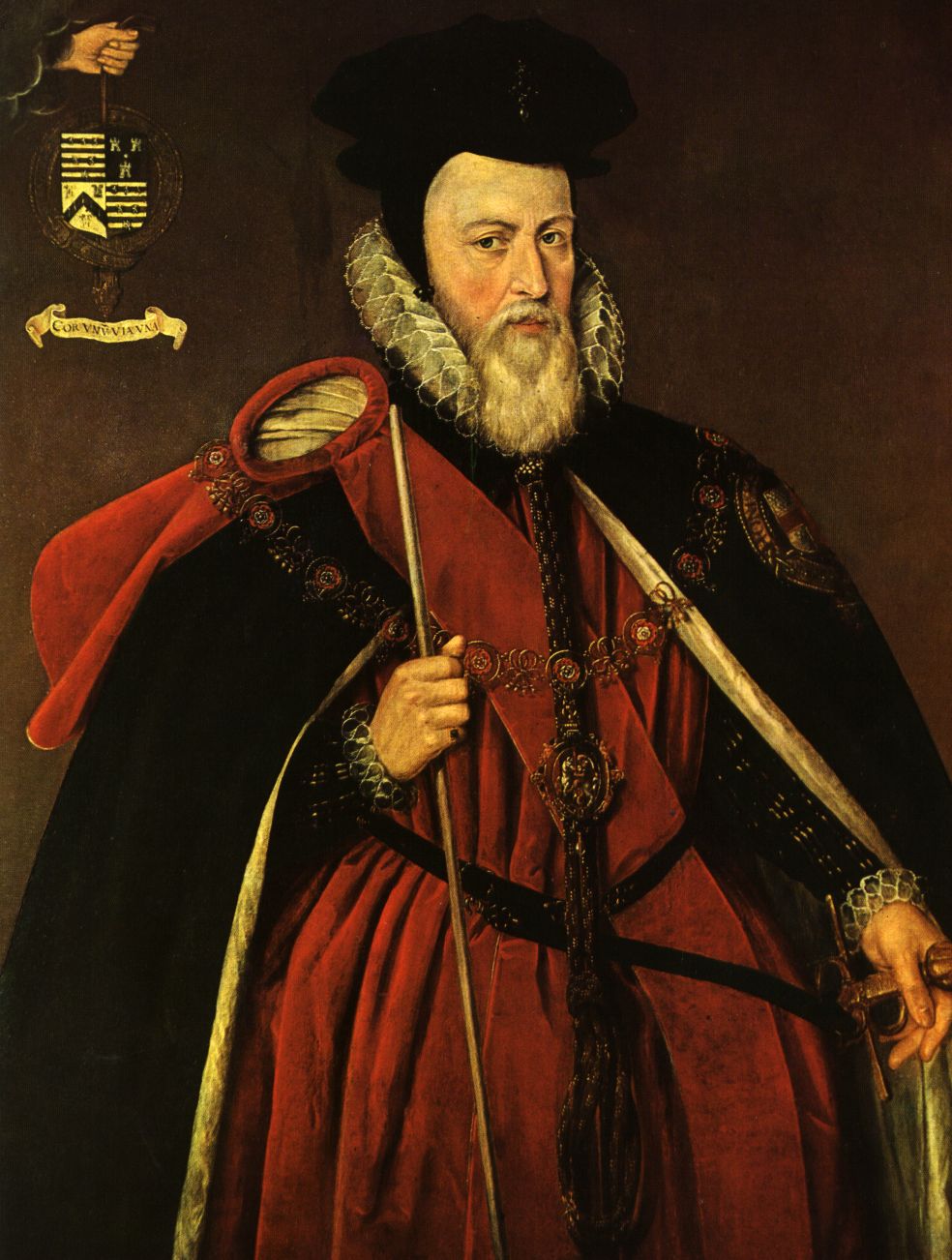
William Cecil, Lord Burghley, who was Queen Elizabeth's chief advisor and Lord Treasurer was well known by the Queen to have Puritan leanings. He took issue with the rigidness of belief to which Elizabeth's bishops were expected to subscribe, and in 1584 he wrote to Elizabeth I's 'model' bishop John Whitgift, who was Archbishop of Canterbury from 1583-1603. Burghley did not wish to see the Puritan clergy compelled to leave the church due to the 3 Articles of Faith they were required to uphold.  In Burghley's letter to Archbishop Whitgift, he said,

"...But I conclude according to my simple judgement, this kind of proceeding is too much savouring of the Romish Inquisition, and is rather a device to seek for offenders than to reform any." (Quoted in Statutes and Constitutional Documents 1558-1625, G.W. Prothero, Oxford University Press 1894.)

Those with Puritan convictions like Burghley found it difficult to swear that the Book of Common Prayer contained nothing in contradiction to the actual Word of God. Whitgift responded to Burghley's concerns saying that  the Church previous to Elizabeth had been suffering from a "lack of discipline" and that the structure the Elizabethan Church Settlement was providing would hold clergy to a higher standard (Palmer, 32).

William Cecil, Lord Burghley (1520-1598), depicted in the robes of the Order of the Garter. Elizabeth made Cecil her chief Secretary of State in 1558. He was styled Lord Burghley in 1571, and in 1572 he was made Lord Treasurer, which was the position he held until his death. Elizabeth called this man who was her chief minister for 40 years her "spirit". Picture acquired through Wikimedia Commons. Image public domain.
 At all costs, Elizabeth wished to keep the peace; she really had no interest in rocking the boat on either side; this disappointed the extremist Catholics who were looking for a clear offense that they could use as cause to rise up against her, but it also disappointed  the Puritans and Presbyterians who had hoped that she would be the figurehead for a stricter Protestant church.  

Elizabeth I's Bishop's Bible from 1568. In the collection of the Folger Shakespeare Library. Picture acquired through Wikimedia Commons. Image public domain.

Elizabeth professed that she "wished not to open window's into men's souls", and she expected the same courtesy that she extended to her own subjects to be afforded to her as well. This is perhaps why the details of her own religious convictions remain somewhat of a mystery. Still, no one should doubt that Elizabeth herself was indeed religious; she had studied the Bible and other ancient texts of religion for many years, and she often professed how she believed God had preserved and guided her through the many trials and tribulations of her life to be crowned Queen of England. 

The frontispiece of Queen Elizabeth's prayerbook, showing her kneeling in reverence and prayer. Picture acquired through Wikimedia Commons. Image public domain.

William Camden (1551-1623) lived through Queen Elizabeth's reign, and as her contemporary he had access to original material (Palmer, 29).  He published his Annals of Queen Elizabeth in Latin in 1615, and he made a point to comment on the Queen's religious habits,

"(Queen Elizabeth was)...truly religious, who every day, as soon as she arose, spent sometime in prayers to God and afterwards also at set times in her Private Chapel; every Sunday and Holy day she went into her chapel ; neither was there ever any other prince present at God's service with greater devotion. The sermons in Lent attentively she heard being all in black, after the manner of old although she many times said that she had rather talk with God devoutly by prayer than hear others speak eloquently of God."

The frontispiece and title page of the 1675 edition of William Camden's Annals of Queen Elizabeth. Picture acquired through Wikimedia Commons. Image public domain.

This observation from Camden, published in the reign of Elizabeth's successor James I, shows that while Elizabeth gave nods to the Catholic way of worship (Attending church during Lent season in all black) she still professed and practiced perhaps the most important concept of Protestantism: the ability to converse directly with God rather than rely on the interpretation or intercession of the clergy to communicate with and understand God and His will.

While Queen Elizabeth adopted an extremely moderate religious policy that brought stability to her realm, it should be emphasized that extremism on either side was considered politically dangerous. Zealous Catholics as well as Puritans and Presbyterians were monitored and sometimes severely punished if they threatened the safety of Queen Elizabeth and her realm, or if their prophesying caused civil unrest.

Puritans took issue with Elizabeth's policy not continuing the work of her late brother Edward VI's regime. The Puritan's has hoped that Elizabeth Tudor would completely reform the Church of England, and rid it of  all vestments, icons, Latin verses and other trappings of the Catholic faith. While services continued to include Latin hymns and incense, Queen Elizabeth did promote the Protestant reform of raising the qualifications of the clergy: Elizabeth's bishops were supposed to be well-educated and Bible-literate; still, Elizabeth always remained wary that any religious study group could develop into cells of Presbyterian doctrine.

Detail of the allegorical work Edward VI and the Pope. Picture acquired through Wikimedia Commons. Image public domain.
Presbyterians, another Christian sect, were the biggest Protestant threat to the peace of Elizabeth's realm, since their rejection of the entire ecclesiastical hierarchy of bishops by implication took issue with the institution of royal supremacy (Palmer, 28).

Some ardent Catholics also gave Queen Elizabeth and her government reason to be cautious. A small number of Catholics in England welcomed militant Catholic priests and assassins from abroad who aimed to attack Queen Elizabeth with the blessing of the pope. When Elizabeth was excommunicated from the Roman Catholic faith (which she had never once been a part of), it was declared by the Bishop of Rome that anyone who saw the "English Jezebel" killed would not be committing murder but instead would be doing God's will, and would be welcomed into Paradise. Elizabeth's network of spy's and informants, led by her spymaster Sir Francis Walsingham, monitored the lives of  individuals associated with this Catholic movement closely.

Detail of a portrait of Sir Franics Walsingham (1536-1589). Walsingham succeeded Burghley as Secretary of State in 1573. He acted as Ambassador to Scotland, France and the Netherlands, while acting as Queen Elizabeth I's "spymaster". It was Walsingham's network that uncovered the Mary, the so-called Queen of Scot's treachery and the Babington Plot. Picture acquired through Wikimedia Commons. Image public domain.

Queen Elizabeth had watched from afar with great concern the religious wars which were tearing apart the kingdom's on the Continent. When she became Queen she wisely decided to occupy herself with healing the religious tension in England as best as she could in order to prevent her nation from befalling a similar fate. While some Protestants and some Catholics took issue with aspects of Elizabeth's religious policy, most found it to be remarkably tolerable. If we compare Elizabeth's decisions pertaining to religion to those of her predecessors, contemporaries, and even her successor, it is very clear that her policy was the least oppressive. Queen Elizabeth really did make a conscience effort to appease the majority of her subjects by permitting them their religious convictions, so long as they remained loyal subjects. The Elizabethan Church Settlement would be one of the many ways in which Queen Elizabeth would improve the lives of her people.

Queen Elizabeth captured the matter of Christianity best when she said, "There is but one God, one Jesus Christ; all else is dispute over trifles."


The Great Seal of Queen Elizabeth I, from 1586. Designed by Nicholas Hilliard. Picture acquired through Wikimedia Commons. Image public domain.
Sources:

Palmer, Michael. Reputations: Elizabeth I. Bath Press, 1988. Print.

Prothero, G.W. Statutes and Constitutional Documents 1558-1625. Oxford University Press, 1894. Print.

Camden, William. The Annals of Queen Elizabeth. London, 1615. Electronic.

Thursday, March 1, 2012

Bess and Bradstreet: A 17th Century Woman's Poetic Tribute to Elizabeth I

As an American, it is hard to find direct ties between Elizabeth and the "New World". Of course, there are the obvious connections, like Elizabethan exploration, Virginia/Roanoke, and the experimental settlement of her successor, Jamestown. But other than than that there are very few! But upon casting my net a little wider, I can recover a whole tradition of literary tributes and allusions to England's most famous monarch.

Today I want to share with you a poem that I first came across when I was studying literature in college. The poem is a tribute to Queen Elizabeth I and her legacy by a British woman, Anne Bradstreet, who settled in New England in 1630. Anne was born Anne Dudley, but she became a Bradstreet when she married Simon Bradstreet at the age of 16 in 1628. Simon was a Cambridge graduate who was nine years her senior. Both the Dudley's and the Bradstreet's were Puritans who journeyed to America for religious freedom. Anne became a prolific writer in her new country. She chronicled spiritual struggles, the tragic deaths of her children, and wrote about her love for her husband while surviving harsh weather, famine, and the destruction of her home by fire. 

A depiction of Anne Bradstreet at her writing desk. Picture acquired through Wikimedia Commons. Image public domain.

In 1650, Anne wrote a poem to honor Queen Elizabeth I, whose reign would have been in the recent memory of her parents and grandparents. Undoubtedly, Anne had listened to stories as a child portraying Queen Elizabeth as the utmost example of Christian learning and piety; however, it is somewhat ironic that any Puritan would sing such high praises of the Protestant queen,  since Elizabeth herself was always wary of extremism on either side of the religious spectrum, be it the fervent Catholics or the strict Puritans.

Without further ado, I share with you Bradstreet's tributary poem, an homage from one strong Protestant woman to another. Bradstreet writes in the traditional style of verse, and also includes many classical allusions. Amidst the formality of the structure, I feel Bradstreet is able to convey a genuine feeling of admiration and affection for Queen Elizabeth, whose achievements she calls on all to recognize. The explanations in italicized parenthesis are my own, to provide greater clarity.

The Rainbow Portrait of  Queen Elizabeth I, attributed to both Isaac Oliver and Marcus Gheeraerts, c. 1600-1602. Inscribed on the left-hand side of the portrait is the Latin phrase NON SINE SOLE/IRIS, or "No Rainbow without the Sun". The sun, of course, is Queen Elizabeth herself, while the rainbow is the hope and peace she has brought to her realm. On her fabric of her dress are symbolic eyes, ears and mouths, to convey that this queen is all-knowing and all-powerful. Interestingly, Elizabeth would nick-name members of her Privy-council and her friends, and some of them where called after body parts. For instance, Elizabeth was known to call the Earl of Leicester her "eyes". This painting is one of my personal favorites of the queen, and it is also the perfect example of the Queen controlling how her image was portrayed; by royal decree, she must always appear youthful, even immortal, so as to deter talk of  her declining health and the succession. The portrait is now on display in Hatfield House. Picture acquired through Wikimedia Commons. Image public domain.

In Honor of That High and Mighty Princess Queen Elizabeth of Happy Memory

The Proem (a brief introductory verse)

Although, great Queen, thou now in silence lie
Yet thy loud herald Fame doth to the sky
Thy wondrous worth proclaim in every clime,
And so hath vowed while there is world or time.
So great's thy glory and thine excellence,
The sound thereof rapts (holds the complete attention of) every human sense,
That men account it no impiety
To say thou wert a fleshly deity.
Thousands bring offerings (though out of date)
Thy world of honors to accumulate;
'Mongst hundred hecatombs (Honorary tributes) of roaring verse
Mine bleating stands before thy royal hearse
Thou never didst nor canst thou now disdain
T'accept the tribute of a loyal brain.
Thy clemency did erst esteem as much
The acclamations of the poor as rich,
Which makes me deem my rudeness is no wrong,
Though I resound thy praises 'mongst the throng.

The Poem

No Phoenix pen, nor Spenser's poetry,  (Edmund Spenser 1552-1599, author of The Faerie Queen)
No Speed's nor Camden's learned history,  (John Speed 1542-1629, Wm.Camden 1551-1623; English historians)
Eliza's works, wars, praise, can e'er compact (summarize) ;
The world's the theatre where she did act.
No memories nor volumes can contain
The 'leven Olympiads of her happy reign, (the 4-yr period between Olympic games; thus asserting correctly that Elizabeth ruled for 44 yrs.)
Who was so good, so just, so learned, so wise,
From all kings on earth she won the prize.
Nor say I more than duly is her due,
Millions will testify that this is true.
She hath wiped off th' aspersion of her sex,
That women wisdom lack to play the rex (Latin for 'king')
Spain's monarch says not so, nor yet his host (Philip II and his army; Elizabeth's Navy defeated his Spanish Armada)
She taught them better manners, to their cost.
The Salic law (ancient law used in France and Spain to forbid women to inherit land, thus preventing them to rule in their own right) in force now had not been,
If France had ever hoped for such a queen.
But can you, doctors (scholars), now this point dispute.
She's argument enough to make you mute.
Since first the Sun did run his ne'er run race,
And earth had, once a year, a new old face,
Since time was time, and unmanly man,
Come show me such a phoenix if you can.
Was ever people better ruled than hers?
Was ever land more happy freed from stirs (conflict and war)
Did ever wealth in England more abound?
Her victories in foreign coasts resound;
Ships more invincible than Spain's, her foe,
She wracked, she sacked, she sunk his Armado;
Her stately troops advanced to Lisbon's wall,
Don Anthony1 in's right there to install.
She frankly helped Frank's brave distress'ed king2; (The references are to 1. Philip's unsuccessful rival to the throne of Portugal, supported by England & France 2. Henri IV, who came to the French throne in 1589 & was aided with money & arms by Elizabeth to fight Catholic rebels backed by Spain.)
The states united now her fame do sing.
She their protectrix was; they well do know
Unto our dreaded virago, what they owe,
Her nobles sacrificed their noble blood,
Nor men nor coin she spared to do them good.
The rude untam'ed Irish she did quell;
Before her picture the proud Tyrone fell (The Earl of Tyrone, assisted by Spain to lead the Irish in rebellion against English rule; defeated at Kinsale).
Had ever prince such counsellors as she?
Herself Minerva caused them so to be (Minerva is the Roman name for the goddess Athena, who was goddess of wisdom, war, and crafts).
Such captains and such soldiers never seen,
As were the subjects of our Pallas queen (a prefix for Athena).
Her seamen though all straits the world did round;
Terra incognita (Latin for 'unknown land') might know the sound.
Her Drake1 came laden home with Spanish gold;
Her Essex2 took Cadiz, their Hurculean hold (1.Francis Drake, English admiral, explorer and privateer 1540-1596. 2. reference to Robert Devereux Earl of Essex).
But time would fail me, so my tongue would too,
To tell of half she did, or she could do.
Semiramis to her is but obscure, (reference to the Semi-legendary Assyrian warrior-queen)
More infamy than fame she did procure.
She build her glory but on Babel's walls,
World's wonder for a while, but yet it falls.
Fierce Tomris (Cyrus' headsman) Scythian's queen, (Tomyris, Scythian warrior who beheaded Cyrus, the founder of the Persian Empire, on the battlefield. Scythians, like the Celts, did not consider it unnatural for women to fight. It has been suggested that the Scythina women-warriors inspired the legends of the Amazons.)
Had put her harness off, had she but seen
Our Amazon in th' Camp of Tilbury, (Site of Elizabeth's famous address to her troops on the eve of the invasion of the Spanish Armada.)
Judging all valor and all majesty
Within that princess to have residence,
And prostrate yielded to her excellence,
Dido1, first foundress of proud Carthage walls
(Who living consummates her funerals), (1. Queen of Carthage; upon her abandonment by her lover Aeneas, Dido threw herself onto her own funeral pyre in despair.)
A great Eliza, but compared with ours,
How vanisheth her glory, wealth, and powers.
Profuse, proud Cleopatra, whose wrong name,
Instead of glory, proved her country's shame, (Cleopatra's reputation has since been vindicated)
Of her what worth in stories to be seen,
But that she was a rich Egyptian queen.
Zenobya, potent empress of the East, (Zenobia, Queen of Palmyra, an ancient city in Syria from 267-72 A.D. Resisted Rome and was taken prisoner by Emperor Aurelian's troops.)
And of all these without compare the best,
Whom none but great Aurelius could quell;
Yet for our Queen is no fit parallel.
She was a phoenix queen, so shall she be,
Her ashes not revived, more phoenix she.
Her personal perfections, who would tell
Must dip his pen in th' Heleconian well, (Well found on the Greek mountain of poetic inspiration, Helicon.)
Which I may not; my pride doth but aspire
To read what others write and so admire.
Now say,
have women worth? or have they none?
Or had they some, but with our Queen is't gone?
Nay masculines, you have thus taxed us long,
But she, though dead, will vindicate our wrong.
Let such as say our sex is void of reason
Know 'tis a slander now but once was treason.
But happy England which had such a queen;
Yea, happy, happy had those days still been.
But happiness lies in the higher sphere,
Then wonder not Eliza moves not here.
Full fraught with honor, riches and with days
She set, she set, like Titan in his rays.
No more shall rise or set so glorious sun
Until the heaven's great revolution (the Day of Judgement),
If then new things their old forms shall retain,
Eliza shall rule Albion (the ancient name for Britain) once again.

Her Epitaph

Here sleeps the queen, this is the royal bed
Of th'damask rose, sprung from the white and red (a reference to the 'Tudor rose' emblem, combining the white and red roses of the York and Lancastrian dynasties upon the peace-bringing marriage of Henry VII and Elizabeth of York after the War of the Roses),
Whose sweet perfume fills the all-filling air.
This rose is withered, once so lovely fair.
On neither tree did grow such rose before,
The greater was our gain, our loss the more.

Another (An alternate epitaph)

Here lies the pride of queens, pattern of kings,
So blaze it, Fame, here's feathers for thy wings
Here lies the envied, yet unparalleled prince,
Whose living virtues speak (though dead long since),
If many worlds, as that fantastic framed, (this may be a reference to Copernicus, who challenged the theory that the heavens revolved around the earth, instead declaring that the planets revolved around the sun.)
In every one be her great glory famed.

I think Elizabeth would approve, don't you? 
What epitaph do you think
Did you have a favorite part of the poem?
I look forward to hearing your opinions!