Showing posts with label Christopher Marlowe. Show all posts

Thursday, February 28, 2013

Theatre Thursday: Shakespeare, Marlowe and "Dueling Divas"

A portrait of a young man, generally thought to be the Elizabethan playwright Christopher Marlowe. Picture acquired through Wikimedia Commons. Image public domain.

For this Theatre Thursday, I bring you links to articles from around the web concerning Elizabethan Theatre and Elizabethan figures in theatre:

Shakespeare For The "Elizabethan Impaired" Offered At The English Rose

Dueling Divas in Donizetti's 'Maria Stuarda' 

The Baptism of Marlowe (Feb 26th)


Thursday, November 8, 2012

Theatre Thursday: Upcoming Lecture on the Bad Boys of Elizabethan Theatre

Dr. Andy Kesson, a writer, teacher, occasional director & historian at the University of Kent & The Globe Theatre, alerted me to his upcoming lecture at the Globe on December 10th at 6 pm. The lecture will be nothing short of exciting, since Dr. Kesson will be discussing the "bad boys" of Elizabethan theatre! 

A 16th century portrait of a man, likely the playwright Christopher Marlowe, who is one of the more famous "bad boys" of Elizabethan theatre. Picture acquired through Wikimedia Commons. Image public domain.

Dr. Kesson's work on John Lyly and Early Modern Authorship & The Elizabethan Top Ten will be available to the public in 2013.

There are also other educational lectures and seminars to look forward to at The Globe this holiday season; if you are in the London area, you should certainly check them out!

A photo of the reconstructed Globe Theatre along the Thames in London. Picture acquired through Wikimedia Commons. Image public domain.

Thursday, June 7, 2012

Theatre Thursday: A-List Elizabethan Actor Edward Alleyn

A 17th century portrait of actor Edward Alleyn in old age. Picture acquired through Wikimedia Commons. Image public domain.

One of the most popular stage actors of the Elizabethan era, and for a short time, the Stuart era, was Edward Alleyn (1566-1626). In addition to the praise he earned as a tragedian actor who defined and popularized the roles of Christopher Marlowe's Tamburlaine and Dr. Faustus, as well as Thomas Kyd's Hieronimo, Alleyn was also a business man. After great success as an actor, Alleyn became a shareholder in several successful London theatre's in his final years.

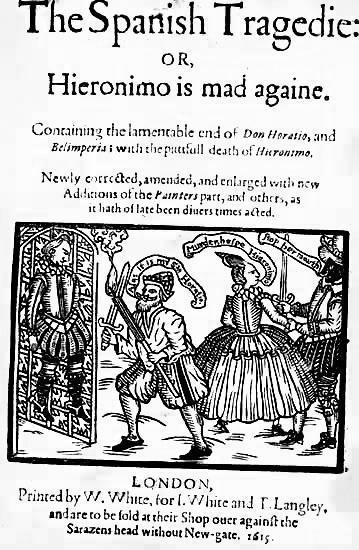
The frontispiece from Thomas Kyd's The Spanish Tragedy. Alleyn's performance of Hieronimo in The Spanish Tragedy  made the character an iconic one. Picture acquired through Wikimedia Commons. Image public domain.

Born and raised in London, Alleyn had absorbed the bustling, dramatic world of 16th century London since youth. Unsurprisingly he was magnetically drawn to the stage. Alleyn first took to the stage in the 1580's, and going professional as part of the company Worcester's Men in 1583. By 1589 he was part of the prestigious Admiral's Men. Alleyn was the lead actor of the Admiral's Men in their many productions at the Rose Theatre.

A detail from a portrait of Queen Elizabeth's maternal cousin and a hero of the defeat of the Spanish Armada, Lord High Admiral Charles Howard. Alleyn was a part of Howard's successful theatre company the Admiral's Men. Picture acquired through Wikimedia Commons. Image public domain.

By 1592, Alleyn was co-running the Rose, as well as several bear garden's (see Mabeth, Merry Wives, and the Business of Bear-baiting for information on Elizabethan bear-baiting and Alleyn's involvement in the business). By 1597 he had retired, but in 1600 he returned to the stage per the request of Queen Elizabeth I who admired and missed his talent. He performed in the New Fortune Theatre that he and his longtime business partner Philip Henslowe had built. Alleyn had married Henslowe's stepdaughter Joan Woodward in 1592.

A portrait of Joan Alleyn from 1596. Picture acquired through Wikimedia Commons. Image public domain.

Primary documents tell us that Alleyn and his wife were very close; whether they had fallen in love before they married or after is irrelevant. When plague broke out in London in the spring of 1593, Alleyn and his fellow actors were forced to tour the countryside for work (Mabillard). When he was working in Chelmsford, he wrote home to his wife the following letter:

My good sweetheart and loving mouse, I send thee a thousand commendations, wishing thee as well as may be, and hoping thou art in good health, which I pray God to continue with us in the country, and with you in London. But mouse, I little thought to hear that which I now hear by you, for it is well known they say that you were by my Lord Mayor's officer made to ride in a cart, you and all your fellows, which I am sorry to know; but you may thank your two supporters, your strong legs I mean, that would not carry you away, but let you fall into the hands of such termagants. But mouse, when I come home I'll be revenged on them; till when, I prithee send me word how thou dost, and do my hearty commendations to my father, mother, and sister, and to thy own self; and so, sweetheart, the Lord bless thee. From Chelmsford, the 2nd May, 1593. Thine ever and nobody else's, by God of Heaven - Edward.

 We can deduce from the letter that Joan was somehow involved with "the fellows" -- those "Admiral's Men who remained in London and had infringed the order prohibiting playing" (Hosking, 50). Though Joan could never have legally acted on stage, she appears to have occasionally traveled with the group and perhaps assisted with their business.

By the time of Joan's death in 1623 the couple had had no children. Since the couple's marriage was by all accounts a happy one, and since Alleyn and his second, much younger wife would also have no children, it is possible Alleyn and his wives suffered from fertility issues.

Interestingly, Alleyn would take for his second wife one of the daughter's of celebrated poet John Donne, who was then Dean of St. Paul's Cathedral in London. Constance Donne was an old acquaintance of Alleyn, and they also seem to have fallen in love rather quickly, since they married within months of Joan's death. Edward was 58, Constance was 20 (Mabillard).

A map c.1560 of the bear and bull-baiting rings along the Thames in Elizabethan London. Picture acquired through Wikimedia Commons. Image public domain.

Alleyn retired again, this time in 1604 after taking part in the coronation procession of James I of England. Alleyn may have left the theatre, but as is the case with many great actors, the theatre never left him; Alleyn became a generous patron of the English theatre scene in London until 1626 when he died. Alleyn may not have left behind any children, but he did leave behind a theatrical legacy that endures to this day.

Sources:

"Alleyn, Edward." The Historical Dictionary of the Elizabethan World. Print. (By John A. Wagner.)

Mabillard, Amanda. The Life of Shakespearean Actor Edward Alleyn Shakespeare Online. 20 Aug. 2001. < http://www.shakespeare-online.com/biography/edwardalleyn.html >.
 
Hosking, G. L. The Life and Times of Edward Alleyn. London: Jonathan Cape, 1952.

Thursday, April 12, 2012

Theatre Thursday: The Mysterious Marlowe and His Works

This anonymous portrait that hangs in Corpus Christi College, Cambridge, is allegedly of Elizabethan playwrite Christopher Marlowe. The painting was completed c. 1585, when Marlowe was 21 years old. He was the only 21 year old student at Cambridge that year; the painting itself was discovered on Cambridge grounds. This painting graces the cover of almost every major Christopher Marlowe biography. Picture acquired through Wikimedia Commons. Image public domain.


Christopher Marlowe's (1564-1593) first play, Tamburlaine The Great tells the story of Timur, a 14th century Turkish warlord. Marlowe portrays the historic figure, "threatening the world with high astounding terms, and scourging kingdoms with his conquering sword." The play was first performed in 1587 by The Admiral's Men, the theatre company of Charles Howard, 1st Earl of Nottingham, Lord High Admiral and maternal relation of Queen Elizabeth I. Tamburlaine was an immediate success, due to the writing, but equally because of the exotic setting. Marlowe, the son of a Canterbury shoemaker, moved to London in time to see it put to the stage (Wagner, 194).


A detail of a portrait of Charles Howard, Lord High Admiral under Elizabeth I. Howard is depicted wearing his robes for The Order of the Garter. Picture acquired through Wikimedia Commons. Image public domain.


Marlowe's literary contributions, like the man himself, were dark, psychological, and pushed the boundaries of societal expectations and propriety in Elizabethan London. He was charged with atheism, and widely suspected to be a spy before he was killed in a bar brawl (though some conspiracy theorists have called it murder, or a way for Marlowe to stage his own death and then disappear). We know that Marlowe's literary patron was Thomas Walsingham, brother to Queen Elizabeth I's spymaster Francis Walsingham, and that Francis and Christopher were well acquainted, which could have led to his employment as a spy or informant (Wagner, 194). Had he lived in the 17th century, and more specifically under the reign of King Charles II, Marlowe's material and his character would have been far less shocking to the sensibilities of the theatre-goers of London.


A detail of a portrait of Sir Francis Walsingham, Elizabeth I's spymaster and a likely acquaintance of Marlowe.


Marlowe's most famous work is The Tragicall History of the Life and Death of Dr. Faustus. According to Logan and Smith, "no Elizabethan play outside the Shakespeare canon has raised more controversy than Doctor Faustus. "(Wagner, 14).  In the play, Doctor Faustus learns necromancy from two magicians. In a thirst for knowledge and power, Faustus summons a devil named Mephistopheles, and sells his soul to Lucifer in exchange for 24 years of Mephistopheles doing his bidding on earth. Even if you have not read Doctor Faustus yourself, you can already surmise that no good can come of such an arrangement.

Doctor Faustus was first published in 1604, eleven years after Marlowe's death, but it had been staged much earlier; The Admiral's Men performed it twenty-five times in three years, between October  of 1594 and October of 1597. It was probably revived again in 1602 (Chambers, Vol. 3, pages 423-424).

Today I would like to leave you with a dark, twisted visual from Marlowe's play, and thus his mind. This line is spoken by an 'evil angel' (one of Lucifer's followers) :

Now Faustus, let thine eyes with horror stare
Into that vast perpetual torture-house,
There are the furies tossing damned souls
On burning forks. Their bodies broil in lead.

A cautionary tale about faith by a suspected atheist? An example of the psyche of the author? I will let you decide!

Sources:

Wagner, John A. The Historical Dictionary of the Elizabethan World. Print.

(pages 194-195)

Chambers, E.K. The Elizabethan Stage, 4 Volumes. Oxford: Clarendon Press, 1923. Print.

Logan, P. Terence, Smith S. Denzell. The Predecessors of Shakespeare: A Survey and Bibliography of Recent Studies in English Renaissance Drama. University of Nebraska Press, 1973. Print.

For further reading on Christopher Marlowe:

Christopher Marlowe: His Life and Work by A. L. Rowse
Christopher Marlowe and Edward Alleyn by Adam Hart.