Showing posts with label Elizabethan Fact of the Day. Show all posts

Tuesday, December 17, 2013

Elizabethan Fact of the Day: Charles Howard is Promoted

A full-length portrait of Charles Howard, Lord High Admiral of England. By Daniel Mijtens, circa 1620. Royal Museums, Greenwich. Picture acquired through Wikimedia Commons. Image public domain.


In 1587, Queen Elizabeth I appointed her maternal cousin Charles Howard to the position of Lord High Admiral, head of the English naval forces. The appointment was due to her anticipation of an invasion from Spain, which would indeed come in 1588.

Wednesday, March 13, 2013

Elizabethan Fact of the Day: Mendoza is Dismissed from Court

An engraving of Bernardino de Mendoza, c. 1595. By an artist from the Spanish School. Image public domain.

In 1583, Queen Elizabeth I hosted her last Spanish Ambassador. When it became known to Elizabeth's intelligence network that Bernardino de Mendoza was conspiring with the Jesuits and negotiating with the French on Philip II of Spain's behalf, he was ordered to leave England. Mendoza was told that his dismissal due to his involvement in the Throckmorton Plot "disturbed the realm of England". Directly before his departure, Mendoza ordered the English officials seeing him off to go and, "tell your mistress that Bernardino de Mendoza was born not to disturb kingdoms, but to conquer them."

This threat was never to materialize, however; all of Mendoza's secret plots came to nothing, a few years later, as the Spanish invasion of England failed when Queen Elizabeth I and her navy defeated Philip II's Armada in 1588.

A 16th century painting of the Spanish Armada and the English Navy. By an artist from the English School. Picture acquired through Wikimedia Commons. Image public domain.

Mendoza was involved in at least two plots against Queen Elizabeth I; to learn more about the Babington Plot, which was supported by de Mendoza, please view our article.

Sunday, March 10, 2013

Elizabethan Fact of the Day: Soldiers Bring Back Plague to England

An engraving of Ambrose Dudley, the Earl of Warwick. Picture acquired through Wikimedia Commons. Image public domain.

In March of 1563, the soldiers of Ambrose Dudley, the Earl of Warwick brought plague back to England upon their return from France. 

To read more about the Earl of Warwick's role in siege of Le Havre, and to discover Queen Elizabeth's role in negotiating the Treaty of Troyes, view our article.

Monday, February 11, 2013

Elizabethan Fact of the Day: The Earl of Leicester's Clothing

A portrait of the Earl of Leicester by an unknown artist, circa 1575-80. Picture acquired through Wikimedia Commons. Image public domain.

Among his many other possessions, two cloaks and seven doublets belonging to the Earl of Leicester were appraised upon his death by the executors of his estate in 1588. These items of clothing were valued at a total of 545 pounds!

Monday, February 4, 2013

Elizabethan Fact of the Day: The 39 Articles of Faith

The frontispiece for the 1569 Bishop's Bible, drawn by an unknown artist. Picture acquired through Wikimedia Commons. Image public domain.

In February of 1563, the "39 Articles of Faith", the doctrinal foundation of the present-day Anglican Church, were finally agreed upon.

To learn more about religious policy in England under Queen Elizabeth I, please see our article here.

Elizabeth I's Bishop's Bible. Folger Shakespeare Library. Image public domain.

Friday, December 21, 2012

Elizabethan Fact of the Day: Ice Skating on the Thames

"Frost Fair on the Thames", from The Elizabethan People, Henry Thew Stephenson. Picture acquired through Wikimedia Commons. Image public domain.

In the winter of 1564, the River Thames became frozen solid. The people of Elizabethan London took advantage of this rare, exciting occurrence and ice skated across the river.

"River Thames with the Docks from Woolwich to the Tower", from A Dictionary Practical, Theoretical, and Historical of Commerce and Commercial Navigation by J.R. M'Culloch, 1882. Picture acquired through Wikimedia Commons. Image public domain.

Sunday, November 18, 2012

Elizabethan Fact of the Day: Queen Elizabeth's Former Jailor Grovels for Forgiveness

Directly before and immediately after Elizabeth Tudor's accession to the throne of England on November 17th, 1559, well-wishers and fortune seekers came to court the new Queen; everyone aspired to earn a place in her household or her government. Sir Henry Bedingfield, the man whom Queen Mary I had appointed as Elizabeth's jailor in the Tower of London and at Woodstock from 1554-55, hurried to present himself to Elizabeth I to ask for her forgiveness. Bedingfield had been a particularly cruel and calculating keeper (though this has been contested by Marian apologists), and Elizabeth had come to believe that Bedingfield had been ordered by her own sister to find a way to quietly dispose of her. 

A portrait of Queen Mary I by Hans Eworth, 1554. Picture acquired through Wikimedia Commons. Image public domain.

There were other alleged Marian plots to murder Elizabeth; it was suspected that both Stephen Gardiner, Mary's Lord Chancellor, and the Spanish ambassador, Simon Renard, had sent assassins to kill Elizabeth. The plots were thwarted only because Bedingfield had instituted a strict policy that no one be allowed to visit the Princess Elizabeth without him being present. Bedingfield transported Elizabeth to Woodstock, and then to court, in June of 1555.

A 16th century portrait of Bishop Stephen Gardiner, who served as Queen Mary's Lord Chancellor. Picture acquired through Wikimedia Commons. Image public domain.


Several years later, it was Elizabeth who had the upper-hand over Sir Henry Bedingfield; she dismissed her grovelling former jailor, saying, "If we have any prisoner whom we would have sharply and straightly kept, we will send for you!"

A detail of a 16th century portrait of Sir Henry Bedingfield. Picture acquired through Glenn-cook.com. Image public domain.

Bedingfield lived out the rest of his days away from court politics in Norfolk, but occasionally he resurfaced in the records as a Catholic recusant.

Thursday, November 1, 2012

Elizabethan Fact of the Day: Queen Elizabeth is Insulted by Count de Feria

When Queen Mary I lay dying, her husband, Philip II of Spain, had no intention of losing England for Catholic Europe, so he began entertaining the idea of persuading Elizabeth Tudor to marry him. Philip had long understood the importance of keeping Elizabeth alive, in the likely event that his sickly wife died before him. In fact, Philip deserves some credit for softening his wife's resolve against her sister. Mary could refuse Philip nothing, even when it pertained to Elizabeth, so when Mary was contemplating executing her sister, Philip interceded on her behalf, and Mary obliged. Had Mary been aware of her husband's ulterior motives, she may not have been so compliant.

A cameo profile portrait of King Philip II and Queen Mary I. Picture acquired through Wikimedia Commons. Image public domain.

Philip could never have predicted that the younger daughter of Henry VIII would not be as charmed by him as the elder had. Where Mary had fallen passionately in love with the idea of Philip before their wedding day, Elizabeth had had the benefit of observing Philip up close, and had been able to develop an informed opinion. In addition to being an emotionally distant husband to an icredibly doting wife, Philip had brought the inquisition to England, which had caused the English people great suffering. He and Mary had also used and abused England's treasury and resources to fund foreign wars. Elizabeth had witnessed nothing to recommend King Philip II of Spain to her.

A woodcut of the burning of Latimer and Ridley, from Foxe's Booke of Martyrs. Picture acquired through Wikimedia Commons. Image public domain.

Historical evidence suggests that long before her ascension to the throne in 1558, Elizabeth had already made the conscience decision to never become subservient to any man. King Philip had no experience with women like Elizabeth, though few at this time did. Over-estimating his powers of persuasion with the heir apparent, he sent the Count de Feria to give his congratulations to his sister-in-law on her impending reign, and to express his hopes for a continued Anglo-Hapsburg alliance.

A portrait detail of King Philip II, circa 1555. After Titian. Picture acquired through Wikimedia Commons. Image public domain.

When Elizabeth was entertaining well-wishers and fortune-seekers at Hatfield, de Feria was granted an audience on Philip's behalf. Boldly, de Feria told Elizabeth that she owed the attainment of her throne to Philip II, and that she was therefore indebted to him. Elizabeth did not take this inference lightly; very bluntly, Elizabeth told de Feria that it was only to God and her people that she owed her crown. The Count de Feria observed,

“She is much attached to the people… and is very confident that they are all on her side; which is indeed true”. (Neale, 54)

The Count, later Duke de Feria, (who happened to be married to Mary I's dear friend and lady-in-waiting, Jane Dormer), did not hold Queen Elizabeth in high esteem; his cultural background held expectations for women which were in direct conflict with the women in England who had been educated in the humanist philosophy. Both King Philip and de Feria dissaproved of the idea of a woman operating in politics without a man to "guide" her. Perhaps de Feria's thinly veiled contempt for women in authority betrayed him when he was in Elizabeth Tudor's company, as he operated with very little tact. 

The Gripsholm Portrait, most likely of Queen Elizabeth I, circa 1563. Picture acquired through Wikimedia Commons. Image public domain.

In one of de Feria's first reports of Queen Elizabeth to King Philip, he described her as,

"...sharp, without prudence. She is a very vain and clever woman. She must have been thoroughly schooled in the manner in which her father conducted his affairs. She is determined to be governed by no one."

How accurate de Feria's assessment would prove to be, as Queen Elizabeth I would competently rule alone for over 40 years.

Source

Neale, J.E. Queen Elizabeth I. Chicago: Academy Chicago Publishers, 2001. Print.

Monday, September 3, 2012

Elizabethan Fact of the Day: John Dee's Home Set on Fire

A 16th century portrait of John Dee in the Ashmoleon Museum collection, Oxford University. According to Charlotte Fell Smith, this portrait was painted when Dee was 67 years of age. Picture acquired through Wikimedia Commons. Image public domain.

In September of 1583, a mob set fire to Master John Dee's home in opposition to his academic pursuits, which some deemed as dubious. Dee and his associate Edward Kelley left London in that same year to travel with a Polish nobleman abroad (MacKay). Upon Dee's return to London six years later, he found much of his personal property in his estate of Mortlake ruined or stolen (MacKay). Queen Elizabeth I agreed to help him financially, appointing him Warden of Christ's College, Manchester in 1595, a position he would hold until his death in 1609 (EB).

The Kitchner Portrait of Queen Elizabeth I, circa 1580. Picture acquired through Wikimedia Commons. Image public domain.

John Dee was a complicated man of many interests and talents; he was an astrologer, prophesier, alchemist, navigator, and mathematician. He was also known to dabble in the occult. Dee collected one of the largest libraries in England so that he could study these topics with ease. Although he was mostly a hermetic scholar, preferring to spend his days in relative seclusion consulting angels and demons, Dee was married twice and had eight children. He also formed close bonds with a few fellow scholars, chief among them Edward Kelley. The associates had a falling out shortly after Kelley informed Dee that an angel had told him that they should share their wives (Roberts). 

"John Dee and Edward Kelley, a Magician, in the Act of Invoking the Spirit of a Deceased Person." An engraving by Ames of Bristol, from an 1806 edition of Astrology, A New and Complete Illustration of the Occult Sciences by Ebenezer Sibly. Picture acquired through Wikimedia Commons. Image public domain.

Queen Elizabeth I valued Dee's abilities, often consulting him on matters of astrology (which was deemed a real science in the 16th century) and prophesy. By 1577, Queen Elizabeth and her administration had proven so competent that Dee saw fit to predict the formation of an "incomparable British Empire" encompassing most of the Northern Hemisphere, and conquered and maintained by sea power. Dee's foresight of England as Empire came to pass; the foundations for England as we know it today were indeed established in the Elizabethan era.

Instruments used by John Dee in his academic studies, which sometimes crossed over into the occult. These artifacts reside in the British Museum, London. Picture acquired through Wikimedia Commons. Image public domain.

Dee was also held in high regard by Robert Dudley, the Earl of Leicester, William Cecil, Lord Burghley, Sir Francis Walsingham and other prominent figures at Queen Elizabeth's court.

John Dee's "Seal of God", an intricately carved stone platform to support the "shew-stone", or crystal ball that was used for scrying. British Museum London. Picture acquired through Wikimedia Commons. Image public domain.
Sources

Mackay, Charles. Memoirs of Extraordinary Popular Delusions and the Madness of Crowds. London: Office of the National Illustrated Library. 1852. Print

"John Dee". Encyclopædia Britannica (11th ed. ed.). London: Cambridge University Press. 1911.

Julian Roberts, ed. (2005). "A John Dee Chronology, 1509–1609". Renaissance Man: The Reconstructed Libraries of European Scholars: 1450–1700 Series One: The Books and Manuscripts of John Dee, 1527–1608. Adam Matthew Publications. Retrieved 27 October 2006.

Sunday, September 2, 2012

Elizabethan Fact of the Day: Sir Francis Drake and the Potato

Sir Francis Drake by Marcus Gheeraerts,1591. Drake is shown wearing the Drake Jewel, given to him by Queen Elizabeth I in 1586. Picture acquired through Wikimedia Commons. Image public domain. 
The Drake Jewel, awarded to Sir Francis Drake by Queen Elizabeth I in 1586. The Drake Jewel currently resides in the collection of the Victoria an Albert Museum. Picture acquired through Wikimedia Commons courtesy Aiwok.

The white potato first arrived in England in 1586, when it was brought over from the America's by Sir Francis Drake. Drake also brought back Guinea Pigs, which Queen Elizabeth I and her courtiers kept as pets. 

For more on Queen Elizabeth and her Guinea Pigs, click HERE.

Tuesday, July 3, 2012

Elizabethan Fact of the Day: Elizabeth Visits Oxford on Progress in 1566

During Queen Elizabeth I's summer progress in 1566, she chose to visit the University of Oxford. The university and the student's were eager to impress the Queen, who had honored them with her visit. So, they prepared a showcase of Oxford talent, where Queen Elizabeth and her courtiers were entertained with debates and plays. 

Portrait of Queen Elizabeth I, c.1590 that hangs in the Hall of Jesus College, Oxford University. Queen Elizabeth founded the school on June 27th, 1571. Jesus College was the first Protestant college to be founded at the university. Elizabeth originally intended Jesus College to be an academic institution for Anglican clergymen. These men would help to enforce her Elizabethan Religious Settlement (please see my article: Religious Policy under Elizabeth I). Picture acquired through Wikimedia Commons. Image public domain.

Queen Elizabeth supported education in many ways throughout her reign; one of the ways in which she showed her support to higher education was by making frequent visits to universities. Queen Elizabeth even helped to pay for some of her god-children's schooling. This is generous, considering she had more than one-hundred in her lifetime! We know that Elizabeth greatly valued her own education; while she believed God had preserved her through many dangers in order to assume the position of Queen of England, it was Elizabeth's education and intellectual ability that can be largely credited for creating the consummate stateswoman we study to this day. (For an assessment of Elizabeth's political aptitude by scholar Garrett Mattingly, click here.)

One of Queen Elizabeth's godchildren was the writer John Harrington; he attended Eton and King's College, Cambridge. The Queen helped to fund his education. Some of Queen Elizabeth and John Harrington's correspondences have survived, and they were published by his descendent under the title Nugae Antique.

Interestingly, John Harrington holds the prestige of being the inventor of the first flushing toilet in England in 1596. He describes this invention, which he originally installed in his house at Kelston in his work, A New Discourse of a Stale Subject, Called the Metamorphosis of Ajax. He also installed the flushing toilet for his royal godmother at Richmond Palace.  

Sources

Doran, Susan. The Tudor Chronicles 1485-1603. London: Quercus, 2008. Print.

Kinghorn, Jonathan."A Privvie in Perfection: Sir John Harrington's Water Closet." Bath History.

Wednesday, April 25, 2012

Elizabethan Fact of the Day: Queen Elizabeth's Political Aptitude

Elizabeth I in her Parliament Robes, c.1585-1590. Painting formerly attributed to Marcus Gheeraerts the Younger, and is on display in Helmingham Hall, Stowmarket. Picture acquired through Wikimedia Commons. Image public domain.

Today, I want to share an excerpt with my readers from the outstanding book The Armada by the late, great Garrett Mattingly. Mattingly's book details the causes and effects of the cold war with Spain, and the English navy's engagement and eventual defeat of the Spanish Armada. Mattingly has a gift for conveying the character of Queen Elizabeth amidst his chronology of the historical facts. It is apparent in reading Mattingly's work that he had a great admiration for Queen Elizabeth's political mastery, and he found several ways to describe her sensational gift for understanding and manipulating politics; one of these is below:

"Neither the shrewdest of her diplomatic adversaries nor her own intimate counselors ever succeeded in reading the mind of Elizabeth Tudor. No one can pretend to now. She was complete mistress of the politicians art of using words to conceal meaning on public questions and on personal relations she covered sheet after sheet with vigorous scrawl, winding her sentences like an intricate coil of serpents about her secret conclusions, hinting, alluding, promising, denying and at last gliding away from the subject with no more said than served her purpose. In council and in public negotiations she permitted herself at times the frankest outbursts, the most vehement outpourings of personal, apparently unrestrained, and those who knew her best were the least certain that they had netted from the torrent of her words the smallest fragment of her real intentions." (Mattingly, 27)

Elizabeth understood that knowledge of politics and wariness of intrigues was just as essential to governing as possessing a commanding stage presence and utilizing theatrics. She herself asserted this truth when she said,

"We princes were set as it were upon stages in the sight and view of the world."

Sources:

Mattingly, Garrett. The Armada. Mariner Books, 2005. Print.


Tuesday, April 10, 2012

Elizabethan Fact of the Day: William Camden's Priceless "Annals of Queen Elizabeth"

The frontispiece and title page from the 1675 edition of The Annals (History) of Queen Elizabeth. Picture acquired through Wikimedia Commons. Image public domain.

William Camden (1551-1623) was an Elizabethan/Stuart antiquarian and author. His Annals of Queen Elizabeth is widely considered to be the most accurate contemporary source account of Elizabeth I and her reign (Wagner, 12). The Annals full and proper title, it should be mentioned, is The Annals or the History of the Most Renowned and Victorious Princess Elizabeth, Late Queen of England. Containing All the Most Important and Remarkable Passages of State, Both at Home and Abroad (So Far as They Were Linked with English Affairs) during Her Long and Prosperous Reign. Phew!

The account was begun only five years after Queen Elizabeth I's death, in 1608, and Camden had experienced her reign personally. Unlike other "Annals" of the time, which had a distinct tabloid flavor, (example: Holinshed's Chronicles) Camden's work is based entirely on oral interviews and written sources, rather than hearsay and gossip (Wagner, 12).

Camden had personal access to the state papers of William Cecil, Lord Burghley, and other members of the Elizabethan administration. Many of these members were still living, and they shared information with him personally (Wagner, 12).


My favorite portrait of William Cecil, Lord Burghley, riding a mule. Although Burghley was dead at the time of Camden's research and writing, Camden had access to the extensive records that Burghley kept. Picture acquired through Wikimedia Commons. Image public domain.

Camden had a great regard for Elizabeth I, and he believed her memory, "...among Englishmen ought ever to be...sacred." Still, he sought to write the facts, rather than his opinion of her and the events that transpired during her reign. Though an Anglican, Camden's work was written in Latin, (ANNALES RERUM ANGLICARUM et HIBENNICARUM REGNANTE ELIZABETH). His Annals is also surprisingly void of the anti-Catholic sentiment which filled the writing of the early 17th century, under the reign of James I.


William Camden was depicted in the famous Funeral Procession of Queen Elizabeth illustration. He is the man wearing the hood in the middle, and the inscription above him describes his role, saying "The coat borne by William Cambden, Clarenceux King of Arms". The 'coat' is the tabbard he holds, bearing the royal heraldry of the House of Tudor. Picture acquired through Wikimedia Commons. Image public domain.

The first volume was started in 1608, and published in 1615 (Wagner, 12). Needless to say, it was a huge success.Volume 1 covered the years 1558 (the years when Elizabeth took the throne) to 1588 (the year of the defeat of the Spanish Armada). The second volume was completed in 1617, but was unfortunately not published in London until 1627, four years after Camden's death.


A 1609 engraving of William Camden. Picture acquired through Wikimedia Commons. Image public domain.

I encourage all admirer's and scholars of Queen Elizabeth I and her achievements to purchase, or at least read a translated copy of William Camden's Annals of Queen Elizabeth.

Sources:

The History of the Most Renowned and Victorious Princes Elizabeth, Late Queen of England edited by Wallace T. MacCaffrey, Chicago: University of Chicago Press, 1970.

Wagner, John A. The Historic Dictionary of the Elizabethan World. Print.

(Page 12) 

Friday, April 6, 2012

Elizabethan Fact of the Day: Easter in Elizabethan Times


Happy Easter!
If you celebrate Easter, we wish you a happy day filled with friends, family, and faith.


And because I never miss an opportunity to tie anything to Queen Elizabeth I, I would like to share with you some information on the Elizabethan Easter....

The celebration of Easter is the most important feast day in the calender of the Elizabethan Church, also known as the Anglican church. Just like today, Easter was a "floating" holiday in the 16th century, and could occur on a Sunday in either March or April.

By the time Elizabeth was on the throne, Easter resided on the first Sunday after the first full moon that occurred on or after March 21st. This means that Easter could fall anywhere between March 22nd and April 25th during Elizabeth's reign (Wagner, 93-94).

Proceeding the actual feast day of Easter was 40 days of Lent, a period of fasting and abstinence from a variety of forms of merriment. Lent was, and still is intended as a time for reflection of Christ's sacrifice on the cross for our sins. Lent begins on Ash Wednesday, and concludes with the week before Easter, appropriately titled "Easter Week" or "Holy Week". Easter Week begins on Palm Sunday. Holy Week concludes with Maundy Thursday, Good Friday and Holy Saturday, all of which were observed retaining some Catholic traditions (Wagner, 94). Queen Elizabeth I herself continued the royal tradition of having a Maundy Thursday rendezvous with the common people, and the annual event was commemorated in the miniature below:


An Elizabethan Maundy, a miniature of Queen Elizabeth observing the tradition of a Maundy with the common people. The miniature is by Elizabethan female court painter Leevina Teerlinc. Picture acquired through Wikimedia Commons. Image public domain.

The Easter Sunday service was one of the three times in a year that Anglican church-goers took communion; the others were Christmas and Whitsun. Whitsun was the feast of Pentecost, which fell in either May or June. After attending church, the Elizabethans would partake in extravagant feasting celebrations.

Since we know that by Queen Elizabeth's reign Easter had acquired some secular customs, the Elizabethans, like modern Christians, were celebrating with decorated eggs and other pagan-derived symbols from ancient Anglo-Saxon culture (Wagner, 94). Though we can say with surety that the Queen herself probably did not participate in any sort of an egg-hunt!

Sources: 

Wagner, John A. The Historical Dictionary of the Elizabethan World. Print.

(Pages 93-94.)


For further reading on Elizabethan religious customs, please see: 

Bonfires and Bells: National Memory and the Protestant Calender in Elizabethan and Stuart England by David Cressy

ALSO: On this Day in Elizabethan History, Sir Francis Walsingham, Queen Elizabeth I's spymaster died in 1590. But because this year this weekend is Easter Weekend, and every year ever-after April 6th will be the death of Sir Francis Walsingham, we will write a mini-bio on him and his achievements next year!

A detail of a 16th century portrait of Sir Francis Walsingham, whom Queen Elizabeth called her "moor", due to his swarthy complexion. Picture acquired through Wikimedia Commons. Image public domain.

In the meantime, to learn more about Walsingham's life and work, please read:

Her Majesty's Spymaster: Elizabeth I, Sir Francis Walsingham, and the Birth of Modern Espionage by Stephen Budiansky.

Mr. Budiansky is an author who specializes in military and intelligence history. We own this book and highly recommend it!

Monday, April 2, 2012

Elizabethan Fact of the Day: Armories in Elizabethan England

By the middle of the 16th century, at-home armour production was now thriving in England. In previous centuries, the majority of armor had been produced in Milan, Italy, Paris, France and Germany, and purchased by much of Western Europe.

King Henry VIII's armor, now residing in the Tower of London Armory exhibit. Picture acquired through Wikimedia Commons. Image public domain.

King Henry VIII can be almost solely credited with encouraging and investing in armor and weapons manufacturing in England. His Royal Armories at Greenwich produced some of his finest tournament suits.


The tournament armor of King Henry VIII, with an "H" and "K" detailing along the edge of the tassets. The "H" refers to the king himself, and the "K" refers to Henry VIII's first wife, Katherine of Aragon. Image acquired through Wikimedia Commons. Image public domain.

A 16th century illustration of King Henry VIII jousting  for his wife, Queen Catherine of Aragon. He is either wearing blackened or blued armor for the tilt. At the museum where I work, we have a stunning composite suit from around 1575 that is decoratively blued. Picture acquired through Wikimedia Commons. Image public domain.

But because of the increase in personal ownership of arms and armor, the possibility of rebellion and civil war was of course heightened. An edict from 1558, the year that Elizabeth Tudor came to the throne, required that all members of the peerage keep an armory to stockpile weapons and armor for the safety of the queen and the realm. Henry Herbert, the Earl of Pembroke maintained one of the more impressive armories of the Elizabethan Age.


A 16th century portrait of Henry Herbert, the 2nd Earl of Pembroke. Image public domain. Please see the 3 quarter length suit that possibly belonged to the Earl of Pembroke in my photo's on the side bar and bottom of the page. Picture acquired through Wikimedia Commons. Image public domain.


Sunday, April 1, 2012

Elizabethan Fact of the Day: Hawkins and Tobacco


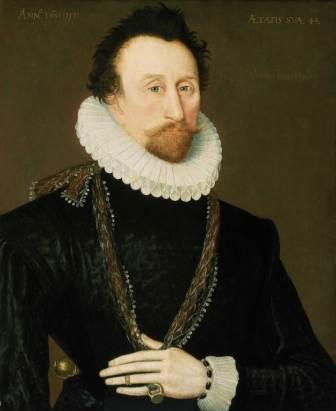
A portrait of Sir John Hawkins from 1581. Hawkins was one of Queen Elizabeth I's more successful "sea-dogs", being both a privateer and an explorer. However, his name is remembered today primarily because of his involvement with the slave trade. Picture acquired through Wikimedia Commons. Image public domain.

"Tobacco was first brought, and made knowne in England by Sir John Hawkins, about the yeere one thousand five hundred sixty five, (1565) but not used by the Englishman in many yeers after, though at this day commonly used by most men, and many women..."- From Howes' edition of Stow's Annales of England

Wednesday, March 14, 2012

Elizabethan Fact Of The Day: Protecting the Queen

Queen Mary I had reigned directly before her sister Elizabeth I for a brief and disastrous five years, bequeathing her a bankrupt Treasury, along with a myriad of other problems. One of the ways Elizabeth cut costs and thus expedited replenishing the Treasury was by choosing not to keep a standing army during her reign. The costs of employing a standing army were astronomical, as the powers on the Continent who kept them had demonstrated. Standing army's with nothing to do also bred anxiety in the population, especially when they caused disturbances of the peace, as they were known to do. The immediate safety of England fell to the local magistrates, who were entrusted with ensuring peace within their own districts (Palliser). And the overall safety of Elizabeth and her realm would be ensured by a network of spy's and informants, overseen by Elizabeth's "spymaster" Sir Francis Walsingham.

A detail of a 16th century portrait of Sir Francis Walsingham, Elizabeth's "spymaster".Walsingham's ability to protect the Queen was never doubted, although sometimes she greatly disliked his methods. Elizabeth nicknamed him her "Moor". Picture acquired through Wikimedia Commons. Image public domain.


Queen Elizabeth prided herself on being accessible to all of her subjects; her practice of walking amongst throngs of people when she exited and entered buildings, often stopping to speak with them, was something that made her Councillors fear for her, and they often told her so. On Elizabeth's progresses throughout her realm, which we know she very much enjoyed, she would always stop and speak with villagers and tradesmen, without a retinue of guards to protect her. Like her mother Queen Anne Boleyn had done so many years before, Good Queen Bess would distribute coins in exchange for poesy's of meadow flowers from village children (Denny).

An Elizabethan Maundy, a miniature by female court painter Leevina Teerlinc depicting Queen Elizabeth I meeting with her subjects. Image public domain.
Elizabeth had good faith in her subjects, and they in her. These were her people, who along with God she believed had preserved her and guided her to become Queen of England. Unlike her father, whose paranoia in the latter half of his reign compelled him to order the locks of his personal apartments changed every time he moved his court to a new castle, Elizabeth would remain tangible to her people up until her death at age 69 in 1603.

Queen Elizabeth used her image (clothes, appearance of perpetual youth due to heavy makeup) and the good faith she demonstrated with her people  to build nationalism and loyalty to the crown. This "Cult of Gloriana" made Elizabeth semi-divine, and thus her people invincible.

A painting of Queen Elizabeth en route to the wedding of Lady Anne Russell, c.1600. Picture acquired through Wikimedia Commons. Image public domain.

Wednesday, February 22, 2012

Elizabethan Fact of the Day: Elizabeth and her Guinea Pigs

UPDATE: In further proof, National Geographic cites new evidence that may support the claim that Guinea Pigs were bred as "curiosity pets" in the Elizabethan Age. Read the article HERE.

A detail from a 1615 painting by Jan Brueghel the Elder, depicting two multicolored Guinea Pigs doing what they do best: nibbling veggies! Image courtesy of lierne via Flickr.

I am always delighted to discover anything new pertaining to Elizabeth I. Recently I came across an authority on Guinea Pigs, who wrote a chapter in her book on their history. She  has found evidence to validate something I have long suspected, based on other contemporary clues from the late 16th century: Queen Elizabeth I had Guinea Pigs! This information comes courtesy Virginia Parker Guidry's book Guinea Pigs: Practical Advice for caring for your Guinea Pig.

I myself have long been a lover of Guinea Pigs, whom are more accurately called Cavy's-I think they are the most underrated "pocket-pet" on the market today, and any time I get the opportunity to sing their praises, like they "sing" for me every morning, I will do so!

GP's are not your typical rodent-they are plucky, verbal (with a series of elaborate trills, squeaks and purrs to alert you of their various needs), cuddly, affectionate, and extremely smart! And every piggy that I have ever had the pleasure of knowing or owning has had their own distinct personality.

One of my piggles, Annabelle, whom I call "Annabelly" due to her tendency to lie on her side or back and push out her big belly so that I can rub it-she loves it, and I will sometimes do it for a half an hour, or until she falls asleep! 

I am about to begin click-training with my most recent pair of piggles, Avery and Annabelle. My heart melts for my "A-Team" on a daily basis, so I am not surprised that even the most authoritative of sovereigns succumbed to their charms! I like to think that Queen Elizabeth benefited from a nice cuddle-session with a trilling Guinea Pig after the end of a long day deliberating with her Privy Council. I doubt, however, that she ever had to clean a pig cage herself! ;)


The Ermine Portrait of Queen Elizabeth I, by William Segar. Elizabeth is depicted with an ermine on her sleeve (a member of the weasel family, along with ferrets, a domesticated form of polecat used for hunting), representing her royal birth. Unfortunately, there is no Guinea Pig Portrait!


Wednesday, January 25, 2012

Elizabethan Fact of the Day: Trinity College

In January of 1592, Elizabeth I founded Trinity College in Dublin, Ireland, which continues to thrive to this day. Some of the greatest literary minds attended and/or graduated from Trinity College, and I myself was lucky enough to visit the illustrious campus several summers ago. I enjoyed a tour of the college's campus, and also, of course, viewing the Book of Kells, which culminated with a visit to Trinity's rare book library. I have never had so many goosebumps as when I walked into the multi-tiered library of ancient and early modern books!

Presently, there is a white tower in the center of the common area, (or a "quad" as we call it here in America-I think "common area" sounds more distinguished, don't you?) and as the legend goes, if a virgin walks under the tower, the bell in its belfry will ring!

Trinity College Tower

I never heard the bell ring when I was there, which either means that there were no virgins present, or that the legend was false-one will never know! In any case, I am certain that if Queen Elizabeth I were to walk under that tower, the bell would ring out loud and clear!

Friday, January 13, 2012

Orphans, Stepchildren and Step-parents in Tudor and Elizabethan England

The revolving door of King Henry VIII’s wives and mistresses is, of course, the exception, rather than the rule of Tudor family life. But one, if not multiple step-parents, and inherited stepchildren were relatively common in the 16th century for a variety of reasons. Many children lost one or both parent’s to illness, some of which we can now determine were probably influenza, smallpox, typhus, malaria, dysentery, bubonic plague, scurvy and syphilis.

A composite image of the Six Wives of Henry VIII. Image created by Inor19 on Flickr.

            In 1599 in Ealing (West London), ¼ of all children had lost at least one natural parent, if not both. Step-parents were common, particularly if the surviving spouse was still able to produce more children, or if a male heir was lacking; therefore they would have good reason to marry again. But sometimes people simply remarried again for love late in life, such as the great Elizabethan matriarch Bess of Hardwick.

Portrait of Bess of Hardwick. If you look closely on the left-hand side of the painting, the sitter was once falsely identified as "Maria Regina"-Queen Mary I! It has since been identified as Bess of Hardwick. Picture acquired through Wikimedia Commons Image public domain.

         Many orphaned noble children benefited from the Court of Wards, which arranged for them to be fostered by other families until they came into their majority. Smaller towns and parishes set up ward programs of a similar structure for orphans who were not of the upper classes. Lord Burghley fostered the young Edward de Vere, later the 17th Earl of Oxford, until he came into his inheritance. Wisely, Burghley married Oxford to his daughter Anne, to keep the lands and money of his Earldom in the family. Despite the children growing up together, the marriage was a complete disaster.
Detail of a portrait of Edward de Vere, the 17th Earl of Oxford, by Marcus Gheeraerts. Picture acquired through Wikimedia Commons Image public domain.

Sometimes, children were fostered by family members, including when a parent was still alive. This was typical of noble families, stemming from the longstanding tradition of sending children away at the youthful age of six or seven to begin training for knighthood as a page. In England in the 16th century, if an affluent relative was in a better position to raise a child and give him or her opportunities, it was wise to send the child to that relative. This was certainly the case when Queen Anne Boleyn fostered her nephew, (and possible stepson, if his father truly was King Henry VIII) Henry Carey. Queen Anne’s sister, Mary Boleyn, was still living, but Anne was able to give little Henry the benefits of an education in the royal household, alongside other children of powerful families, dress him in fine clothes, and ensure him a future in the king’s household. Henry Carey would eventually become a close, trusted, and loyal servant of his cousin, (or half-sister? This was contemporary gossip of the time; he was even called “the queen’s brother” on more than one occasion) Queen Elizabeth.

Henry Carey, 1st Baron Hunsdon, by Steven van Herwijk. Picture acquired through Wikimedia Commons Image public domain.

 Whether he was a sibling or not is irrelevant, though; Elizabeth kept all her Carey and many of her less ambitious Howard relatives close to her. She was undoubtedly trying to fill the void of not knowing her mother by becoming close with her maternal family.

Henry Carey, created Baron Hunsdon by Elizabeth I

Step-families were prevalent in 16th century, as they are now, though for arguably very different reasons. There are many accounts of happily “blended” families in Elizabethan England, but also many horror stories as well. And like today, many children benefited from state/social programs, like the Court of Wards, and were brought up with great success by foster families or well-connected relatives.