|
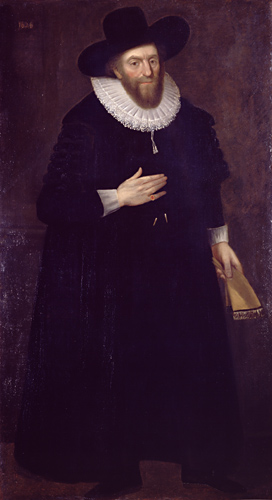
| A 17th century portrait of actor Edward Alleyn in old age. Picture acquired through Wikimedia Commons. Image public domain. |
One of the most popular stage actors of the Elizabethan era, and for a short time, the Stuart era, was Edward Alleyn (1566-1626). In addition to the praise he earned as a tragedian actor who defined and popularized the roles of Christopher Marlowe's Tamburlaine and Dr. Faustus, as well as Thomas Kyd's Hieronimo, Alleyn was also a business man. After great success as an actor, Alleyn became a shareholder in several successful London theatre's in his final years.
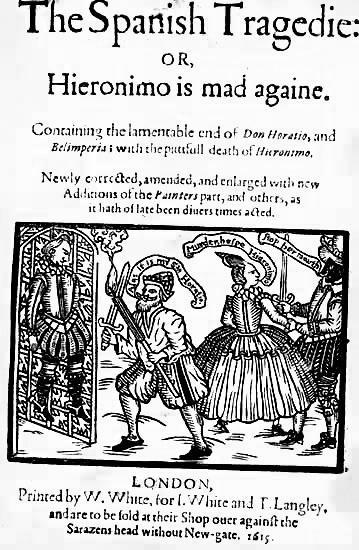 |
| The frontispiece from Thomas Kyd's The Spanish Tragedy. Alleyn's performance of Hieronimo in The Spanish Tragedy made the character an iconic one. Picture acquired through Wikimedia Commons. Image public domain. |
Born and raised in London, Alleyn had absorbed the bustling, dramatic world of 16th century London since youth. Unsurprisingly he was magnetically drawn to the stage. Alleyn first took to the stage in the 1580's, and going professional as part of the company Worcester's Men in 1583. By 1589 he was part of the prestigious Admiral's Men. Alleyn was the lead actor of the Admiral's Men in their many productions at the Rose Theatre.
 |
| A detail from a portrait of Queen Elizabeth's maternal cousin and a hero of the defeat of the Spanish Armada, Lord High Admiral Charles Howard. Alleyn was a part of Howard's successful theatre company the Admiral's Men. Picture acquired through Wikimedia Commons. Image public domain. |
By 1592, Alleyn was co-running the Rose, as well as several bear garden's (see Mabeth, Merry Wives, and the Business of Bear-baiting for information on Elizabethan bear-baiting and Alleyn's involvement in the business). By 1597 he had retired, but in 1600 he returned to the stage per the request of Queen Elizabeth I who admired and missed his talent. He performed in the New Fortune Theatre that he and his longtime business partner Philip Henslowe had built. Alleyn had married Henslowe's stepdaughter Joan Woodward in 1592.
Primary documents tell us that Alleyn and his wife were very close; whether they had fallen in love before they married or after is irrelevant. When plague broke out in London in the spring of 1593, Alleyn and his fellow actors were forced to tour the countryside for work (Mabillard). When he was working in Chelmsford, he wrote home to his wife the following letter:
We can deduce from the letter that Joan was somehow involved with "the fellows" -- those "Admiral's Men who remained in London and had infringed the order prohibiting playing" (Hosking, 50). Though Joan could never have legally acted on stage, she appears to have occasionally traveled with the group and perhaps assisted with their business.
By the time of Joan's death in 1623 the couple had had no children. Since the couple's marriage was by all accounts a happy one, and since Alleyn and his second, much younger wife would also have no children, it is possible Alleyn and his wives suffered from fertility issues.
Interestingly, Alleyn would take for his second wife one of the daughter's of celebrated poet John Donne, who was then Dean of St. Paul's Cathedral in London. Constance Donne was an old acquaintance of Alleyn, and they also seem to have fallen in love rather quickly, since they married within months of Joan's death. Edward was 58, Constance was 20 (Mabillard).
 |
| A portrait of Joan Alleyn from 1596. Picture acquired through Wikimedia Commons. Image public domain. |
Primary documents tell us that Alleyn and his wife were very close; whether they had fallen in love before they married or after is irrelevant. When plague broke out in London in the spring of 1593, Alleyn and his fellow actors were forced to tour the countryside for work (Mabillard). When he was working in Chelmsford, he wrote home to his wife the following letter:
My good sweetheart and loving mouse, I send thee a thousand commendations, wishing thee as well as may be, and hoping thou art in good health, which I pray God to continue with us in the country, and with you in London. But mouse, I little thought to hear that which I now hear by you, for it is well known they say that you were by my Lord Mayor's officer made to ride in a cart, you and all your fellows, which I am sorry to know; but you may thank your two supporters, your strong legs I mean, that would not carry you away, but let you fall into the hands of such termagants. But mouse, when I come home I'll be revenged on them; till when, I prithee send me word how thou dost, and do my hearty commendations to my father, mother, and sister, and to thy own self; and so, sweetheart, the Lord bless thee. From Chelmsford, the 2nd May, 1593. Thine ever and nobody else's, by God of Heaven - Edward.
We can deduce from the letter that Joan was somehow involved with "the fellows" -- those "Admiral's Men who remained in London and had infringed the order prohibiting playing" (Hosking, 50). Though Joan could never have legally acted on stage, she appears to have occasionally traveled with the group and perhaps assisted with their business.
By the time of Joan's death in 1623 the couple had had no children. Since the couple's marriage was by all accounts a happy one, and since Alleyn and his second, much younger wife would also have no children, it is possible Alleyn and his wives suffered from fertility issues.
Interestingly, Alleyn would take for his second wife one of the daughter's of celebrated poet John Donne, who was then Dean of St. Paul's Cathedral in London. Constance Donne was an old acquaintance of Alleyn, and they also seem to have fallen in love rather quickly, since they married within months of Joan's death. Edward was 58, Constance was 20 (Mabillard).
 |
| A map c.1560 of the bear and bull-baiting rings along the Thames in Elizabethan London. Picture acquired through Wikimedia Commons. Image public domain. |
Sources:
"Alleyn, Edward." The Historical Dictionary of the Elizabethan World. Print. (By John A. Wagner.)
Mabillard, Amanda. The Life of Shakespearean Actor Edward Alleyn Shakespeare Online. 20 Aug. 2001. < http://www.shakespeare-online.com/biography/edwardalleyn.html >.
Hosking, G. L. The Life and Times of Edward Alleyn. London: Jonathan Cape, 1952.
Mabillard, Amanda. The Life of Shakespearean Actor Edward Alleyn Shakespeare Online. 20 Aug. 2001. < http://www.shakespeare-online.com/biography/edwardalleyn.html >.
Hosking, G. L. The Life and Times of Edward Alleyn. London: Jonathan Cape, 1952.