Friday, April 6, 2012

Elizabethan Fact of the Day: Easter in Elizabethan Times


Happy Easter!
If you celebrate Easter, we wish you a happy day filled with friends, family, and faith.


And because I never miss an opportunity to tie anything to Queen Elizabeth I, I would like to share with you some information on the Elizabethan Easter....

The celebration of Easter is the most important feast day in the calender of the Elizabethan Church, also known as the Anglican church. Just like today, Easter was a "floating" holiday in the 16th century, and could occur on a Sunday in either March or April.

By the time Elizabeth was on the throne, Easter resided on the first Sunday after the first full moon that occurred on or after March 21st. This means that Easter could fall anywhere between March 22nd and April 25th during Elizabeth's reign (Wagner, 93-94).

Proceeding the actual feast day of Easter was 40 days of Lent, a period of fasting and abstinence from a variety of forms of merriment. Lent was, and still is intended as a time for reflection of Christ's sacrifice on the cross for our sins. Lent begins on Ash Wednesday, and concludes with the week before Easter, appropriately titled "Easter Week" or "Holy Week". Easter Week begins on Palm Sunday. Holy Week concludes with Maundy Thursday, Good Friday and Holy Saturday, all of which were observed retaining some Catholic traditions (Wagner, 94). Queen Elizabeth I herself continued the royal tradition of having a Maundy Thursday rendezvous with the common people, and the annual event was commemorated in the miniature below:


An Elizabethan Maundy, a miniature of Queen Elizabeth observing the tradition of a Maundy with the common people. The miniature is by Elizabethan female court painter Leevina Teerlinc. Picture acquired through Wikimedia Commons. Image public domain.

The Easter Sunday service was one of the three times in a year that Anglican church-goers took communion; the others were Christmas and Whitsun. Whitsun was the feast of Pentecost, which fell in either May or June. After attending church, the Elizabethans would partake in extravagant feasting celebrations.

Since we know that by Queen Elizabeth's reign Easter had acquired some secular customs, the Elizabethans, like modern Christians, were celebrating with decorated eggs and other pagan-derived symbols from ancient Anglo-Saxon culture (Wagner, 94). Though we can say with surety that the Queen herself probably did not participate in any sort of an egg-hunt!

Sources: 

Wagner, John A. The Historical Dictionary of the Elizabethan World. Print.

(Pages 93-94.)


For further reading on Elizabethan religious customs, please see: 

Bonfires and Bells: National Memory and the Protestant Calender in Elizabethan and Stuart England by David Cressy

ALSO: On this Day in Elizabethan History, Sir Francis Walsingham, Queen Elizabeth I's spymaster died in 1590. But because this year this weekend is Easter Weekend, and every year ever-after April 6th will be the death of Sir Francis Walsingham, we will write a mini-bio on him and his achievements next year!

A detail of a 16th century portrait of Sir Francis Walsingham, whom Queen Elizabeth called her "moor", due to his swarthy complexion. Picture acquired through Wikimedia Commons. Image public domain.

In the meantime, to learn more about Walsingham's life and work, please read:

Her Majesty's Spymaster: Elizabeth I, Sir Francis Walsingham, and the Birth of Modern Espionage by Stephen Budiansky.

Mr. Budiansky is an author who specializes in military and intelligence history. We own this book and highly recommend it!

Thursday, April 5, 2012

Theatre Thursday: Literary Rivalries of Elizabethan London

It is no secret that the theatrical type thrives on drama. Broadway and the West End are no more competitive and sensational than the 16th century theatre community along the Thames.

Robert Greene (c.1558-1592) wrote an attack on a playwright in Greene's Groats-Worth of Wit bought with a million of Repentance, whom he refers to as "Shake-scene". Most literary scholars agree that through a copious amount of allusions, puns and references it can be determined that the object of Greene's disdain was Shakespeare, although most anti-Stratfordian's disagree (and whoever you think Shakespeare was or certainly wasn't, I thinkwe can all agree that, by any other name, there was still a genius who wrote the plays). In any case, Greene's dislike of Shakespeare was so strong and so bitter that he was willing to devote the last moments of his own life to speak ill of his competition. Greene's rant was found in his personal papers after his death, and published posthumously.


A woodcut of Robert Greene writing in his burial shroud, symbolizing that his words come from beyond the grave. This woodcut is from the title page of English author and Greene- follower John Dickenson's Greene in conceipt: New raised from his grave to write the Tragic History of Valeria of London (1598) . Picture acquired through Wikimedia Commons. Image public domain.

Greene was an eccentric character-flamboyant in both his mannerisms and clothing. Greene mastered the art of self-promotion, publishing pamphlets about the exploits of himself and his fellow rogues and rakes to boost his own popularity. Green's most successful works were The Honarable History of Friar Bacon and Friar Bungay (1591) which was first performed in 1594, two years after his death, and The Comical History of Alphonsus, King of Aragon (c.1590). Some have suggested that the faerie characters present in his work The Scottish History of James the Fourth, Slain at Flodden (1590) inspired Shakespeare's use of faeries in A Midsummer Night's Dream (Wagner, 129). An earlier play, Pandosto (1588) has a plot similar to Shakespeare's later work  A Winter's Tale, though the plot of the latter likely drew inspiration from a variety of other materials.

The title-page of the first edition of Greene's Groats-Worth of Wit, which most scholars agree is an attack on the great English dramatist Shakespeare. Picture acquired through Wikimedia Commons. Image public domain.
 We know that Greene had masters from Cambridge in 1583, and that he earned another at Oxford in 1588. But Greene preferred the life of a bohemian to the life of an academic, and according to Greene's own pamphlets (much of which we can assume was sensationalized) he abandoned his well-born wife and child in Norwich for a life in the theatre (Wagner, 129). If born in modern times, this man with the red beard, formed to a devilish point with sculpting wax, would have been ready-made for reality television.

Playwright and poet Ben Jonson (c.1572-1637) felt that Shakespeare's seemingly never-ending production of material was a sign of carelessness. Of course, it is also quite possible that Jonson was just jealous of Shakespeare's talent, (not that Jonson was lacking any himself) or perhaps that he was just a little irritated at Shakespeare's fame. Jonson took pride in revising his work until he deemed it to perfect, and he frowned on others who did not do the same. In Timber, published after his death, Jonson wrote that he had heard much of Shakespeare's lack of revision, saying, "Whatsoever he penned, he never blotted out a line." Jonson mused slyly, "Would he had blotted a thousand."

One of Jonson's earliest plays, The Case is Altered is startlingly similar in its story arch and themes to Shakespeare's Italian comedies. But Jonson's craft developed over time, and he soon received a lot of praise for his comedic plays, earning a reputation as one of the best humorists of the Elizabethan theatre scene. He is best remembered for plays like The Devil is an Ass, (and one has to love it for the title alone!) Eastward Ho, and The Magnetic Lady. Jonson also enjoyed the prestige of writing masques for the court of King James I, Queen Elizabeth's successor, as part of the newly formed company The Kings Men (Wagner, 170).


The title page of the 1616 edition of Ben Jonson's Every Man in His Humour. As the title page explains, the play was first performed in 1598 by The Lord Chamberlain's Men. The Lord Chamberlain at this time was Henry Carey, 1st Baron Hunsdon, who depending on who you asked, was either a maternal cousin or a half-brother of Queen Elizabeth I. Stratfordian's will recognize that Shakespeare was a member of the company The Lord Chamberlain's Men (Wagner, 61). Picture acquired through Wikimedia Commons. Image public domain.Picture acquired through Wikimedia Commons. Image public domain.
 All good artists, whatever their craft, draw inspiration from one another. They use their rivalries, real or manufactured, as motivation to do better, (or outdo their peers) and as a way to generate attention. (And I am sure that we all can think of many celebrity "feuds" that gain artists attention today.) In the end, Jonson expressed some repressed admiration for Shakespeare, writing "there was ever more in him to be praised than pardoned." He also declared of Shakespeare, "He was not of an age, but for all time."

I do not think that Shakespeare could have written his own epitaph better than that.


A detail of The Chandos Portrait of William Shakespeare, long thought to be the only portrait of the "Bard of Avon" painted from life until the discovery of The Cobbe Portrait in 2009. Picture acquired through Wikimedia Commons. Image public domain.

Source:

Wagner, John A. Historical Dictionary of the Elizabethan World. Print.
(Pages 61, 129-130, 170-171.)

Tuesday, April 3, 2012

The Borgia's Window Display in LA...or, What do Anne Boleyn and Lucrezia Borgia have in Common?

Dear Valued Readers,

I have recently been getting a lot of emails concerning different educational and PR related opportunities for Elizabeth I and BeingBess Blog. These recent developments are exciting beyond words! To know that my efforts are in some small way increasing interest in Elizabeth I and her era is nothing less than a dream come true!

One of these opportunities I want to share with you today: Although this blog is dedicated to Elizabeth I, I am a lover of all things pertaining to European history, and the Borgia's are no exception. Lucrezia Borgia, like Anne Boleyn, is one of the most misunderstood, and wrongly maligned female figures of history. 


A detail of St. Catherine of Alexandria,. The model for this painting by Pinturicchio, made c. 1492-1494, is generally accepted by scholars to have been Lucrezia Borgia. Picture acquired through Wikimedia Commons. Image public domain.


A miniature of Anne Boleyn, thought to be around age 25, by Hoskins. Picture acquired through Wikimedia Commons. Image public domain.

An employee of an Atlanta, GA based social media agency, Everywhere, read an article about my Elizabeth I programs and our Women in Armor Month programs that run every March at the museum where I work.  She contacted me regarding a new Borgia-themed window display at the Beverly Center in Los Angeles CA, running through April 15th.

If any of my readers are from LA, or traveling there before the 15th, you should check OUT this stunning display, configured to promote Season Two of The Borgia's on Showtime, premiering on April 8th 10 P.M ET/PT.

Below is the link for details on the display:

http://pitchengine.com/macys/macys-invites-you-to-celebrate-the-season-premiere-of-the-borgias-with-their-stunning-new-window-displays

If any of my readers view the display firsthand, please leave a comment of your reaction, and share a photo or two of yourself standing in front of it! I would love to see it!

SEMPER EADEM,

Ashlie

Monday, April 2, 2012

Elizabethan Fact of the Day: Armories in Elizabethan England

By the middle of the 16th century, at-home armour production was now thriving in England. In previous centuries, the majority of armor had been produced in Milan, Italy, Paris, France and Germany, and purchased by much of Western Europe.

King Henry VIII's armor, now residing in the Tower of London Armory exhibit. Picture acquired through Wikimedia Commons. Image public domain.

King Henry VIII can be almost solely credited with encouraging and investing in armor and weapons manufacturing in England. His Royal Armories at Greenwich produced some of his finest tournament suits.


The tournament armor of King Henry VIII, with an "H" and "K" detailing along the edge of the tassets. The "H" refers to the king himself, and the "K" refers to Henry VIII's first wife, Katherine of Aragon. Image acquired through Wikimedia Commons. Image public domain.

A 16th century illustration of King Henry VIII jousting  for his wife, Queen Catherine of Aragon. He is either wearing blackened or blued armor for the tilt. At the museum where I work, we have a stunning composite suit from around 1575 that is decoratively blued. Picture acquired through Wikimedia Commons. Image public domain.

But because of the increase in personal ownership of arms and armor, the possibility of rebellion and civil war was of course heightened. An edict from 1558, the year that Elizabeth Tudor came to the throne, required that all members of the peerage keep an armory to stockpile weapons and armor for the safety of the queen and the realm. Henry Herbert, the Earl of Pembroke maintained one of the more impressive armories of the Elizabethan Age.


A 16th century portrait of Henry Herbert, the 2nd Earl of Pembroke. Image public domain. Please see the 3 quarter length suit that possibly belonged to the Earl of Pembroke in my photo's on the side bar and bottom of the page. Picture acquired through Wikimedia Commons. Image public domain.


Sunday, April 1, 2012

Elizabethan Fact of the Day: Hawkins and Tobacco


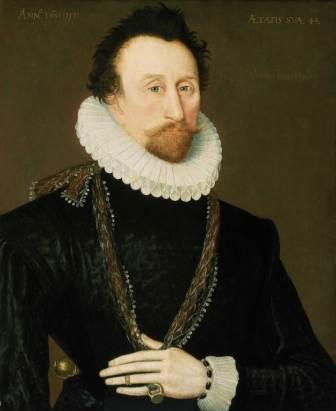
A portrait of Sir John Hawkins from 1581. Hawkins was one of Queen Elizabeth I's more successful "sea-dogs", being both a privateer and an explorer. However, his name is remembered today primarily because of his involvement with the slave trade. Picture acquired through Wikimedia Commons. Image public domain.

"Tobacco was first brought, and made knowne in England by Sir John Hawkins, about the yeere one thousand five hundred sixty five, (1565) but not used by the Englishman in many yeers after, though at this day commonly used by most men, and many women..."- From Howes' edition of Stow's Annales of England