Showing posts with label Shakespeare. Show all posts

Thursday, February 28, 2013

Theatre Thursday: Shakespeare, Marlowe and "Dueling Divas"

A portrait of a young man, generally thought to be the Elizabethan playwright Christopher Marlowe. Picture acquired through Wikimedia Commons. Image public domain.

For this Theatre Thursday, I bring you links to articles from around the web concerning Elizabethan Theatre and Elizabethan figures in theatre:

Shakespeare For The "Elizabethan Impaired" Offered At The English Rose

Dueling Divas in Donizetti's 'Maria Stuarda' 

The Baptism of Marlowe (Feb 26th)


Thursday, February 14, 2013

Our Valentine to Our Readers...

A pair of miniatures of Queen Elizabeth I and her favorite and friend, Robert Dudley, the Earl of Leicester. Painted by Nicholas Hilliard, circa 1575. Picture acquired through Wikimedia Commons. Image public domain.

On this Valentine's Day, I wish to express my extreme gratitude to all of my loyal BeingBess blog readers, Facebook friends, Twitter followers, Google+ pals, LinkedIn connections, and Pinterest pinners. I appreciate your support of my BeingBess work, and I value your insight on historical figures and controversies. I delight in this online, international community of people who share my passion for researching and discussing the 16th century.

Sending you love & light wherever you are!

SEMPER EADEM,

Ashlie

Here is my Valentine to you all, Shakespeare's Sonnet 116, which is my personal favorite!

Let me not to the marriage of true minds
Admit impediments. Love is not love
Which alters when it alteration finds,
Or bends with the remover to remove:
O no! it is an ever-fixed mark
That looks on tempests and is never shaken;
It is the star to every wandering bark,
Whose worth's unknown, although his height be taken.
Love's not Time's fool, though rosy lips and cheeks
Within his bending sickle's compass come:
Love alters not with his brief hours and weeks,
But bears it out even to the edge of doom.
If this be error and upon me proved,
I never writ, nor no man ever loved.

Thursday, December 27, 2012

Theatre Thursday: Winter in Love's Labour's Lost

Edwinsford Manor in winter; Edwinsford was built in the 16th and 17th centuries. Picture acquired through Wikimedia Commons. Photo shared for public use by Anthony Gostling.

"When icicles hang by the wall,
And Dick the Sheperd blows his nail,
And Tom bears logs into the hall,
And milk comes frozen home in pail..."

-Winter in Love's Labour's Lost

A comedy, Shakespeare's Love's Labour's Lost was first published in 1598, though it was most likely written in the mid 1590's. Around this same time, Shakespeare also composed two of his more popular plays, the comedy A Midsummer Night's Dream and the tragedy Romeo and Juliet.

Stay warm, dear BeingBess readers!

Semper Eadem,

Ashlie

Thursday, October 11, 2012

Theatre Thursday: Shakespeare Exhibit, Improv, and The History of the Reconstructed Globe Theatre

Today for Theatre Thursday I bring you more important links related to Elizabethan Theatre from around the web!

The reconstructed Globe Theatre in London. Picture acquired through Wikimedia Commons. Image public domain.

See a Play as Shakespeare Would've Staged It: The History of the Reconstructed Globe Theatre

A cameo version of the Chandos Portrait of William Shakespeare. Picture acquired through Wikimedia Commons. Image public domain.

Shakespeare Puts All the World on Stage: Staging the World Exhibit at The British Museum


Thursday, September 27, 2012

Theatre Thursday: Mirren Takes to the Stage, 'Anna Bolena' and more

A 2007 photo of Dame Helen Mirren at the Orange British Academy Film Awards in London's Royal Opera House. Picture acquired through Wikimedia Commons, courtesy of the photographer Caroline Bonarde Ucci.

There is a lot happening this week in Elizabethan and Tudor-themed theatre! As I continue to polish tomorrow's article for Feature Friday, the first in my Elizabethan Power Couples series, I bring you links from around the web to peruse at your leisure. Of course, the biggest news, which you have most likely already heard, is that Dame Helen Mirren is set to play Queen Elizabeth II once more, this time, on the stage. The accomplished Mirren will be playing Her Majesty from the age of 25 until her 80's! Now if only we could get a reprisal of Mirren as Elizabeth I....

Helen Mirren Set to Reign on the Stage

'Anna Bolena': Experiencing Henry VIII's World Through Tragic Opera

Shakespeare's Globe Theatre Offers 3 Plays at Cinemas

Old Pros to Perform 'Twelfth Night' 

Thursday, September 6, 2012

Theatre Thursday: Current Interpretations of Elizabethan Theatre

A cameo detail of the Chandos Portrait of William Shakespeare. Picture acquired through Wikimedia Commons. Image public domain.

Today for Theatre Thurday, I bring you links to two articles on current interpretations/productions of Elizabethan theatre. 

Enjoy!


Thursday, August 30, 2012

Theatre Thursday: Back to School in "As You Like It"

"Rosalind Gives Orlando a Chain"; a 19th century illustration by Emile Bayard from Shakespeare's As You Like It. Picture acquired through Wikimedia Commons. Image public domain.

To commemorate "back to school" time for children and adults continuing their education around the world, I bring you a quote concerning a reluctant schoolboy from Shakespeare.

"And then the whining schoolboy with his satchel, and shining morning face, creeping like a snail unwillingly to school. "
-Jacques, As You Like It

Coincidentally, The Globe Theatre (currently on tour) is performing As You Like It. They will also be doing a special showing of the play at Penrhyn Castle, only on Sept 1st.

This month I will begin working toward my Masters in History; my first course will be about The Wars of the Roses, and I am very much looking forward to it!

Friday, August 24, 2012

Elizabethan Quote of the Day: "Affection is False!"-the Sordid Life of Mary Fitton

 "Affection? Affection is false!"-Queen Elizabeth I, 1600.
Queen Elizabeth I had long been observing the frivolous ways of one of her maids of honor, Mary Fitton, and she did not approve of what she saw. In June of 1600, Mary Fitton was leading a court masque entertainment for the wedding celebration of her fellow maid of honor, the Lady Anne Russell. Queen Elizabeth I attended the wedding festivities, and her arrival was famously captured in a painting by Robert Peake the Elder.

Queen Elizabeth Going in Procession to Blackfriars in 1601 by Robert Peake the Elder. This portrait depicts Queen Elizabeth I being carried by her maternal relatives in a litter, on her way to the wedding festivities of the Lady Anne Russell. The bride follows behind. You can read more about this painting, and the event it captures HERE.

Mary selected her mistress the Queen to take part in the dance, suggesting that Her Majesty should personify "affection" in the allegorical masque. When Elizabeth heard this, she scoffed, "Affection? Affection is false!"

Elizabeth was well aware of Fitton's reputation at court as a young woman who tempted even the most sensible of men, and she may have been giving her a public warning about the superficiality and fleeting nature of court liaisons. Also, Elizabeth's open skepticism to romance may have been informed by her own misadventures in love. In an case, Mary Fitton did not heed her mistress's warning, since she would go on to lead a life that defied societal expectations, becoming a mistress to a succession of powerful men at court.

A detail of a portrait of Mary Fitton, c. 1595, by an unknown artist. Picture acquired through Wikimedia Commons. Image public domain

Prior to the wedding of the Lady Anne Russell to Henry Somerset, later 1st Marquess of Worcester, Mary Fitton had entered the Queen's service just five years before. Mary's father, Sir Edward Fitton, had asked the Queen's kinsman and comptroller, Sir William Knollys, to recommend her and look out for her. Knollys, who was the son of Queen Elizabeth I's most beloved cousin and friend (or possible half-sister), Catherine Carey-Knollys, and her husband, Sir Francis Knollys, happily obliged. He told Sir Edward, "I will be as careful of her well doing as if I were her own true father." (Haynes, 44)

A 17th century engraving by Simon van de Passe of William Knollys, 1st Earl of Banbury. Picture acquired through Wikimedia Commons. Image public domain.

William Knollys's interest in his young charge was far from paternal, however. Though presently married to Dorothy Bray, Baroness Chandos, William fell in love (or lust) with Mary. William did not hide his interest in the young Mary from his peers, and he was lampooned throughout the court for his obsession (Haynes, 46).

Dorothy, the widow of Edmund Brydges, 2nd Baron Chandos, had five children of her own, but had been unable to provide her second husband with a child. Since Dorothy was more than 20 years her husband's senior, she may have been well past her child-bearing years. The 50-year-old William's infatuation with Mary may have been in part because of her youth, and thus her perceived ability to bear him a biological heir.

A portrait of a woman by John Bettes the younger, probably Dorothy Bray, Baroness Chandos c. 1578. Picture acquired through Wikimedia Commons. Image public domain.

When Dorothy Bray did die (in 1605) Mary still had no interest in the elderly William Fitton. He took another wife, Elizabeth Howard, the daughter of Thomas Howard, 1st Earl of Suffolk. Thus, William Fitton's second wife was the granddaughter of Thomas Howard, the 4th Duke of Norfolk, who had been executed for high treason against Queen Elizabeth I in 1572.

A portrait from 1598 of Thomas Howard in his robes for the Order of the Garter. He was later the 1st Earl of Suffolk. Picture acquired through Wikimedia Commons. Image public domain.

Mary Fitton left court briefly due to illness in 1599, returning in time to help lead the court entertainments for Lady Anne Russell's wedding. On this occasion, Mary was not only the subject of one of Queen Elizabeth's many witty, biting retorts; she also caught sight of the man who would change her life significantly: William Herbert, the eventual 3rd Earl of Pembroke.

A detail of a portrait by Daniel Mytens of William Herbert, 3rd Earl of Pembroke, 1625. Picture acquired through Wikimedia Commons. Image public domain.

William Herbert was the son and heir of one of the leading figures in Queen Elizabeth's court, Henry Herbert, the 2nd Earl of Pembroke and his literary wife, Mary Sidney-Herbert, Countess of Pembroke.

A miniature from around 1590 of Mary Sidney-Herbert, Countess of Pembroke. By Nicholas Hilliard. Picture acquired through Wikimedia Commons. Image public domain.

Eventually following in his mother's footsteps, William would become involved in the literary world, helping to fund the publication of Shakespeare's First Folio in 1623.

The frontispiece of Shakespeare's First Folio, published in 1623. Picture acquired through Wikimedia Commons. Image public domain.

But as a young, unmarried man of around 20 on the precipice of inheriting his Earldom, William took up with the slightly older Mary Fitton. Given her previous experience of being the object of affection for a much older man, Mary may have been taking control of her own happiness, either consciously or sub-consciously, by having an affair with a younger man. Mary became pregnant with William Herbert's child; she also was likely carrying something else: syphilis, which it is suspected William had.

When William admitted paternity of his illegitimate child in February of 1601, but refused to answer for his indiscretion by marrying his mistress, he was thrown into Fleet Prison by the Queen. This was not surprising, since just one year ago, a writer observed of William Herbert that, "I don't find any disposition at all in this gallant young lord to marry" (Furnivall, 3). A month later, aged about 23, Mary gave birth to a son who died almost immediately (Furnivall, 3). Some modern researchers have suggested that the infant's cause of death could have been congenital syphilis.

Mary Fitton and her former lover were banished from Queen Elizabeth's court for their transgressions. Elizabeth had always punished those ladies in her service who had compromised their chastity very harshly; she likewise punished the men who impregnated her ladies if they refused to marry them.

Still as obsessed as ever, Sir William Knollys offered himself to Mary Fitton once again, even though she was in disgrace. Mary seems to have abhorred the idea of stability and defied convention at all costs, since she spurned Knollys once again to have an affair with the married Vice Admiral Richard Leveson. Leveson's wife was the daughter of Lord High Admiral Charles Howard, a cousin to the Queen. When the Vice Admiral died in 1605 at the age of 35, he left Mary 100 pounds.

A statue of Sir Richard Leveson at St. Peter's church, Wolverhampton, by Hubert Le Sueur. This statue was originally part of a larger group in the chancel, now in the Lady Chapel. Picture acquired through Wikimedia Commons courtesy of Siwells53.

Still having no interest in marriage, Fitton began a liaison with Captain William Polwhele, and bore him a son. Mary's parents had understandably had quite enough of their daughter's serial dalliances. Mary's mother, Alice Halcroft-Fitton, wrote to her other daughter, Anne, the wife of John Newdigate, in great distress:

"such shame as never had a Cheshire woman, worse now than ever. Write no more to me of her." (quoted in Haynes, 49)

Captain William Polwhele and Mary did eventually get married, but Mary was widowed by 1610. Presumably to provide for the two children she had had with her late husband, and to attach some respectability to her own name, Mary got married for the last time to another captain.

In 1890, Thomas Taylor was the first to put forth the theory that Mary Fitton may have been the mysterious "Dark Lady" of Shakespeare's sonnets. This theory relies heavily on the assumption that William Herbert, 3rd Earl of Pembroke was Shakespeare's "fair youth", whom Shakespeare urges to marry, though there are other candidates. William and his brother Philip made up the "incomparable pair of bretheren" to whom Shakespeare's First Folio is dedicated.

According to the Folio editors, the Herbert brothers had "prosecuted both them and their author living with so much favor". Other parts of the dedication imply Shakespeare was close to the Pembroke's. Shakespeare's sonnets are dedicated to "the onlie begetter of these insuing sonnets, Mr. W.H." These initials, of course match those of William Herbert. But "W.H." could just as well be an encrypted reference to Henry Wriothesley, the Earl of Southampton (DNB, 227-28).

A full-length portrait of Henry Wriothesley,  the 3rd Earl of Southampton, painted between 1594-1600. Picture acquired through Wikimedia Commons. Image public domain.

Frank Harris also championed this theory in several of his books, as did A.L. Rowse.  Of course, since many Shakespeare scholars cannot even agree on whether Shakespeare really was Shakespeare, attempting to identify the subjects of his sonnets is almost futile. For all the evidence we have that suggests Mary Fitton was the Dark Lady, we have an equal amount of evidence that suggests she was not. One of the chief arguments against her is that the Dark Lady had to have been married to break her "bed-vow"(Furnivall, 5). Fitton was not married at the time of her affair with William Herbert.

Playwright George Bernard Shaw knew Thomas Taylor personally, and discussed his theory with him. Shaw was one of the first authors to build a strong case against Mary Fitton as the Dark Lady. Even so, he did use Fitton as the Dark Lady in a work of fiction!

While we will probably never know for sure who the Dark Lady was (and really, isn't it almost better that way?) we do know that Mary Fitton has been referenced in other Elizabethan poetry, and had at least one literary work dedicated to her. The comedic actor Will Kempe dedicated his account of his record breaking morris-dancing jig across the English countryside in 9 days to Mary; the work was entitled Nine Daises Wonder (Furnivall, 3). That being said, Kempe was so ill-acquainted with Mary that he painstakingly called her Anne Fitton in his dedication, confusing her first name with that of her married sister, Anne Newdigate! (Funivall, 3).

A woodcut of Elizabethan clown William Kempe dancing a jig across the English countryside. Picture acquired through Wikimedia Commons. Image public domain.

Whether Mary is the Dark Lady of Shakespeare's sonnets or not, she certainly led a bold and fascinating life!


Sources:

Haynes, Alan. Sex in Elizabethan England. Gloucestershire: Sutton Publishing Limited, 1997. Print.

"Herbert, William, third Earl of Pembroke, 1580-1630". Dictionary of National Biography. Retrieved 8-23-2012. Electronic.

Furnivall, Frederick James. "Shakespeare and Mary Fitton". Cornell University Library Database.  Retrieved 8-23-2012. Electronic.
"Earl of Banbury". Leigh Rayment's Peerage pages. Retrieved 08-22-2012. Electronic

Thursday, August 23, 2012

Theatre Thursday: Publishing in Elizabethan England, and Other Topics

The title page of Shakespeare's First Folio, first published in 1623. Picture acquired through Wikimedia Commons. Image public domain.

Today for Theatre Thursday I bring you a selection of a few interesting and informative articles on Shakespeare Online.  

Shakespeare Online if a content-rich site focused on the Shakespeare canon, and the the world of Elizabethan actors and the theatre-going public. All of the articles reproduced have been previously published in literary or historical journals, and are fully annotated.

Enjoy!


Thursday, August 9, 2012

Theatre Thurs: John of Gaunt's Description of England in Richard II

A portrait of 14th century Prince John of Gaunt, painted circa 1593 for Sir Edward Hoby of Queensborough Castle, Kent. This portrait currently resides in the collection of a descendant of John of Gaunt and his third wife, Katherine Swynford,  the Duke of Beaufort. In addition to being the Duke of the vast and agriculturally rich duchy of Lancaster,  John of Gaunt was the titular King of Castile and Leon, (through his second wife) and Duke of Aquitaine, Earl of Derby, Leicester and Lincoln, and Seneschal of England. Picture acquired through Wikimedia Commons. Image public domain.

One of my favorite historical personages, John of Gaunt, Duke of Lancaster (14th century), was immortalized in Shakespeare's tragedy Richard II. In the play, Gaunt delivers one of the most famous descriptions of England in literature, in Act 2, Scene 1.

This royal throne of kings, this scepter'd isle,
This earth of majesty, this seat of Mars,
This other Eden, demi-paradise,
This fortress built by Nature for herself
Against infection and the hand of war,
This happy breed of men, this little world,
This precious stone set in the silver sea,
Which serves it in the office of a wall,
Or as a moat defensive to a house,
Against the envy of less happier lands,
This blessed plot, this earth, this realm, this England,
This nurse, this teeming womb of royal kings,
Fear'd by their breed and famous by their birth,
Renowned for their deeds as far from home,...
...This land of such dear souls, this dear dear land,
Dear for her reputation through the world,
Is now leased out, I die pronouncing it,
Like to a tenement or pelting farm:
England, bound in with the triumphant sea
Whose rocky shore beats back the envious siege
Of watery Neptune, is now bound in with shame,
With inky blots and rotten parchment bonds:
That England, that was wont to conquer others,
Hath made a shameful conquest of itself.
Ah, would the scandal vanish with my life,
How happy then were my ensuing death! 

The ruins of Kenilworth Castle. Picture acquired through Wikimedia Commons courtesy of Dave. Image public domain.

Interestingly, Kenilworth Castle, which Queen Elizabeth I gave to her life-long favorite Robert Dudley, the Earl of Leicester in 1563, was previously in the possession of John of Gaunt.

Thursday, June 21, 2012

Theatre Thursday: A-List Elizabethan Actor Richard Burbage

A detail of a portrait of actor Richard Burbage by an unknown artist. Picture acquired through Wikimedia Commons. Image public domain.

Along with Edward Alleyn, Richard Burbage (c.1567-1619) was one of the two most celebrated actors of the Elizabethan age. Richard Burbage's unique interpretations of some of Shakespeare's more complex characters were what made him famous, although like his father he was also a businessman.

The son of James Burbage, the founder of The Curtain theatre and an owner of a prominent acting troop, Richard was trained as a thespian by his father. In 1587, when Richard was about 20 years of age, he followed in his father's footsteps by joining Leicester's Men, the Earl of Leicester's acting troop. Richard would remain an integral part of this group well into the 1590's, when Leicester's Men was re-incarnated as the Earl of Derby's Men and subsequently the Chamberlain's Men, finally becoming the King's Men upon the accession of James I (Wagner, 42).

Upon the death of Richard's father James in 1597, Richard and his brother inherited two London playhouses, The Theatre and Blackfriars. After a nasty dispute over the lease with landlord Giles Allen (James Burbage article) Richard and his brother feared that Allen might demolish The Theatre altogether in order to rent the land to someone new. Not wishing their father's legacy to be destroyed, the Burbage boys dismantled the entire structure themselves and had it reassembled in Southwark on the Thames. This newly assembled theatre was re-christened The Globe when it reopened in 1599 (Wagner, 42). The Globe, of course, is inextricably linked with the earliest performances of Shakespeare's plays.

The modern reconstruction of the Burbage's Globe Theatre on the Thames. Picture acquired through Wikimedia Commins. Image public domain.

Richard Burbage, already a popular actor in Elizabethan London, quickly ascended to what would be the modern equivalent status of celebrity through his turns as Shakespearean leading men. He was the first actor to play Hamlet, Macbeth, Richard III, Othello, King Lear and Romeo (Wagner, 42). In the world of Elizabethan theatre and well through the period of the Restoration, theatrical performances were driven by roles, not the entirety of a play. Actors made particular roles popular through their portrayals and often became especially associated with one of their characters. Up-and-coming actors would find the task of re-inventing a role made popular by their predecessor a daunting one. For Burbage, the role that he defined as an actor was Richard III (Wagner, 42). As anyone familiar with Shakespeare's canon will have recognized, the roles played by Burbage all has an incredible amount of lines, and most were psychologically charged. While Burbage would have known his characters like the back of his hand, he still would have had to brush up a mere few days before a performance.

A portrait of King Richard III of England, c.1520 after an lost original. The most famous character portrayed by Richard Burbage was Shakespeare's villainous version of Richard III. Picture acquired through Wikimedia Commons. Image public domain.

Being the majority shareholder of The Globe theatre afforded Richard Burbage more wealth than his acting career ever did. In 1609 he was able to afford buying out the lease of the acting company associated with the Blackfriars Theatre so that he could move The King's Men there (Wagner, 42).

Sadly, Burbage would live to see the destruction of The Globe in 1613, when it caught fire during a performance of Henry VIII. Richard Burbage barely escaped the fiery carnage with his life (Wagner, 42). The Globe was rebuilt remarkably quickly, re-opening in 1614. Never retiring, Richard Burbage continued to delight audiences acting there until his death in 1619. Like many of the widows of thespians past and present, Burbage's widow Winifred had to settle her husband's debts before marrying one of her husband's associates in The King's Men, Richard Robinson (Halliday, 77).

Though the location of Richard Burbage's grave is unknown, a memorial was erected to him, his brothers and other actors of the Elizabethan era in St. Leonard's, which is near the original site of The Theatre in Shoreditch.

A memorial plaque for Richard Burbage, his brothers, and other great actors of the Elizabethan era at St. Leonard's in Shoreditch on the Thames. Picture acquired through Wikimedia Commons. Image public domain.


Sources:

"Burbage, Richard." The Historical Dictionary of the Elizabethan World. Print. (By John A. Wagner)

F.E. Halliday, A Shakespeare Companion 1564-1964, Baltimore, Penguin,1964; p.77.

Thursday, May 3, 2012

Theatre Thursday: Shakespeare and Ovid

A modern interpretation, after the Roman style, of the poet Ovid. Picture acquired through Wikimedia Commons courtesy the artist, Aureola. Image public domain.

Shakespeare admired Ovid, (43 B.C.-17 A.D.) and he drew a great deal of inspiration from his body of work. Ovid's Metamorphoses was the work that Shakespeare appears to have studied the most; Metamorphoses was a collection of stories from the ancient Greek and Roman myths. The Elizabethan people regarded the knowledge and aesthetic of the classical world as a muse for art, theatre, literature, and even decorative etching on armor. 

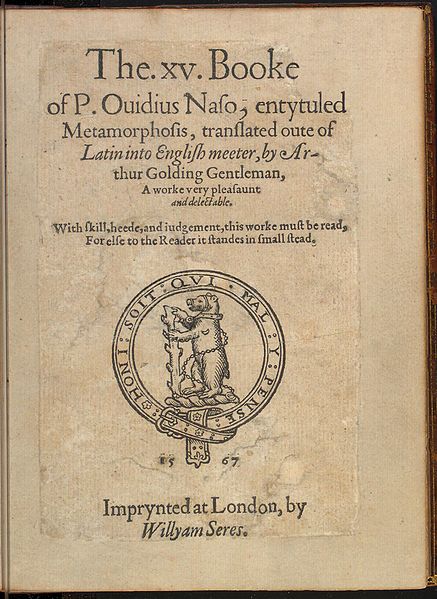
The frontispiece of a 1567 edition of Ovid's Metamorphoses, translated from Latin into English by "Arthur Golding, gentleman." This page also prominently displays the heraldic bear and ragged staff of Robert Dudley, the Earl of Leicester. I have been unable to confirm with certainty that this work was commissioned by him, but all evidence would suggest that it probably was. If anyone has more information on this, please comment or email me! Picture acquired through Wikimedia Commons. Image public domain.

Francis Meres was an Elizabethan author who received his M.A. at Oxford and wrote the Wits Treasury, which was a valuable compendium of information on Elizabethan poets. Wits Treasury is acknowledged in the Shakespeare circle as being the first account with  merit on on the early works of Shakespeare, even establishing some basic chronology of the publications of the works. Meres, who was well acquainted with Shakespeare's gift, compared the Bard's work to Ovid's, saying:

"The sweet witty soul of Ovid lives in mellifluous and honey-tongued Shakespeare."

Sources:  

Francis Meares, Alumni Cantabrigienses, (online edition) Cambridge University Press.

Thursday, April 19, 2012

Theatre Thursday: Essex's Rebellion in Much Ado About Nothing?

A detail from a portrait of Robert Devereux, the 2nd Earl of Essex by Marcus Gheeraerts. The painting is from the 1590's, so this is probably how Essex looked at the time he staged his senseless rebellion against Queen Elizabeth I. Picture acquired through Wikimedia Commons. Image public domain.

The rebellion of Robert Devereux, the 2nd Earl of Essex (1566-1601) and his cronies is very likely alluded to in one of my favorite Shakespeare comedies, Much Ado About Nothing:

"Like favorites, made proud by princes, that advance their pride against the power that bred it."

Social commentary and political criticism was always very craftily hidden within Shakespeare and other early-modern playwrights works. There could be serious consequences for openly criticizing policies or questioning authority in the age of monarchy. For example, Ben Jonson's work The Isle of Dogs was banned from ever being published because it was deemed so utterly offensive after being performed only once in 1587. Jonson and two others were arrested and thrown into prison under the orders of Robert Cecil. The co-author, Thomas Nashe was spared the humiliation; Nashe claimed that he had merely written the introduction to the play, and those investigating the matter believed him. 

Robert Cecil, Earl of Salisbury and son of William Cecil Lord Burghley. Elizabeth called Robert Cecil her "pygmy" (she was fond of giving odd pet-names to those who were close to her) because of his abnormally small stature. This painting of Robert Cecil in his robes of The Order of The Garter is by John de Critz; It was completed c. 1608 in the reign of James I, under whom Robert Cecil also served. Picture acquired through Wikimedia Commons. Image public domain.

 The work was so effectively suppressed that to this day we still do not know why it was deemed to be objectionable. Some theories are that the Queen herself was satirized in the play, but more likely it was because the piece was lampooning a few high-ranking nobles at court. Jonson would also be reprimanded for other works in the 17th century under the reign of James I.

Thursday, April 5, 2012

Theatre Thursday: Literary Rivalries of Elizabethan London

It is no secret that the theatrical type thrives on drama. Broadway and the West End are no more competitive and sensational than the 16th century theatre community along the Thames.

Robert Greene (c.1558-1592) wrote an attack on a playwright in Greene's Groats-Worth of Wit bought with a million of Repentance, whom he refers to as "Shake-scene". Most literary scholars agree that through a copious amount of allusions, puns and references it can be determined that the object of Greene's disdain was Shakespeare, although most anti-Stratfordian's disagree (and whoever you think Shakespeare was or certainly wasn't, I thinkwe can all agree that, by any other name, there was still a genius who wrote the plays). In any case, Greene's dislike of Shakespeare was so strong and so bitter that he was willing to devote the last moments of his own life to speak ill of his competition. Greene's rant was found in his personal papers after his death, and published posthumously.


A woodcut of Robert Greene writing in his burial shroud, symbolizing that his words come from beyond the grave. This woodcut is from the title page of English author and Greene- follower John Dickenson's Greene in conceipt: New raised from his grave to write the Tragic History of Valeria of London (1598) . Picture acquired through Wikimedia Commons. Image public domain.

Greene was an eccentric character-flamboyant in both his mannerisms and clothing. Greene mastered the art of self-promotion, publishing pamphlets about the exploits of himself and his fellow rogues and rakes to boost his own popularity. Green's most successful works were The Honarable History of Friar Bacon and Friar Bungay (1591) which was first performed in 1594, two years after his death, and The Comical History of Alphonsus, King of Aragon (c.1590). Some have suggested that the faerie characters present in his work The Scottish History of James the Fourth, Slain at Flodden (1590) inspired Shakespeare's use of faeries in A Midsummer Night's Dream (Wagner, 129). An earlier play, Pandosto (1588) has a plot similar to Shakespeare's later work  A Winter's Tale, though the plot of the latter likely drew inspiration from a variety of other materials.

The title-page of the first edition of Greene's Groats-Worth of Wit, which most scholars agree is an attack on the great English dramatist Shakespeare. Picture acquired through Wikimedia Commons. Image public domain.
 We know that Greene had masters from Cambridge in 1583, and that he earned another at Oxford in 1588. But Greene preferred the life of a bohemian to the life of an academic, and according to Greene's own pamphlets (much of which we can assume was sensationalized) he abandoned his well-born wife and child in Norwich for a life in the theatre (Wagner, 129). If born in modern times, this man with the red beard, formed to a devilish point with sculpting wax, would have been ready-made for reality television.

Playwright and poet Ben Jonson (c.1572-1637) felt that Shakespeare's seemingly never-ending production of material was a sign of carelessness. Of course, it is also quite possible that Jonson was just jealous of Shakespeare's talent, (not that Jonson was lacking any himself) or perhaps that he was just a little irritated at Shakespeare's fame. Jonson took pride in revising his work until he deemed it to perfect, and he frowned on others who did not do the same. In Timber, published after his death, Jonson wrote that he had heard much of Shakespeare's lack of revision, saying, "Whatsoever he penned, he never blotted out a line." Jonson mused slyly, "Would he had blotted a thousand."

One of Jonson's earliest plays, The Case is Altered is startlingly similar in its story arch and themes to Shakespeare's Italian comedies. But Jonson's craft developed over time, and he soon received a lot of praise for his comedic plays, earning a reputation as one of the best humorists of the Elizabethan theatre scene. He is best remembered for plays like The Devil is an Ass, (and one has to love it for the title alone!) Eastward Ho, and The Magnetic Lady. Jonson also enjoyed the prestige of writing masques for the court of King James I, Queen Elizabeth's successor, as part of the newly formed company The Kings Men (Wagner, 170).


The title page of the 1616 edition of Ben Jonson's Every Man in His Humour. As the title page explains, the play was first performed in 1598 by The Lord Chamberlain's Men. The Lord Chamberlain at this time was Henry Carey, 1st Baron Hunsdon, who depending on who you asked, was either a maternal cousin or a half-brother of Queen Elizabeth I. Stratfordian's will recognize that Shakespeare was a member of the company The Lord Chamberlain's Men (Wagner, 61). Picture acquired through Wikimedia Commons. Image public domain.Picture acquired through Wikimedia Commons. Image public domain.
 All good artists, whatever their craft, draw inspiration from one another. They use their rivalries, real or manufactured, as motivation to do better, (or outdo their peers) and as a way to generate attention. (And I am sure that we all can think of many celebrity "feuds" that gain artists attention today.) In the end, Jonson expressed some repressed admiration for Shakespeare, writing "there was ever more in him to be praised than pardoned." He also declared of Shakespeare, "He was not of an age, but for all time."

I do not think that Shakespeare could have written his own epitaph better than that.


A detail of The Chandos Portrait of William Shakespeare, long thought to be the only portrait of the "Bard of Avon" painted from life until the discovery of The Cobbe Portrait in 2009. Picture acquired through Wikimedia Commons. Image public domain.

Source:

Wagner, John A. Historical Dictionary of the Elizabethan World. Print.
(Pages 61, 129-130, 170-171.)

Sunday, October 9, 2011

Who Was the Earl of Oxford?

A detail from a portrait of Edward de Vere, the 17th Earl of Oxford, by Marcus Gheeraerts. Picture acquired through Wikimedia Commons. Image public domain.Picture acquired through Wikimedia Commons. Image public domain.

Some of you may be wondering what all the fuss is about, with the upcoming controversial movie Anonymous, opening Oct. 28th worldwide.

In the literary world there has long been controversy over the true authorship of the most important pieces of drama in the Western world. Was William Shakespeare of Stratford-Upon-Avon the actual author of the collected works of Shakespeare, or was it perhaps a more believable candidate using a pen name or a decoy, such as Edward de Vere, the 17th Earl of Oxford?
This brief article is intended to give a brief introduction to the “Authorship Question” of Shakespeare’s works, and provide you with a brief overview of the facts supporting Oxfords candidacy. I hope this article will clarify much of the confusion that will be caused by the upcoming film Anonymous (see my previous post on the films problems/inaccuracies HERE) and I also hope that it will galvanize you to learn more on the Earl of Oxford and why he is the most likely candidate for Shakespeare, in my opinion. Once you discover the facts, of which there are too many to include here in a mini-article, it will be hard for you to believe that William Shakespeare was anything more that a front man for the works, employed by De Vere.
Many people ask me if I believe in any Tudor or Elizabethan conspiracy theories. Let me be clear: I do not subscribe to any of them. The "authorship controversy" would be the only thing that could come remotely close to being categorized by others as a conspiracy theory; however, to me it is more a historical misunderstanding than anything else, not some great, epic cover up in order to protect the crowns secrets, as the new film Anonymous suggests!
I am in good company; The De Vere Society, among other societies of literary, legal, and 16th century academics are dedicated to proving the Earl of Oxfords authorship. And early 20th century game changers like Sigmund Freud and Mark Twain, though by no means the first to be suspicious about lowly William Shakespeare being the true author of the plays, did bring great attention to the idea that the Earl of Oxford is a more likely candidate.
The traditionally accepted Shakespeare, or Shaksper, as it is spelled in some written records, (and how I will refer to him hear, for clarity) was born in 1564, attended grammar school, traveled to London in 1580, and died in 1616. Church records detail his marriage and his children’s baptisms, and financial records show him to be a significantly wealthy moneylender. Legal documents from 1612 recorded a deposition in court from Shaksper. However, no evidence exists anywhere of a higher education and no letters to or from this supposed great literary figure have ever been found. If you had received a letter from the great Shaksper, wouldn’t you save his signature? Even more surprisingly, no books or manuscripts were listed in his will. No contemporary referred to him as a writer of any sort, and no one dedicated any works to him, which was a common homage of respect and admiration in 16th century literary circles. His physician son-in-law referred in his notes to knowing another author of the time, but never once mentioned his own father-in-law as a literary genius!
In 1550, Edward de Vere, later the Earl of Oxford, was being educated by private tutors and subsequently graduated from the two premiere institutions in England, Cambridge and Oxford Universities, all by the tender age of 16! He was a royal ward of Queen Elizabeth I’s most trusted advisor, William Cecil. In 1571 he was married to Cecil’s daughter, Anne, although they did not like one another and Anne would later be under suspicion of infidelity, and the paternity of one of her children questioned. Oxford had an affair with the 'interesting in her own right' Anne Vavasour, and an illegitimate son. 

The joint tomb of Edward de Vere's wife, Anne Cecil, and her mother, Mildred Cooke-Cecil in Westminster Abbey. Picture acquired through Wikimedia Commons. Image public domain.

 Like so many of Shakespeare’s characters, Oxford had credentials as a favorite in the queen’s court (although this in no way insinuates a romantic relationship, as the new movie suggests!) and he was known to possess the most celebrated talents a nobleman could have: being an accomplished dancer, champion jouster, a participator in court masques, and an unusually sharp dresser! 

The Earl of Oxford was the Lord Great Chamberlain of England; he is depicted here bearing the Sword of State in front of Queen Elizabeth I. Picture acquired through Wikimedia Commons. Image public domain.

He was a known writer of poetry that pleased the queen and her court, and it was once said that he was a man who “shaketh like a spear”. The atmosphere in which Oxford resided made him knowledgeable in tournaments, armor, and court customs, and he helped to facilitate the planning of court entertainment for the queen. These are things Shakper of Avon could only have guessed at, especially with no library of his own to speak of!

A detail of a portrait of Edward de Vere, the 17th Earl of Oxford. Picture acquired through Wikimedia Commons. Image public domain.

In 1575 Oxford traveled to the European continent, visiting many places mentioned in Shakespeare’s stories, such as Venice and Verona. William Shaksper, on the other hand, never left England.  There are written records of Oxford receiving a 1000 pound grant each year from the queen beginning in 1586, which was an unusually large sum for any courtier. Interestingly, James Stuart, Elizabeth’s successor, continued Oxfords annuity, again with no explanation. Oxford would die a year after his queen, in 1604, with no will and according to my research, his resting place is still unknown. (However, if anyone has knowledge of where he has been buried, I would be interested to know!)

A portrait of Anne Vavasour, Edward de Vere's mistress and the mother of his only son. She was also the longtime live-in love of Sir Henry Lee, Queen Elizabeth's tournament champion and commissioner of the Ditchley portrait. Picture acquired through Wikimedia Commons. Image public domain. 

Proponents of the "Earl of Oxford as Shakespeare" theory, also known as Oxfordians, are able to point out many extraordinarily intimate, specific details of his life residing within the volumes of Shakespearean works. While it is true that many of Shakespeare’s plots are “lifted” from earlier stories or legends, and also histories (Romeo and Juliet, Macbeth, King Lear) the details are purely the authors creation. In the plays, there are characters and events that replicate the situations surrounding the Earls engagement and wedding, his involvement in the re-enactment of the Gads Hill Robbery, his mother’s hasty remarriage, his cousin Horace, his encounter with pirates, and unusual character names such as Rosencrantz and Guildenstern. In yet one more coincidence, the book that Hamlet reads, which many scholars believe to be the epic Beowulf, only existed in printed form in one library in England at the time: William Cecil’s, Oxford’s father in-law. 

A portrait of William Cecil, Lord Bughley, in his robes for the Order of the Garter. Picture acquired through Wikimedia Commons. Image public domain.

It would have been political suicide for Oxford not to have used a pen name; most of the Shakespearean plays include direct commentaries, and often criticism, of political figures and policies of the time. A nobleman who was too free with his social views, especially Oxford, who already had attracted controversy for various other reasons, risked being reprimanded, banished from court, or worse. While it was not acceptable for a courtier to write anything for the playhouses, affluent men, Oxford included, could run or support theatre companies. Oxford could easily have crossed paths with Shaksper in his London residency, and paid him to be the front, or the face of his work.  The nature of their proposed relationship and much more on the Earl of Oxford and the authorship controversy is worth looking into. I hope I have sparked your interest to go and learn more!
 
Thoughts, dear readers?

To learn more, we recommend the following books...

Shakespeare by Another Name: A biography of Edward de Vere, Earl of Oxford
by Mark Andersen
First published 2005

One of the best and most popular studies on the Earl of Oxford. Andersen makes his case for Oxford as the true author of the Shakespeare canon.

De Vere as Shakespeare: An Oxfordian Reading of the Canon
By William Farina
First published 2005

Each of the Shakespearean plays and sonnets are analyzed through an Oxfordian lens, finding ties to the Earl of Oxford through references, writing style and syntax. A good read for people as interested in the literature as in the history