
 |
| A composite image of Queen Elizabeth I and her mother, Anne Boleyn. Picture acquired through Flickr, created and shared for public use by Inor19/Kiki. Image public domain |
~This article is dedicated to my dear friend Mia, who has been researching Queen Elizabeth I and already knows so much! Mia is now working on a program where she portrays the young Elizabeth Tudor in the first person for her local library; I look forward to supporting this bright young star at her first performance. Mia is only ten, and she already reads Alison Weir! :)~
It is often asserted that we do not know how Queen Elizabeth I felt about her mother, Anne Boleyn. And it is still widely written that Elizabeth was recorded as having only spoken of her mother twice in her entire lifetime. As a voracious researcher of all things Elizabeth Tudor, and a first-person historical interpreter of Elizabeth I, I am constantly asked how I believe Elizabeth felt about her mother, Anne Boleyn, who was executed when she was just two years and 8 months old.
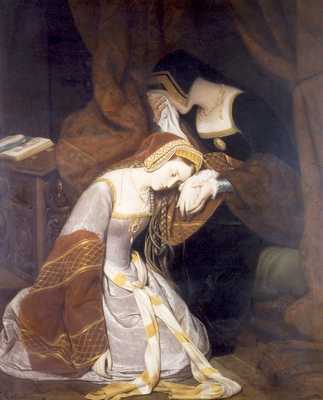 |
| Anne Boleyn in the Tower by Edouard Cibot, 1836. Picture acquired through Wikimedia Commons. Image public domain. |
This is a very valid question, that gives birth to a variety of other questions. If we can ask, "how did Elizabeth Tudor feel about her mother?" then we must also ask, "how did she form that opinion?" Furthermore, we must examine how she rectified her feelings about her deceased mother with her relationship with the father that had her killed.
Using a surprising amount of contemporary evidence and a little bit of conjecture based on fact, I believe I have arrived at a formed opinion on the matter, and I am excited to share it with my readers. Hopefully you will discover things here that you did not know before, and upon finishing the article, share with others how Queen Elizabeth I really felt about her mother, Queen Anne Boleyn.
Queen Anne and Her Daughter
Elizabeth Tudor spent a very brief time with her mother. As was typical in 16th century royal families, Elizabeth was breastfed by a wet-nurse, (despite Anne Boleyn's protestations that she would breastfeed her daughter herself) and infrequently saw her mother. Still, Anne Boleyn and Henry VIII visited their daughter as often as their schedules would allow, and Anne kept up fervent correspondence with those she had entrusted with Elizabeth's care. And, since many of Queen Anne's personal records survive, we know that Anne took great care planning her baby daughter's wardrobe, personally selecting cloth and trimming. Had Anne and Elizabeth been allowed more time together, these two kindred spirits would have undoubtedly enjoyed a close bond. And, perhaps in Elizabeth's adolescence, they would have butted heads a little bit, given that they were so similar!
Despite the fact that Henry VIII had moved heaven and earth to marry Anne Boleyn, his passion for her had almost died out by the third year of their marriage. The qualities in Anne that had initially captivated Henry now irritated him greatly. Queen Anne had been informed that her husband's staff was now questioning members of her own household, and a cancellation of the couples trip to Calais was imminent. The Queen decided to confront her husband about the rumors that he was displeased with her. She must have known that her time was running out, and she appealed to her husband in the most dramatic way possible: through her daughter. The religious reformer Alesius was present at this tragic occasion on Sunday, April 30th, and he later retold the story to an inquisitive Queen Elizabeth I, saying,
"Alas, I shall never forget the sorrow I felt when I saw the sainted Queen, your most religious mother, carrying you, still a baby, in her arms, and entreating the most serene King your father in Greenwich Palace, from the open window of which he was looking into the courtyard and she brought you to him. The faces and gestures of the speakers plainly showed the King was angry."(quoted in Denny)Before Queen Anne was imprisoned in the Tower, she made provisions for her daughter's welfare. Just four days before the now-infamous May Day joust, Anne entrusted the Boleyn family chaplain, Matthew Parker, with her daughter's spiritual well-being (Weir, 5). Matthew Parker would fulfill this duty, and upon Elizabeth's accession he was rewarded for his loyalty to her and her mother, being made Archbishop of Canterbury.
Parker preserved many of Queen Anne and her family members' letters and papers before their ruin; most likely he entrusted them to Queen Elizabeth sometime after 1558. These documents probably did a great deal to illuminate for Elizabeth the life of the mother she had barely known. Another Boleyn family friend, Thomas Cranmer, wrote a very long letter to King Henry VIII on Anne's behalf, in the hope that it would buy her some time (Denny, 279). Still, though, Cranmer's wording in the letter was heavily guarded, because he knew better than to go against the King's justice . After-all, Cranmer had been appointed the task of securing an annulment for the King from Queen Anne; Anne would die for adultery, having never been a wife (Weir, 242-45).
 |
| A detail from a Tudor portrait of Archbishop Thomas Cranmer. Picture acquired through Wikimedia Commons. Image public domain. |
There is evidence that Queen Anne may have been led to believe, at least for a short time, that she and her daughter would be allowed to go into exile in the Protestant countries on the Continent, provided they never returned to England. Cranmer likely fed Queen Anne false information in an attempt to get her to cooperate with an annulment. The Constable of the Tower, Master Kingston reported after Cranmer's meeting with Anne, "This day at dinner, the Queen said she should go to a nunnery, and is in hope of life" (Weir 245). But this, as we know all too well, did not come to pass.
 |
| Anne Boleyn Says a Final Goodbye to her Daughter, Princess Elizabeth by Gustaf Wappers, 1838. Picture acquired through InspirationNow's Tumblr, courtesy of aurora_von_g. Image public domain. |
After The Fall of Anne Boleyn
After the execution of Queen Anne, the court was ripe with horrible slander against her, and given the crimes she had been convicted of, questions concerning her daughter's paternity were circulating (Weir, 316-317). Lady Margaret Bryan and Elizabeth's gentlewoman (and later Governess) Kat Champernowne, no doubt shielded Elizabeth I as best they could from what had really happened, given her young and impressionable age. Margaret Bourchier, Lady Bryan (who was the half-sister of Elizabeth Howard, Anne Boleyn's mother) and Katherine Champernowne (later Astley or Ashley) were both installed by Queen Anne to take care of the Princess Elizabeth (Weir, 314-315). Champernowne was some sort of a Boleyn family connection shown favor by Queen Anne, and she was likely to have always been indebted to her former benefactress. The women cared for Elizabeth as best as they could, given the King's lackadaisical interest in his daughter's upbringing, and provided her with some stability. But the walls of the nursery could not hide Elizabeth from the truth forever.
Since Kat became a surrogate mother figure to Elizabeth, serving her until her death in 1565, we can assume that whatever Kat thought of Anne Boleyn would have been shared, either purposefully or inadvertently, with Elizabeth, even though Henry VIII has forbidden anyone to speak to Elizabeth about her mother.
Since Kat became a surrogate mother figure to Elizabeth, serving her until her death in 1565, we can assume that whatever Kat thought of Anne Boleyn would have been shared, either purposefully or inadvertently, with Elizabeth, even though Henry VIII has forbidden anyone to speak to Elizabeth about her mother.
 |
| A detail of a portrait in the collection of Lord Hastings, purportedly of Katherine Champernowne-Ashley. Picture acquired through Wikimedia Commons. Image public domain. |
We do not know when or how Elizabeth discovered her mother had been beheaded on the orders of her father, but we do know that she recognized the change in her status by the way people were addressing her. Elizabeth, as we know, was incredibly perceptive and precocious from the time that she could speak, and very soon after her mother's death she was recorded to have remarked, "How hath it, yesterday my Lady Princess, and today but my Lady Elizabeth?"
I agree with Weir's conjecture that Elizabeth probably found out what had really happened to her mother over time, having only initially been told a simplified version as a child, and then some placating half-truths as she questioned the story as she grew. Let us hope that she did not find out about the nature of her mother's demise by overhearing it when she was staying at Hunsdon House with her half sister, the Lady Mary Tudor; Lady Kingston visited the Lady Mary on May 26th, 1536, probably to give Mary a first-hand account of Anne's demise (Weir, 319).
However she found out, the "growing awareness of her bastard status must have caused the maturing Elizabeth recurring distress and enduring insecurities, and certainly affected her emotional development." (Weir, 320)
However she found out, the "growing awareness of her bastard status must have caused the maturing Elizabeth recurring distress and enduring insecurities, and certainly affected her emotional development." (Weir, 320)
 |
| A portrait of the Princess Elizabeth Tudor by William Scrots, c.1546. Picture acquired through Wikimedia Commons. Image public domain. |
Most historians agree that her mother's death at the hands of her father, along with the other tragic fates of women in her family at the hands of men, was one of the primary reasons Elizabeth I resolved herself never to marry. The execution of her mother's cousin, and her young stepmother, Katherine Howard in 1542 for similar charges, likely brought Elizabeth's feelings about marriage and her mother to a fever pitch, along with her knowledge of the sordid and sometimes sad marriages of her paternal aunts. Elizabeth's lifelong favorite, Robert Dudley, the Earl of Leicester, would later recall his friend Elizabeth declaring at the tender age of 8, "I will never marry." The young Elizabeth had experienced family-induced trauma, and was trying to make sense of it all at a very young, and vulnerable age.
 |
| A sketch by Hans Holbein, supposedly of Anne Boleyn's cousin and Henry VIII's fifth wife, Katherine Howard. Picture acquired through Flickr, created and shared for public use by Inor19/Kiki. Image public domain |
The Earliest Clues
By 1544 we have our first clue to show us what Elizabeth Tudor thought about her mother. This strong piece of evidence comes to us from the Whitehall family grouping, The Family of Henry VIII. Weir references the evidence and its significance to the bond Elizabeth was forging with her deceased mother in several of her books.
 |
| The Family of King Henry VIII, c. 1544. From left to right: A female fool, probably Will Sommers wife, Mary Tudor, Edward VI, King Henry VIII, Jane Seymour, and Elizabeth, followed by Will Sommers. Picture acquired through Wikimedia Commons. Image public domain. |
Around the year 1544, Henry VIII had a brilliant piece of Tudor propaganda commissioned to portray his ideal nuclear family, and to also re-iterate his Act of Succession of that same year. It now hangs in Hampton Court Palace. The young Elizabeth, aged about ten or eleven, is shown wearing around her neck a pendant in the shape of an "A." Initial pendants were popular in Tudor times, and we know that Anne Boleyn had at least three initial pendants made, the aforementioned "A", the famous "B" necklace, and an "AB", which she wears in the Nidd Hall portrait (Weir, 187).
Elizabeth was probably wearing this pendant that had belonged to her mother often enough for it to have been associated with her. And, I agree with Weir's conclusion that for Elizabeth to publicly display her connection to her mother by donning the pendant in the portrait was not only a quiet act of defiance, (which Henry VIII must have chosen to ignore, given he approved the portrait) but it proves that she must have already been told enough sympathetic things about her mother to have formed a good opinion of her. This means that the royal edict to never speak of Anne Boleyn in Elizabeth's presence was being ignored by more than a few people, and perhaps King Henry had accepted that his daughter had already made up her mind on her mother's innocence, and he was not going to fight the matter with Elizabeth, who was as stubborn as he was.
 |
| The Nidd Hall Portrait, probably of Anne Boleyn. The portrait was done in the second half of the 16th century, and may have been copying an earlier original. One of the major clues that this portrait is of Queen Anne is that the sitter can be seen wearing one of her documented initial pendants, the "AB". Picture acquired through Wikimedia Commons. Image public domain. |
Elizabeth was probably wearing this pendant that had belonged to her mother often enough for it to have been associated with her. And, I agree with Weir's conclusion that for Elizabeth to publicly display her connection to her mother by donning the pendant in the portrait was not only a quiet act of defiance, (which Henry VIII must have chosen to ignore, given he approved the portrait) but it proves that she must have already been told enough sympathetic things about her mother to have formed a good opinion of her. This means that the royal edict to never speak of Anne Boleyn in Elizabeth's presence was being ignored by more than a few people, and perhaps King Henry had accepted that his daughter had already made up her mind on her mother's innocence, and he was not going to fight the matter with Elizabeth, who was as stubborn as he was.
 |
| A composite image of King Henry VIII's daughters from the portrait The Family of King Henry VIII. Mary is on the left and Elizabeth is on the right. Take special note of the "A" pendant around Elizabeth's neck, which once belonged to her mother, Anne Boleyn. Picture acquired through Flickr, created and shared for public use by Kotomic Creations. |
By 1548 the young Elizabeth was blossoming into an an ambitious pupil, thanks to the education and attention allotted to her by her loving stepmother, Queen Katherine Parr. Elizabeth choice of literary text to translate as a gift for Katherine Parr may be another early clue that Elizabeth felt positively about her mother. Elizabeth's choice to translate Margaret of Navarre's moralistic The Mirror of The Sinful Soul may have been purposeful, given that Anne Boleyn had been well acquainted with Margaret of Navarre, when she was known as Margaret of Angloume.
 |
| The cover to Elizabeth Tudor's translation of The Mirror of the Sinful Soul, which was given as a gift to her beloved stepmother, Katherine Parr in 1548. The young Elizabeth personally embroidered the cover as well, including her stepmothers initials, "KP" in the center. Picture acquired through Wikimedia Commons. Image public domain. |
Elizabeth and Mary Boleyn
 |
| Alison Weir builds a convincing case that this miniature, previously thought to be Anne Boleyn at 25, is actually Mary Boleyn. As I have long suspected myself, the portrait commonly identified as Mary Boleyn can only be of a woman of noble birth, and Weir puts forth theories as to her identity, (one possibility if Frances Brandon) as well. Picture acquired through Wikimedia Commons. Image public domain. |
Besides Elizabeth learning about her mother from the usual suspects, (Kat Champernowne-Ashley, Lady Bryan, Matthew Parker, Thomas Cranmer) her uncle by marriage, William Stafford, may have supplied her with information. William Stafford had married Elizabeth's maternal aunt, Anne Boleyn's sister, Mary Boleyn, for love; and he was still employed at court in the years when Elizabeth would have been visiting her father off-and-on.
Though Elizabeth's initial visits to court were few and far between, they may have given Stafford the opportunity to interact with Elizabeth, or even pass information from his wife on to her niece, whom she had not seen since 1534. Mary and Anne were estranged at the time of Anne's fall, but Mary may have had some good memories she wanted to pass on to Elizabeth through her husband or other clandestine methods. Of course, this is all speculation, but in later years Elizabeth's relationship with William Stafford and his second wife, Dorothy, suggests an already established bond that perhaps had its origins in childhood (Weir discusses this topic at length in her book Mary Boleyn: The Mistress of Kings).
Though Elizabeth's initial visits to court were few and far between, they may have given Stafford the opportunity to interact with Elizabeth, or even pass information from his wife on to her niece, whom she had not seen since 1534. Mary and Anne were estranged at the time of Anne's fall, but Mary may have had some good memories she wanted to pass on to Elizabeth through her husband or other clandestine methods. Of course, this is all speculation, but in later years Elizabeth's relationship with William Stafford and his second wife, Dorothy, suggests an already established bond that perhaps had its origins in childhood (Weir discusses this topic at length in her book Mary Boleyn: The Mistress of Kings).
Elizabeth Almost Shares Her Mother's Fate
 |
| The Queen's House inside The Tower of London, where Elizabeth Tudor was imprisoned. This part of the Tower is not open to the public, as it is a private residence, and one can only tour the rooms with prior permission. Picture acquired through Wikimedia Commons. Image public domain. |
In 1554, when Elizabeth was 20, she came very close to sharing the exact same fate as her mother. One can imagine her horror when she was arrested at Ashridge and imprisoned in the Tower by her sister, Queen Mary I for three months on suspicion of treason. Elizabeth, along with four female attendants, (one of which was probably her illegitimate half sister, Ethelreda Malte) was imprisoned in the Queen's lodgings.
 |
| A photo of the The Tower of London as it looks today, with the missing Tudor buildings super-imposed and labeled. Picture acquired through Flickr courtesy of That Boleyn Girl. |
(Friends to BeingBess Natalie Grueninger and Claire Ridgway have called to my attention that Anne was lodged in quarters close to the White Tower; these were the same apartments in which she stayed before her coronation. Unfortunately, these rooms have since been demolished. Seeing as the primary subject of my research is Elizabeth Tudor, I am always grateful for the feedback I receive from those who study her mother, Anne Boleyn, with equal intensity.)
 |
| A photo of the Tower of London as it looks today, with the missing Tudor buildings super-imposed and labeled. Queen Anne Boleyn's apartments are clearly visible in this view. Picture acquired through Flickr courtesy of That Boleyn Girl. |
As a prisoner of royal birth Elizabeth was afforded a few privileges. She could take a daily, supervised walk, which unfortunately took her along the wall that overlooked the scaffold site before the House of Ordnance. Thus, if Elizabeth wanted fresh air and the opportunity to stretch her legs, she must repeatedly pass the exact place where her mother died, and where she, Anne Boleyn's daughter, might meet her own end (Weir, 321).
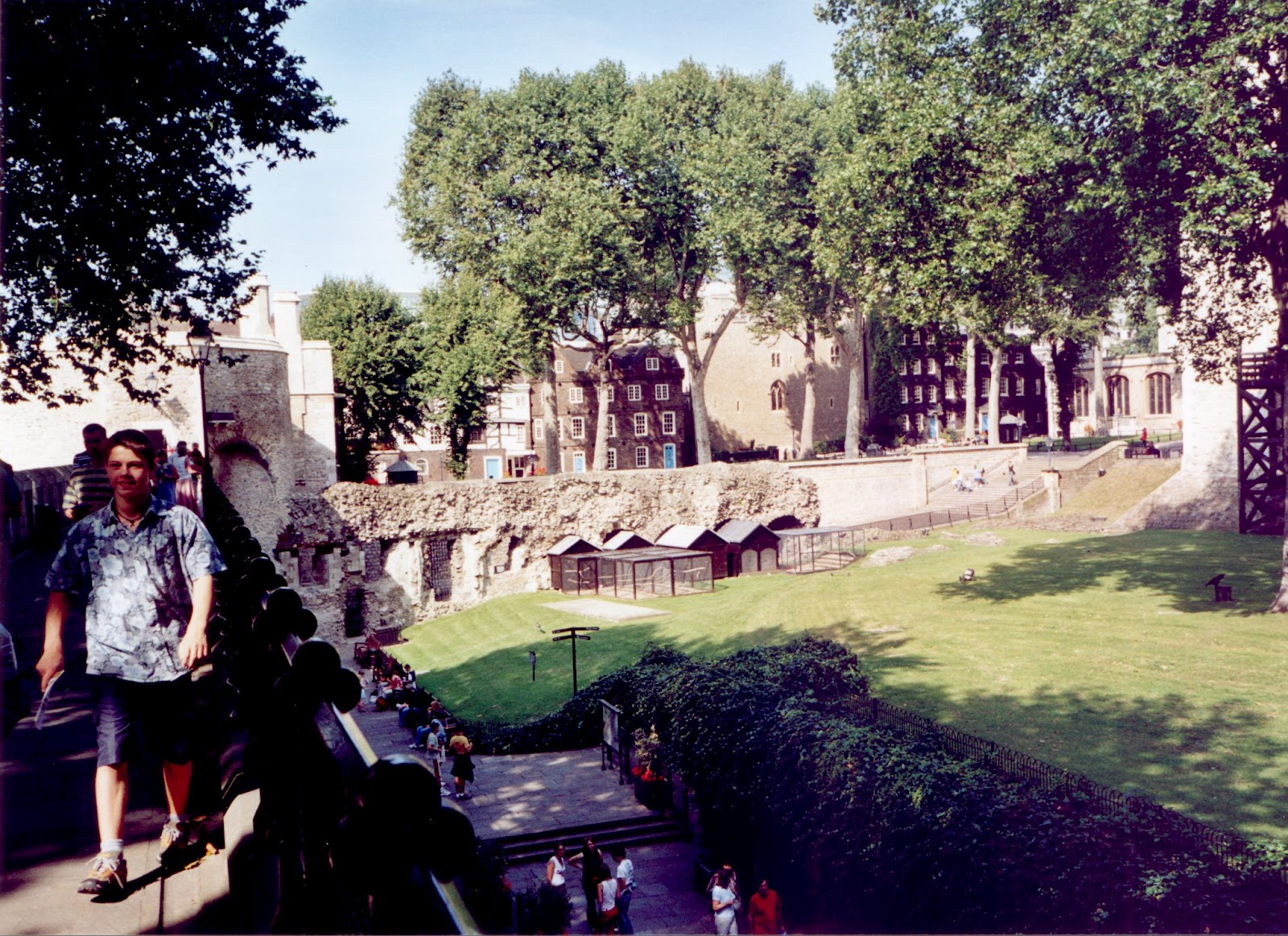 |
| The inner courtyard seen from the wall-walk at The Tower of London. Picture acquired through Wikimedia Commons, courtesy of Crux. Image public domain. |
Years later, when Elizabeth was Queen, she divulged to a French nobleman that she had thought she would die in the Tower, and that she could not bear the thought of an axe hacking at her neck. So, she had resolved herself to ask for a French swordsman instead. That way she, like her mother, could be quickly dispatched (Erikson, cited in Weir, 321).
Elizabeth and Her Carey Cousins
While the young Elizabeth may not have remembered her aunt, and perhaps had only brief encounters, if any, with her uncle in childhood, she did enjoy a special closeness with her Carey cousins. Katherine and Henry Carey were the children of Mary Boleyn. Though their individual paternity is uncertain, they were her first cousins. Their relationship is another shining example that Elizabeth felt positively about her mother; had she believed in her mother's guilt, she would never have wanted to put her reputation at risk by associating with the immediate relatives of a convicted traitor and adulteress.
While Queen Anne had secured the wardship of her nephew Henry Carey and cared for him well during her brief time as Queen, Henry VIII continued to provide for him after her execution. This was not out of any genuine affection, or, as some have suggested, because he was Henry VIII's illegitimate child, but because it was his duty to do so as King. Henry VIII also provided for Katherine Carey, albeit in a much more generous and interested manner. Weir makes a very strong case that it was Katherine, not her brother Henry, who was Henry VIII illegitimate child by Mary Boleyn.
 |
| King Henry VIII by Joos van Cleve, circa 1535. Picture acquired through Wikimedia Commons. Image public domain. |
Elizabeth and her Carey cousins first came into acquaintance in childhood; we can imagine how delighted Elizabeth must have been to have finally made contact with a part of her life that had been forbidden to her for so long. Elizabeth probably first met Henry Carey when he was her father's ward, or possibly a short time after, when he had become a member of the King's household. There is some evidence that Katherine Carey spent some of her formative years time in the household of the Lady Elizabeth (Weir).
The cousins were certainly acquaintances by 1551, since Elizabeth's Hatfield accounts for the years 1551-52 show that she made a monetary gift "at the christening of Mr. Carey's child." (Weir, 259) This child was probably Philadelphia Carey, later the wife of Baron Thomas Scrope. She and her elder sister Katherine Carey-Howard (see my biography of her HERE) were to become two of Queen Elizabeth I's favorite Maids of Honor (Weir, 259).
While one or both of the Carey siblings could have been Queen Elizabeth I's half-siblings (she certainly would have heard the rumors, and likely had formed her own opinion on the matter) Elizabeth could never safely make any overtures that would suggest as much, as this would have been proof of the impediment concerning her mother and father's marriage; Elizabeth herself had been declared illegitimate in 1536 simply because of her father's affair with Mary Boleyn, despite a prior papal dispensation that allowed Henry VIII to marry the sister of his mistress (Weir, 259).
 |
| A portrait of Henry Carey, the first husband of Mary Boleyn and most likely the father of Henry Carey, later 1st Baron Hunsdon. Picture acquired through Wikimedia Commons. Image public domain. |
Siblings or not, the bond between Elizabeth, Henry and Katherine was unusually strong. After she became Queen, Elizabeth treated them both with a great deal less formality than her other intimates at court, and often laughed and joked with them boisterously, particularity in the case of her saucy cousin, Henry.
 |
| A portrait of Henry Carey, 1st Baron Hunsdon, maternal first cousin of Queen Elizabeth I. Picture acquired through Wikimedia Commons. Image public domain. |
Elizabeth's letters are a testament to their bond; in one letter, written in 1579, she referred to Henry Carey as "our cousin of Hunsdon." She also signed letters to Katherine as simply, "your loving cousin."
Upon her accession in November of 1558, Elizabeth immediately began assembling her maternal relatives around her in what I would call a makeshift family. Henry and Katherine Carey were her closest living blood relatives, aside from the problematic Grey sisters, Margaret Douglass, Countess of Lennox, and of course, Mary Stuart, Queen of Scot. The Carey siblings were Elizabeth's only direct connection to her own mother (Mary Boleyn had unfortunately died in 1543). And, unlike most of Elizabeth I's friendships and romantic attachments, her Carey cousins' devotion to her never wavered. Elizabeth never had to question their integrity or loyalty, and she found great peace, and perhaps even a feeling of saftey, because of it.
 |
| A detail from a portrait of Margaret Douglass, Countess of Lennox, who was the mother of Henry, Lord Darnley, and thus mother-in-law to Mary, Queen of Scots. Picture acquired through Wikimedia Commons. Image public domain. |
In addition to the many honors the the hard-working Henry Carey earned while Elizabeth was Queen, he was created 1st Baron Hunsdon. As Lieutenant General of the North, Hunsdon suppressed one of the most serious threats of Elizabeth's reign, the Northern Rebellion of 1569-70. When the rebel army was defeated, with Hunsdon driving Leonard Dacre back over the border, Elizabeth added a personalized note to the congratulatory form letter sent from the state, saying,
"I doubt much, my Harry, whether that the victory were given me more joyed me, or that you were by God appointed the instrument of my glory, and I assure you that, for my country's good, the first might suffice, but for my heart's contentation, the second pleased me...your loving kinswoman, Elizabeth R." (National Archives, cited in Weir, 263)
In addition to quelling the Northern Rebellion, Henry Carey, or Baron Hunsdon, was part of all the major political and military events of Queen Elizabeth's reign; most notably he was a commissioner at the Queen of Scots' trial, and commanded a force of over 30,000 at Tilbury Fort in 1588, where Queen Elizabeth had sent him "for the defense and security of our royal person."
 |
| A romantic interpretation of Queen Elizabeth I addressing her troops at Tilbury. Picture acquired through Wikimedia Commons. Image public domain. |
Still, Queen Elizabeth, not one for sycophancy like her predecessors, only gave accolades to those that had earned it. One of the many ways she kept her celebrated cousin Hunsdon in check was by never granting him his long-sought-after hereditary titles, Earl of Ormond and of Wiltshire. Hunsdon laid claim to these titles through their shared grandfather, Thomas Boleyn (Weir, 262).
While Henry Carey was a leading figure in the public life of Queen Elizabeth, his sister Katherine Carey, or Lady Knollys, got to see the private side of their cousin. This was a privilege allotted to few. Katherine and Elizabeth were already very close by the time Mary Tudor sat upon the throne. Katherine and her husband Francis Knollys, an outspoken man whose religious convictions would later lead him to become a champion in Parliament for the Puritan movement, felt it best to flee abroad with their children rather than run the risk of persecution (Read my bio of Sir Francis Knollys HERE).
Elizabeth mourned her separation from her dear cousin, signing her farewell letter to her "cor rotto", or, "broken heart." (Weir, 270) Elizabeth must have experienced great fear and sadness, and perhaps a sense of betrayal, as the majority of the people she had trusted (such as the Knollys' and the Stafford's) fled abroad. As the sister of the Queen, Elizabeth was very closely monitored and never could have escaped herself, even if she had wanted to. Elizabeth may have permitted the dark thought that her sister's reign of terror would only continue, and that she would never see her friends and family again.
Elizabeth mourned her separation from her dear cousin, signing her farewell letter to her "cor rotto", or, "broken heart." (Weir, 270) Elizabeth must have experienced great fear and sadness, and perhaps a sense of betrayal, as the majority of the people she had trusted (such as the Knollys' and the Stafford's) fled abroad. As the sister of the Queen, Elizabeth was very closely monitored and never could have escaped herself, even if she had wanted to. Elizabeth may have permitted the dark thought that her sister's reign of terror would only continue, and that she would never see her friends and family again.
 |
| A portrait of a pregnant lady with her dog, most likely Katherine Carey-Knollys, by Steven van der Muelen c. 1562. |
Upon Elizabeth I's accession, the Knollys' returned to England. Katherine was made a Lady of the Privy Chamber, her husband a Privy Councilor and Vice Chamberlain of the Queen's household, as well as Governor of Portsmouth.
The French Ambassador Fenelon observed that Queen Elizabeth "loved Lady Knollys above all other women in the world." Besides the shared Boleyn/Howard blood running through their veins, Elizabeth was certainly drawn to Katherine's personality; she was reported to have been graced with "wit and council sound" and "a mind so clean [and] devoid of guile."
Upon the death of Elizabeth's childhood governess and surrogate mother figure, Katherine Champernowne-Astley in 1595, Katherine Carey-Knollys succeeded her as Chief Lady of the Bedchamber.
Katherine's devotion to the Queen and her duties as a wife and mother were often at odds; Elizabeth could not bear to part with her cousin for any substantial length of time, and Francis was just as attached to his wife as the Queen was. Elizabeth often refused Katherine and Francis's requests to visit one another.
In the end it was Elizabeth who was with Katherine Carey-Knollys when she died in 1569 at Hampton Court Palace while Francis was away on state business. Both would mourn Katherine's passing with equal intensity. Knollys lamented, "my case is pitiful" and that he was "distracted with sorrow." Queen Elizabeth assisted with her cousin's funeral, paying more for her burial that she ever had for any other relation; the sum reached the modern equivalent of 111,300 pounds!
 |
| The tomb effigy of Katherine Carey-Knollys' husband, Sir Francis Knollys. Picture acquired through Wikimedia Commons. Image public domain. |
In the end it was Elizabeth who was with Katherine Carey-Knollys when she died in 1569 at Hampton Court Palace while Francis was away on state business. Both would mourn Katherine's passing with equal intensity. Knollys lamented, "my case is pitiful" and that he was "distracted with sorrow." Queen Elizabeth assisted with her cousin's funeral, paying more for her burial that she ever had for any other relation; the sum reached the modern equivalent of 111,300 pounds!
Even the trappings of the memorial service were lavish, as there was a dispute between the clergy of Westminster Abbey and the College of Arms over who got to keep the furniture (Weir, 272).
Queen Elizabeth: Her Mother's Daughter
As we have seen, there is ample evidence which strongly suggests that Queen Elizabeth I felt positively about her mother. Still, many people continue to try to counter the evidence. Some historians, like David Starkey, believe that Elizabeth and her father has a mostly positive relationship. With respect to Mr. Starkey and his great contribution to researching Tudor history, I find this to be an over-generalization of a very complicated dynamic, and an examination of their relationship if worthy of its own article!
Why would Elizabeth, many have wondered, constantly assert that she was "a lion's cub" and her "father's daughter" etc., if she believed her father had deprived her of a mother by unlawfully ending her life on trumped-up charges? And why didn't Elizabeth I, like her sister Mary, push to have her mother's reputation restored and her parent's marriage declared legitimate?
Why would Elizabeth, many have wondered, constantly assert that she was "a lion's cub" and her "father's daughter" etc., if she believed her father had deprived her of a mother by unlawfully ending her life on trumped-up charges? And why didn't Elizabeth I, like her sister Mary, push to have her mother's reputation restored and her parent's marriage declared legitimate?
 |
| Elizabeth I's half-sister, Mary Tudor. Picture acquired through Wikimedia Commons. Image public domain. |
The answer to the first question is very simple: Elizabeth was first and foremost a survivor, and her choice to stress her connections to her father, rather than to her mother was deliberate and strategic. With so much doubt cast on Elizabeth I's paternity, it was essential that she continue to stress, throughout her life, that she was the daughter of King Henry VIII. And, while her father was royal, a distinction that con-notated prestige and respectability, her mother was the daughter of an upwardly mobile nobleman, one of King Henry VIII's "new men." There was no reason to stress a connection that would politically gain her nothing.
While Elizabeth constantly stressed her paternity, she also did not hide away her pride in being her mother's daughter; in fact, she sometimes flaunted it! On her way to her coronation in 1559, Elizabeth passed through a triumphal arch in Gracechurch street during her progress through London to Westminster Abbey. One of the spectacles displayed en route in her honor was a very blatant tribute to both her father and her mother. The "Pageant of the Roses" featured life-size effigies of King Henry VIII and Anne Boleyn seated together on a dais:
"King Henry the Eighth with a white and red rose [Tudor rose] in front of him, with the pomegranate [symbol of their fertility, resulting in the birth of Elizabeth] between the, and Queen Anne Boleyn, mother of the present Queen, with a gold crown on the head and a gilt scepter, and in front of her small branches of little roses [and] the coat of arms and device of the same Queen." (Foxe, quoted in Weir, 322)
Above the effigy's of King Henry VIII and Queen Anne sat Elizabeth I's own figure. There is also evidence to support the theory that the lighter crown worn by Queen Elizabeth after her coronation may have been the one originally made for her mother in 1533 (Arnold, cited in Weir, 322).
 |
| A rendering (probably by an eye-witness) of the coronation procession of Queen Elizabeth I, c.1559. Sketch from a document in the College of Arms. Picture acquired through Wikimedia Commons. Image public domain. |
Since Queen Elizabeth's decision to stress her paternity rather than play up the connections to her mother is understandable, the harder question to answer is why did Queen Elizabeth not do as Mary had done and reverse the legal rulings concerning her parents marriage?
There was, in fact, much debate early in Elizabeth's reign as to whether she should do as her sister had done. It would have been unwise to bring up and dissect old controversies surrounding her mother's conviction and execution; doing so would have certainly caused not only an uproar in England but also Catholic Europe, who watched Queen Elizabeth and all her decisions with great interest. To have re-hashed the past may have cast further doubt on the already precarious Tudor dynasty and Elizabeth's right to rule.
Queen Elizabeth ultimately chose to put aside her personal belief that her mother was innocent, instead favoring a more reasonable approach, which would help to ensure the stability of her realm. Instead of ordering a full-blown investigation, Queen Elizabeth took the advice of her Lord Keeper of the Great Seal, Sir Nicholas Bacon, who had pointed out to her that she was the lawful heiress to the throne of England under Henry VIII's 1544 Act of Succession, and no further validation was needed.
Parliament drew up a sparsely worded, to-the-point statute confirming Elizabeth's right to be Queen of England. Elizabeth then had a separate act passed declaring that she was her mother's sole heiress, enabling her to inherit her mother's property, which had been forfeited to the crown upon her death (Ridley, Neale, cited in Weir).
Elizabeth did not move her mother's body from the Royal Chapel in the Tower for the very same reason: she did not want to court controversy. Also, there was the problematic technicality that Anne Boleyn had died in the Catholic faith, having been a reformer of the Catholic religion, and not a Lutheran as she is sometimes called. It would have been quite difficult to determine the appropriate funeral rites for re-burial.
Queen Elizabeth never forgot the grisly death of her mother at the hands of her father, and she often referenced the tragedy that had come to pass, even if it was somewhat indirectly. In 1561 Elizabeth told a Scottish envoy that marital conflicts and disastrous ends in her own family (without referencing her mother specifically) had led her to doubt the stability of the institution of marriage, saying,
Queen Elizabeth ultimately chose to put aside her personal belief that her mother was innocent, instead favoring a more reasonable approach, which would help to ensure the stability of her realm. Instead of ordering a full-blown investigation, Queen Elizabeth took the advice of her Lord Keeper of the Great Seal, Sir Nicholas Bacon, who had pointed out to her that she was the lawful heiress to the throne of England under Henry VIII's 1544 Act of Succession, and no further validation was needed.
 |
| A copy of another relevant document, the Oath of Allegiance from 1534, which required all of Henry VIII's subjects to swear an oath that they believed in the validity of their King's marriage to Anne Boleyn. This oath would also by default also confirm their belief in the Princess Elizabeth's legitimacy. Picture acquired through Wikimedia Commons. Image public domain. |
Elizabeth did not move her mother's body from the Royal Chapel in the Tower for the very same reason: she did not want to court controversy. Also, there was the problematic technicality that Anne Boleyn had died in the Catholic faith, having been a reformer of the Catholic religion, and not a Lutheran as she is sometimes called. It would have been quite difficult to determine the appropriate funeral rites for re-burial.
Queen Elizabeth never forgot the grisly death of her mother at the hands of her father, and she often referenced the tragedy that had come to pass, even if it was somewhat indirectly. In 1561 Elizabeth told a Scottish envoy that marital conflicts and disastrous ends in her own family (without referencing her mother specifically) had led her to doubt the stability of the institution of marriage, saying,
"Some say that this marriage was unlawful, some that one was a bastard, some other, to and fro, as they favored or misliked. So many doubts of marriage was in all hands that I stand [in] awe myself to enter into marriage, fearing the controversy." (Weir, 320)
 |
| A portrait of Queen Anne Boleyn at Hever Catle, the Boleyn family ancestral home. This portrait is probably a copy of a now-lost 1534 original. Picture acquired through Wikimedia Commons. Image public domain. |
In 1565, the Queen expressed her fear that, if she were to marry, her husband might "carry out some evil wish, if he had one," and that she "hated the idea of marriage every day more, for reasons which she would not divulge to a twin soul, if she had one, much less a living creature." (First quote delivered to a French diplomat, recorded in Relations Politiques de France avec l'Ecosse, quoted in Weir, 320-21. Second quote from the Spanish Calender, quoted in Weir, 321.)
 |
| The Rainbow Portrait of Queen Elizabeth I, the eternal Virgin Queen, c. 1600-02. Picture acquired through Wikimedia Commons. Image public domain. |
Even Archbishop Parker could not sway her opinions on marriage; when he had spoken to the new Queen, per the request of William Cecil, about the benefits of the estate of matrimony, Parker reported her taking the occasion, "to speak in bitterness of the holy estate of matrimony." He told Cecil that "he was in a horror to hear her." (Weir, 320)
 |
| A detail of a portrait of Archbishop Matthew Parker. To learn more about him, read my biography on him HERE. Picture acquired through Wikimedia Commons. Image public domain. |
Elizabeth's aversion to violence, (a most un-Tudor-like quality) in particular decapitation, especially when it had to do with relations, (such as Thomas Howard, 4rth Duke of Norfolk and Mary Stuart) was probably due in large part to her childhood traumas and her own near-death experience in the reign of her sister. Queen Elizabeth always made a great effort to spare her people of the frequent violence she had personally experienced, and that they had endured under the rules of her family members.
 |
| A portrait of Mary,Queen of Scots, which resided in the Blairs museum. Queen Elizabeth I had to make the very difficult decision to execute her cousin for actively plotting against her life and planning to steal the throne of England. However guilty Mary Stuart may have been, Elizabeth I experienced genuine distress over ordering her execution. Picture acquired through Wikimedia Commons. Image public domain. |
After Elizabeth I was excommunicated by the Pope in 1572, she had Matthew Parker, Archbishop of Canterbury, track down and study the papal bull of dispensation from 1528 that had sanctioned her parents marriage. Queen Elizabeth wanted to have the document on file in case she needed to prove her legitimacy, beyond a shadow of a doubt, to Catholic Europe.
At St. Margaret's Church in Norfolk, the tympanum, dating from 1587, displays the Tudor arms and Queen Elizabeth I's achievements. If you look closely, you will be able to see the crowned falcon badge painted below the Tudor family heraldic shield!
Amongst Queen Elizabeth I's many virginals, there is a set one that bears the Boleyn coat of arms, and may have once belonged to Anne Boleyn herself. The pair of virginals are now part of the collection in the Victoria and Albert Museum, London (Weir, 324).
SEMPER EADEM and Shared Heraldry
Another way we know how Elizabeth felt about her mother was that she chose to adopt her mothers heraldic emblem and motto, and display it publicly. Queen Elizabeth used one of her mother's motto's, SEMPER EADEM, which is Latin for the phrase, "Always the Same."
She also adopted her heraldic badge of a crowned falcon upon a tree stump, surrounded with Tudor roses. The falcon is the heraldic charge standing for "perseverance," a quality that both Elizabeth and Anne embodied.
 |
| The crowned falcon badge of Queen Anne Boleyn, later adopted by her daughter, Queen Elizabeth I. In addition to adopting her mothers heraldic badge, Elizabeth also used her motto, SEMPER EADEM, which is Latin for "Always the Same." Picture acquired through Wikimedia Commons. Image public domain. |
At St. Margaret's Church in Norfolk, the tympanum, dating from 1587, displays the Tudor arms and Queen Elizabeth I's achievements. If you look closely, you will be able to see the crowned falcon badge painted below the Tudor family heraldic shield!
 |
| This tympanum is part of the lavishly painted interior of St. Margaret's Church, Norfolk. Picture acquired through Wikimedia Commons. Image public domain courtesy of Evelyn Simak. |
The Chequers Ring
30 years after a ten- or eleven-year-old Elizabeth had defiantly donned her mother's "A" initial pendant in the portrait The Family of King Henry VIII, she commissioned a unique piece of jewelry herself. Even if you disregard all the other evidence presented, this ring alone proves, beyond a shadow of a doubt, that Elizabeth believed in her mother's innocence.
 |
| The exterior of Queen Elizabeth's locket-ring, commissioned in 1575 and now known as the Chequers ring. Picture acquired through Wikimedia Commons. Image public domain. |
In 1575, Queen Elizabeth I commissioned a gold locket ring, which was covered in diamonds that formed the letter "E", for Elizabeth, and had the letter "R", for Regina in blue enamel. The locket's secret compartment opened to reveal the painted miniature reliefs of her mother and herself, side by side.
 |
| The interior of the Chequers ring, commissioned in 1575 and worn by Queen Elizabeth I until her death. The interior reveals the cameo reliefs of Elizabeth I and her mother, Anne Boleyn. Picture acquired through Wikimedia Commons. Image public domain. |
From 1575 until her death, Queen Elizabeth I never took the ring off of her finger; it only left her person after when it was taken to her successor, James VI of Scotland, as proof of her death. The ring is now in the Chequers collection, from which it derived it's name, and is currently on display in the new exhibit, Gold: Power and Allure.
If you have the opportunity, I hope you will go and see this stunning testament to the eternal bond between England's greatest monarch, Elizabeth I, and the enigmatic mother she barely knew, Queen Anne Boleyn.
If you have the opportunity, I hope you will go and see this stunning testament to the eternal bond between England's greatest monarch, Elizabeth I, and the enigmatic mother she barely knew, Queen Anne Boleyn.
Sources
Weir, Alison. Mary Boleyn: The Mistress of Kings. New York: Ballantine Books, 2011. Print.
Weir, Alison. The Lady in The Tower. New York: Ballantine Books, 2010. Print.
Weir, Alison. Henry VIII: The King and His Court. New York: Ballantine Books, 2007. Print
Denny, Joanna. Anne Boleyn: A New Life of England's Tragic Queen. De Capo Press, 2006. Print.
(Please note this biography has been scrutinized as being too partial to Anne; Denny never says a single bad thing about her subject, and her work is considered extremely biased. That being said, I agree with the way Denny synthesizes the evidence at hand, and I do like that she cites many primary sources which are often overlooked.)
Weir, Alison. Henry VIII: The King and His Court. New York: Ballantine Books, 2007. Print
Denny, Joanna. Anne Boleyn: A New Life of England's Tragic Queen. De Capo Press, 2006. Print.
(Please note this biography has been scrutinized as being too partial to Anne; Denny never says a single bad thing about her subject, and her work is considered extremely biased. That being said, I agree with the way Denny synthesizes the evidence at hand, and I do like that she cites many primary sources which are often overlooked.)


