Showing posts with label Bess to Impress: The Portraits of Queen Elizabeth I. Show all posts

Tuesday, April 18, 2017

Bess to Impress: A Rare Portrait of Elizabeth I, From a Private Collection


Portrait of Queen Elizabeth I, circa 1560. Oil on panel, by an Unknown Artist. Yale Center for British Art. On loan from Neville and John Bryan. Photo by A.Jensen.
On my most recent trip to the Yale Center for British Art, I was pleased to discover that they had rotated some new Elizabethan portraits into the galleries. Of the new pieces on display, the portrait that captivated me the most was a small, unassuming oil on panel portrait of Queen Elizabeth I that I hadn't been previously aware it existed. I read that it was on loan to the museum from a private collection, which explained its anonymity. This also made me wonder how many other long-lost portraits of Queen Elizabeth I there are in people's personal homes.

When this portrait of Queen Elizabeth I was made, it was still early in her reign, and Elizabeth's counselors expected her to marry a foreign prince. However, her attachment to her friend, Robert Dudley, prevented her from taking any marriage proposal seriously at this time.

In the portrait, Elizabeth I is shown before a Canopy of State, with a courtyard in the background. The small stature of the portrait suggests that it may have been made for the home of someone close to Queen Elizabeth I. This is a possibility, as there have been many other portraits discovered of Elizabeth I that were made for personal use. It is easy to see the difference between the opulent, majestic State portraits of the queen, intended for display at court, versus the more understated ones, intended for private devotion in the homes of Elizabeth I's courtiers.

Portrait of Queen Elizabeth I, circa 1560. Oil on panel, by an Unknown Artist. Yale Center for British Art. On loan from Neville and John Bryan. Photo by A.Jensen.

A label on the reverse of the portrait shows that Elizabeth I had long been mistaken for another sitter, until the portrait came into the hands of the present owners. It is surprising to me that the sitter could have been thought to be anyone else, as her facial features so distinctly identify her as Elizabeth.

It's always exciting to discover something new that you never knew existed before; I was so happy to have seen this portrait in person, that I just knew I had to share it with all of you! It was encased in glass, so it was challenging to get a picture without a glare, but I hope the pictures I did manage to get captured the appeal of the portrait.


Monday, January 5, 2015

Bess to Impress: Elizabeth I (1565-70) by Hans Eworth

I recently visited the Portland Art Museum to view their temporary exhibit Treasures of British Art 1400-2000, from the Berger Collection at the Denver Art Museum. The exhibit featured paintings of Tudor monarchs and their courtiers and other subjects, including, of course, Queen Elizabeth I. In fact, her visage was clearly considered the one most likely to garner attention for the exhibit, as it advertised it and greeted patrons at the front entrance of the museum.

At the Portland Art Museum, being greeted by Queen Elizabeth I at the front door! Photo by L.Jensen.

It is one of my personal goals in life to see every portrait of Queen Elizabeth I that was painted during her lifetime, meaning the ones that are in public collections, or that are regularly put out on loan from private collections into exhibits. I call it my "Queen Elizabeth I Portrait Bucket List"! At the Portland Art Museum, I was able to check yet another one off my list: A portrait of Queen Elizabeth I from early in her reign, painted between 1565-1570 by Belgian-born Elizabethan court artist Hans Eworth (circa 1520-after 1578). The portrait was painted shortly after the Protestant Queen Elizabeth I, Head of the Church of England, was excommunicated by the pope in Rome from the Catholic faith (I'll just let the futility of the pope's gesture sink in for a second). 

Portrait of Queen Elizabeth I of England. By Hans Eworth, circa 1565-70. Photography by A.Jensen permitted by the Portland Art Museum. In the Berger Collection at the Denver Art Museum.

The pose of Queen Elizabeth I's face in this Eworth painting has been copied in a series of other similar portraits from around the same time; typically, portraits approved by the queen were copied by other artists for the mass market, as images of the queen were in high demand from her loyal subjects.

The Eworth painting is oil on panel. Paintings done on wood were often subject to rot and water damage over time, and the original image may have been cut down. Likely, Queen Elizabeth was originally depicted with her hands shown, like the following portraits of her father and her brother, also on display in the exhibit.

Portrait of Henry VIII, circa 1513. Photography by A.Jensen permitted by the Portland Art Museum. In the Berger Collection at the Denver Art Museum.
Portrait of Edward, Prince of Wales (later King Edward VI). By Hans Holbein the Younger and his studio, circa 1538. Photography by A.Jensen permitted by the Portland Art Museum. In the Berger Collection at the Denver Art Museum.

 The young Queen Elizabeth I, as painted by Eworth, is not dressed in the elaborate, overwhelming costumes of the 1580's and 90's, when she fashioned herself as "Gloriana". Rather, she wears more understated cothing and accesories. To view other Queen Elizabeth portraits from around the same time period, click on the links below:

Bess to Impress: The Clopton Portrait 

Bess to Impress: The Hampden Portrait


Thursday, May 23, 2013

Bess to Impress: The Hampden Portrait

 
The Hampden Portrait of Queen Elizabeth I, c. 1563. Attributed to Steven van der Meulen. Philip Mould Fine Paintings. Picture acquired through Wikimedia Commons. Image public domain.


The Hampden Portrait of Queen Elizabeth I was painted c.1563 and is attributed to Steven van der M eulen. Its existence was first documented in the 19th century, when it was still part of the private collection at Hampden House, which also included a portrait of Queen Elizabeth that had been intended as a gift for Mary, Queen of Scots, and a portrait of Queen Mary I (Burke, 186). The portrait was originally given as a gift from Queen Elizabeth to Griffith Hampden to commemorate her visit to Hampden House; this was a typical way in which Queen Elizabeth demonstrated her gratitude to those who housed her and her extensive retinue on progress. The Hampden Portrait was sold at auction through Sotheby's in London on the 22nd of November, 2007. It was purchased by Philip Mould Fine Paintings of London for 2,596,000 pounds!

Through his studies of the portraits of Queen Elizabeth I, Sir Roy Strong has determined that The Hampden Portrait is one of the first portraits of Queen Elizabeth I to include a political agenda, since she had only just survived a brush with death due to smallpox, and needed to reassert her authority. In the portrait, Queen Elizabeth I wears a red and white dress; this was likely purposeful, chosen to signify the unity of the House of York and the House of Lancaster through the marriage of Henry VII and Elizabeth of York, which brought relative peace to England after years of dynastic struggle (a series of wars posthumously known as the Wars of the Roses) and established the illustrious Tudor dynasty. To further the message, the Queen wears a Tudor rose corsage and Tudor rose collar around her neck. The pendant worn by the Queen appears to be one of the Arundel gems, later acquired by the Duke of Marlborough in the 18th century. The tapestry in the background includes the Queen's heraldic arms and a tree bearing fruit, advertising Elizabeth's fertility.  

Strong has identified The Hampden Portrait as the first portrait of Elizabeth I to include the armillary sphere as a royal emblem; the sphere can be seen on the lower part of her large strand of pearls. This celestial sphere was used ad naseum in the Renaissance and was adopted by Queen Elizabeth I. Other notable appearances of the armillary sphere include:

* at the end of a French psalter given to Elizabeth when she was Princess
* on the back of a coin from about 1569
* on the Queen's sleeve in a portrait from the 1580's
* and in The Ditchley Portrait the Queen's earring is shaped like an armillary sphere

Queen Elizabeth has removed her left glove in order to display her "beautiful hand", as it was described by Giovanni Michiel in 1557 when he wrote to the Venetian Doge. In her right hand, the Queen holds a pink carnation, also known as a gilly-flower. The gilly-flower represents betrothal, and tantalizingly hints at an impending marriage, which of course never came to fruition.

The realm of England had descended into chaos for a brief time when Queen Elizabeth I contracted smallpox and nearly died in 1563. Upon recovering, there was even more pressure on the Queen to marry; in the event of illness or death, her Councillors wanted her to have an heir to carry on the Tudor line and to preserve the kingdom.

Criticism of Queen Elizabeth's apprehension to marry was at a fever pitch. Alexander Nowell, the Dean of St. Paul's, critically addressed the Queen's unmarried state at the opening of Parliament in January of 1563, saying, "All the Queen’s most noble ancestors have commonly had some issue to succeed them, but Her Majesty none … the want of your marriage and issue is like to prove a great plague." Rather contemptuously he concluded, "If you parents had been of your mind, where had you been then?" Nowell was expressing the opinions held by many, and Queen Elizabeth knew that she had to respond to relieve her people of their fears.

Queen Elizabeth I presiding over Parliament, circa 1580-1600. Picture acquired through Wikimedia Commons. Image public domain.

Queen Elizabeth I addressed Parliament on the issue of her marriage and succession on 10th April, 1563. She also addressed the House of Lords, saying, in part,


"…the two proceedings that you presented me, in many words expressed, contained these two things: my sortie in marriage, and of your cares the greatest, my succession, of which two the last I think is best be touched, and of the other a silent thought may serve, for I had thought it had been so desired as none other tree's blossoms should have been minded or hope of my fruit had been denied you. If any here doubt that I am, as it were, by vow or determination bent never to trade that life (i.e., marriage), put out that heresy; your belief is awry. I hope I shall die in quiet with nunc dimittis; which can not be without I see some climpse (glimpse) of your following surety after my graved bones (i.e., death)."

Sotheby's has presented a possible connection between The Hampden Portrait and a portrait of Robert Dudley, the Earl of Leicester from c. 1564 which was formally at Apethorpe but is now in a private collection. Leicester is shown facing toward the right, and like the Queen is shown holding a glove in his hand. This hints at a link between the two portraits, especially when we consider that both of the gloves appear to be hawking gloves, and the two friends often hunted and hawked together, and also because Queen Elizabeth I and the Earl of Leicester had companion portraits painted on numerous occassions.

A portrait of Robert Dudley, the Earl of Leicester, c.1564. Picture acquired through Wikimedia Commons. Image public domain.

Other portraits of Queen Elizabeth I from this time include the portraits mentioned within our article about The Clopton Portrait, as well as the following:

The sitter in the The Gripsholm Portrait, painted circa 1563, is generally believed to be Queen Elizabeth I. Picture acquired through Wikimedia Commons. Image public domain.

The Gripsholm Portrait shows Queen Elizabeth I wearing clothing in the Italian style.

Elizabeth I and the Three Goddesses, 1569. Attributed to Hans Eworth and Joris Hoefnagel. Picture acquired through Wikimedia Commons. Image public domain.

The allegorical Elizabeth I and the Three Goddesses was painted in 1569. It is attributed to both Hans Eworth and Joris Hoefnagel and is part of The Royal Collection.

A detail of the Queen from Elizabeth I and the Three Goddesses, 1569. Attributed to Hans Eworth and Joris Hoefnagel. Picture acquired through Wikimedia Commons. Image public domain.


Sources:


J.B. Burke. A Visitation of the Seats and Arms of the Nobleman and Gentleman of Great Britain

     Vol. I.1852.


R. Strong. Portraits of Queen Elizabeth. 1963.
       

R. Strong. Tudor and Jacobean Portraits. 1969.

"Historical Portraits Picture Archive: Portrait of Elizabeth I (1533-1603)." Philip Mould Fine

     Paintings. GalleryinaBox. Web. 15 May 2013.

"Sotheby's Catalogue Notes and Provenance: Portrait of Queen Elizabeth I (1533-1603)." Sotheby's 

     Important British Paintings. E-catalogue. Web. 15 May 2013.
 

Friday, May 3, 2013

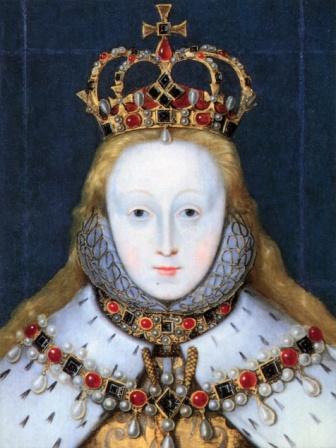
Bess to Impress: The Coronation Portrait

 
The Coronation Portrait of Queen Elizabeth I. Image public domain through Creative Commons licensing, NPG, London.

The Coronation Portrait of Queen Elizabeth I, now in the collection of  National Portrait Gallery, was painted somewhere around 1600, copied after a now-lost original. Elizabeth I succeeded to the throne of England in 1558 and was crowned in 1559 at the age of twenty-six. In addition to the official coronation portrait, there are several miniature versions, including one attributed to Levina Teerlinc.

A miniature version of The Coronation Portrait of Queen Elizabeth I. Picture acquired through Wikimedia Commons. Image public domain.

Unlike most Tudor and Elizabethan portraits, Queen Elizabeth I is depicted full-face in The Coronation Portrait; this is because the coinage and royal seals for the new regime were to be based off of this image. Her hair hangs loose about her shoulders, as was typical for a queen at her coronation. Elizabeth's heavy coronation robes are decorated with Tudor roses and fleur-de-lis. The fleur-de-lis, which is the heraldic emblem of France, represents the longstanding English claim to the French throne. According to the National Portrait Gallery, these elaborate robes were not custom-made for Queen Elizabeth, but were reused from the coronation of her sister, Queen Mary I just five years before, when England still had possession of its last French territory, Calais. Mary lost Calais in the final year of her reign.

A detail from a portrait of Queen Mary I. By Anthonis Mor, 1554. Picture acquired through Wikimedia Commons. Image public domain.

Queen Elizabeth I's cloak is trimmed in ermine, the fur that sumptuary law dictated was only to be worn by royalty. This is one of the reasons why Alison Weir and other historians have questioned the attribution of the portrait known as Mary Boleyn, as the sitter is wearing ermine, and Mary Boleyn was not of royal birth.

The identity of this portrait is in question, due in part to the sitter wearing a robe trimmed with ermine. Picture acquired through Wikimedia Commons. Image public domain.

In addition to projecting royal majesty in her portrait, Queen Elizabeth also embodies the standards of 16th century beauty. Queen Elizabeth is pale, as only people who had to work outdoors for a living had significant color in their skin. Elizabeth also has an unnaturally high hairline; she and other well-bred women plucked their hairlines to make their faces appear longer and thinner. Queen Elizabeth I would exaggerate these features as she aged in an effort to appear more youthful.

A detail of The Coronation Portrait of Queen Elizabeth I. Image public domain through Creative Commons licensing, NPG, London.

Sources:

Gittings, Clare. Portraits of Queen Elizabeth.  London: National Portrait Gallery Publications, 2003. 
     Print.

 
Weir, Alison. Mary Boleyn: The Mistress of Kings. New York: Ballantine Books, 2011. Print.

Thursday, May 2, 2013

Bess to Impress: The Clopton Portrait

The Clopton Portrait of Queen Elizabeth I. In the private collection of Mr. Peter James Hall. Picture acquired through Wikimedia Commons. Image public domain.

The Clopton Portrait of Queen Elizabeth I dates from early in her reign, circa 1560-65, before she reinvented herself as Gloriana. The portrait, by an unknown artist, is in the private collection of Mr. Peter James Hall, though there are other existent versions.

Another Clopton-esque portrait of Queen Elizabeth I by an unknown artist, circa 1560. Image public domain through Creative Commons licensing, NPG, London.

Queen Elizabeth I has purposefully donned the colors associated with a modest Protestant intellectual, black and white, in her portrait. In the system of heraldry, the tincture of black represents constancy, while the tincture of white/silver represents sincerity. Queen Elizabeth draws attention to her favorite feature, her hands, by wearing multiple rings and holding a book in her right hand and gloves in her left; Elizabeth had a fondness for fine gloves, several pairs of which have gone on display in recent years. 

An exquisite ceremonial pair of Queen Elizabeth I's gloves.

This portrait bares similarities to the portrait of Elizabeth as Princess from around 1546; In addition to being depicted with books again, Elizabeth's haunting gaze is very similar. The Clopton Portrait, painted before Queen Elizabeth's portraits included copious amounts of symbolism and her image became regulated, gives us a very good idea of what the young Queen of England actually looked like.

Other portraits of Queen Elizabeth I from this time include the following: 

A portrait of Queen Elizabeth I by an unknown artist, circa 1565. Picture acquired through Wikimedia Commons. Image public domain.

Recently discovered in 1994 when it went up for auction, this portrait of Queen Elizabeth was painted around 1565 by an unknown artist of the British School. The portrait, sold through Christie's, is now in a private collection. Interestingly, the entire portrait, including the frame, is painted on a single piece of wood (Cody). Once again, Queen Elizabeth I is shown holding a book; below her  hand on the frame is a verse that she purportedly spoke to a Marian priest when questioned about transubstantiation,

'Twas God the word that spake it,
He took the bread and brake it,
And what the word did make it,
That I believe and take it.

A miniature portrait of Queen Elizabeth I, circa 1560-65. Attributed to Levina Teerlinc. Picture acquired through Wikimedia Commons. Image public domain.

A miniature of Queen Elizabeth I, circa 1560-65. Attributed to Levina Teerlinc. Part of The Royal Collection.

Another miniature portrait of Queen Elizabeth I, circa 1560-65. Attributed to Levina Teerlinc. Picture acquired through Wikimedia Commons. Image public domain.

A miniature of Queen Elizabeth I, circa 1560-65. Attributed to Levina Teerlinc. Part of The Royal Collection.

Sources:

Sutherland-Harris, Ann, and Linda Nochlin. Women Artists: 1550-1950. Los Angeles: Museum
     
     Associates of the Los Angeles County Museum of Art, 1976. Print. 

 "Portraits of Queen Elizabeth." Marilee Cody. Web. 4 April. 2013.