Showing posts with label William Camden. Show all posts

Tuesday, September 4, 2012

On This Day in Elizabethan History: The Death of Robert Dudley, the Earl of Leicester

A portrait of Robert Dudley, Earl of Leicester from 1564, the same year Queen Elizabeth granted him his earldom. Picture acquired through Wikimedia Commons. Image public domain.

 "A personage so dear unto us."
-Queen Elizabeth describing the Earl of Leicester in a letter to the Earl of Shrewsbury, 1588.
 
On this day in Elizabethan history, 1588, Robert Dudley, the Earl of Leicester died. While the earl had been unwell for quite some time, nobody expected his illness to be fatal, least of all Queen Elizabeth (ODNB)

Dudley's unexpected death occurred when he was on the road to "take the waters" in Buxton, Derbyshire. A few miles after stopping to write the Queen a letter at Rycote in Oxfordshire on August 29th, Leicester grew gravely ill and took shelter at the nearby manor of Cornbury. It is there that he died in the early morning hours of September 4th (Gristwood, 334).

Only a week earlier Leicester had bid the Queen farewell after she had ordered him to go on retreat and tend to his health. The letter that Leicester had sent her from Rycote became her most prized possession; on it she scrawled, "His last letter", and she kept it in a private box in her closet. The letter now resides in the National Archives.

"His last letter", in the National Archives in England. Picture acquired through Wikimedia Commons. Image public domain.

Leicester had been in physical anguish following his role as the Queen's Lieutenant General at Tilbury, a position that he had welcomed and a duty that he had been honored to fulfill. But  the work had been stressful none the less. Leicester had been in charge of between 12,000-17,000 men at Tilbury fort, and another 6,000 were under his command in Sandwich (Gristwood, 328). The Earl of Leicester had urged his Queen to visit her troops at Tilbury, writing to her that, "you shall comfort not only these thousands, but many more that shall hear of it" (quoted in Gristwood, 330).

Indeed, once a chaplain in Leicester's service recorded Queen Elizabeth's "excellent oration", which he wrote that she delivered dressed like an "armed Pallas", (Athena, Greek goddess of wisdom and war) the speech was printed and circulated throughout Europe within the week (Gristwood, 329-30). The English people were inspired by the Queen's Tilbury Speech, which they could now hold in their hands, and the rest of the world knew from the pamphlet that the English were not to be intimidated.

A painting of Queen Elizabeth at Tilbury, courtesy of Anniina Jokinen. Image public domain.

Leicester and Elizabeth's collaboration at Tilbury would be their last; yet their romantic and political partnership had spanned almost 30 years. Leicester was the Queen's emotional support, and sometimes her stand-in an state functions. Theirs was a bond unlike any other; it survived imprisonment, threat of execution, a mysterious death, rejections, indiscretions, marriage, and the threat of assassination and war.

A composite image of a pair of portrait miniatures of Queen Elizabeth I and Robert Dudley, Earl of Leicester. Painted c.1575, by Nicholas Hilliard. Picture acquired through Wikimedia Commons. Image public domain.

According to the antiquarian William Camden, (the author of the invaluable primary source, The Annals of Queen Elizabeth) after the defeat of the Spanish Armada, Queen Elizabeth was having papers drawn up to make Leicester the permanent Lieutenant Governor of England. Camden claimed that the Queen was only dissuaded from putting this plan into action by William Cecil, Lord Burghley and Sir Christopher Hatton.

A detail of a portrait of Sir Christopher Hatton, c.1575. Picture acquired through Wikimedia Commons. Image public domain.

Perhaps this was true; Camden was working from many primary sources now lost to us, and his work is largely accurate and free of the religious bias that permeated most works of the 16th and 17th century. Certainly Elizabeth was starting to think about what would happen to England upon her death, even if she refused to speak of the succession aloud.

The frontispiece and title-page of the 1575 edition of The Annals of Queen Elizabeth, by William Camden. Picture acquired through Wikimedia Commons. Image public domain.

Leicester dined every day in the Queen's apartments before he left for Buxton (Gristwood, 333). We can hope that Queen Elizabeth found comfort in her memories of their last days together, after she had recovered from the initial shock of Leicester's unexpected death.

A miniature of the Earl of Leicester, c.1572-76. By Hilliard. Picture acquired through Wikimedia Commons. Image public domain.

The Earl of Leicester's demise was probably caused by stomach cancer, which his persistent gastric symptoms seem to suggest, or complications caused by chronic malaria (Gristwood, 333-34). Malaria was rampant in England in the 16th century and had claimed the lives of many, including prominent members of the royal family, like Arthur Tudor. We do know that Leicester had complained of "the stone", which was a colloquialism for any intestinal problem (Gristwood, 334).

A miniature of Queen Elizabeth, c.1572-76. By Hilliard. Picture acquired through Wikimedia Commons. Image public domain.

 The juxtaposition of England's celebration over the defeat of the Spanish Armada, and the death of her oldest and dearest friend was almost too much for Queen Elizabeth to bear:

"Elizabeth was condemned to an extraordinary conjunction of public rejoicing and private agony. This was her own personal sorrow-it would be folly to try to damper the mood of he country-and against a background of the national victory celebrations she shut herself into her own chamber to grieve." (Gristwood, 334-365)

Many contemporary reports confirm that Queen Elizabeth locked herself away in her apartments. Sir Francis Walsingham lamented that he could not get the Queen to attend to state business at this time, "by reason that she will not suffer anybody to have access to her" (quoted in Gristwood, 335).

Sketch of Queen Elizabeth I from life. By Zuccaro, 1575.

This tells us how profound Queen Elizabeth's grief was. Here is a woman who relished her role in government and never shirked her public responsibilities because of her private feelings, save for this one instance. Elizabeth's life experiences had caused her to develop a hard, protective exterior, which rarely cracked to reveal signs of affection or vulnerability; Robert Dudley had always been the only exception.

Sketch of the Earl of Leicester from life. By Zuccaro, 1575.

Yet, however much the Queen of England mourned her "Sweet Robin", his death barely registered with the rest of England in comparison to the victory over Spain. The antiquarian John Stow, who himself admitted that he owed his career to Leicester, wrote: "All men, so far as they durst, rejoiced no less outwardly at his death than for the victory lately obtained against the Spaniard." 

Still, Robert Dudley, Earl of Leicester left this life having accomplished a great deal for Queen and Country, and should be remembered for it. I think William Camden's epitaph of the earl conveys many of the aspects of his character; this is fitting since the way the earl was thought of differed so greatly from person to person. 
"He was reputed a complete courtier, magnificent, liberal, a protector and benefactor of soldiers and scholars...very officious, and cunning toward his ill-willers; for a time much given to women...to say the truth, he was openly held to be in the rank of those which were worthy of praise, but the things which he secretly plotted displeased many."

We do not know how Robert's widow, Lettice Knollys dealt with the loss of her husband. Let it be said that we should not for a minute entertain the idea that she and her second-cousin, the Queen, would have commiserated over their mutual loss. Lettice's greatest testament to her husband may have been their joint tomb. Elizabeth's may have in fact been her relationship with Leicester's step-son, Essex.

The tomb of Robert Dudley, Earl of Leicester and his wife, Lettice Knollys in Beauchamp Chapel in the Collegiate Church of St.Mary, Warwickshire. Picture acquired through Wikimedia Commons. Image public domain.

Historian Sarah Gristwood explains the significance of Queen Elizabeth's relationship with the Earl of Essex:

"Perhaps it is to the years ahead (of Leicester's death) that we should look for Elizabeth's last (and almost disastrous) great loving gesture towards her lost companion to her relationship with Leicester's stepson and surrogate, Essex. Leicester had brought Essex to court as he himself began to tire and age, willing still to perform necessary duties, but unable any longer to flatter Elizabeth with the conviction he once has; unable to provide the energetic, exciting pageant of eager masculinity. Elizabeth obediently would follow his programme almost to her destruction; would try to believe Essex was another Leicester. The Queen's long, her extraordinary, indulgence towards Robert Devereux was her long lament for Robert Dudley."
(Gristwood, 337)

When Elizabeth whispered the name "Robert" on her deathbed in 1603, there can be no doubt to which earl she was referring.

A portrait of Robert Dudley, Earl of Leicester circa 1560-65. Attributed to Steven van der Muelen. Picture acquired through Wikimedia Commons. Image public domain.


Sources

Gristwood, Sarah. Elizabeth and Leicester: Power, Passion, Politics. New York: Viking, 2007. Print.

"Dudley, Robert, earl of Leicester (1532/3–1588)" Oxford Dictionary of National Biography online edition. Retrieved 09-02-2012

Tuesday, April 10, 2012

Elizabethan Fact of the Day: William Camden's Priceless "Annals of Queen Elizabeth"

The frontispiece and title page from the 1675 edition of The Annals (History) of Queen Elizabeth. Picture acquired through Wikimedia Commons. Image public domain.

William Camden (1551-1623) was an Elizabethan/Stuart antiquarian and author. His Annals of Queen Elizabeth is widely considered to be the most accurate contemporary source account of Elizabeth I and her reign (Wagner, 12). The Annals full and proper title, it should be mentioned, is The Annals or the History of the Most Renowned and Victorious Princess Elizabeth, Late Queen of England. Containing All the Most Important and Remarkable Passages of State, Both at Home and Abroad (So Far as They Were Linked with English Affairs) during Her Long and Prosperous Reign. Phew!

The account was begun only five years after Queen Elizabeth I's death, in 1608, and Camden had experienced her reign personally. Unlike other "Annals" of the time, which had a distinct tabloid flavor, (example: Holinshed's Chronicles) Camden's work is based entirely on oral interviews and written sources, rather than hearsay and gossip (Wagner, 12).

Camden had personal access to the state papers of William Cecil, Lord Burghley, and other members of the Elizabethan administration. Many of these members were still living, and they shared information with him personally (Wagner, 12).


My favorite portrait of William Cecil, Lord Burghley, riding a mule. Although Burghley was dead at the time of Camden's research and writing, Camden had access to the extensive records that Burghley kept. Picture acquired through Wikimedia Commons. Image public domain.

Camden had a great regard for Elizabeth I, and he believed her memory, "...among Englishmen ought ever to be...sacred." Still, he sought to write the facts, rather than his opinion of her and the events that transpired during her reign. Though an Anglican, Camden's work was written in Latin, (ANNALES RERUM ANGLICARUM et HIBENNICARUM REGNANTE ELIZABETH). His Annals is also surprisingly void of the anti-Catholic sentiment which filled the writing of the early 17th century, under the reign of James I.


William Camden was depicted in the famous Funeral Procession of Queen Elizabeth illustration. He is the man wearing the hood in the middle, and the inscription above him describes his role, saying "The coat borne by William Cambden, Clarenceux King of Arms". The 'coat' is the tabbard he holds, bearing the royal heraldry of the House of Tudor. Picture acquired through Wikimedia Commons. Image public domain.

The first volume was started in 1608, and published in 1615 (Wagner, 12). Needless to say, it was a huge success.Volume 1 covered the years 1558 (the years when Elizabeth took the throne) to 1588 (the year of the defeat of the Spanish Armada). The second volume was completed in 1617, but was unfortunately not published in London until 1627, four years after Camden's death.


A 1609 engraving of William Camden. Picture acquired through Wikimedia Commons. Image public domain.

I encourage all admirer's and scholars of Queen Elizabeth I and her achievements to purchase, or at least read a translated copy of William Camden's Annals of Queen Elizabeth.

Sources:

The History of the Most Renowned and Victorious Princes Elizabeth, Late Queen of England edited by Wallace T. MacCaffrey, Chicago: University of Chicago Press, 1970.

Wagner, John A. The Historic Dictionary of the Elizabethan World. Print.

(Page 12) 

Tuesday, March 13, 2012

Religious Policy Under Elizabeth I

Upon succeeding to the throne of England in 1558,  Queen Elizabeth immediately set to work devising the Church Settlement that progressed through Parliament to be passed in 1559. Of course, the religious policy saw opposition from the Marian bishops who remained in office, but it still passed. The Church Settlement allowed Elizabeth's subjects to honor their own religious convictions privately, provided that they demonstrate their loyalty to Queen and Country by outwardly conforming. This meant that subjects were required to attend an Elizabethan church service weekly, and those who refused to do so were fined 1 shilling per a week.


The Coronation Portrait of Queen Elizabeth I, depicted at the age of 25. Thought to be a 17th century copy from a lost original. Picture acquired through Wikimedia Commons. Image public domain.

Outward conformity from both sides, Protestant and Catholic, helped Elizabeth's subjects to see themselves for the first time unified as English, rather than divided into religious factions.  It certainly helped that the Church of England's services retained elements of the old Catholic faith, while adopting some of the reforms of the Protestant movement. One of the tools used to rectify the Queen's subjects of any Christian affiliation was the Book of Common Prayer. The Book of Common Prayer was revised in 1559 in an attempt to appease as many English subjects as possible. For example, for the Service of Holy Communion, the Book of Prayer contains this phrasing to be spoken:

"The Body of our Lord Jesus Christ which was given for thee, preserve thy body and soul unto everlasting life; Take and eat this in remembrance that Christ died for thee, and feed on him in thy heart by faith with thanksgiving."

The first statement comes from the 1549 Prayer Book and would have been acceptable to Catholics who believe that the bread is transformed into the flesh of Christ by the miracle of transubstantiation. The second phrasing comes from the 1552 Prayer Book and would have been deemed acceptable to the English Protestants who believed that the taking of the bread is an act of memorial to the Last Supper, making the bread symbolically the flesh of Christ, rather than literally. The issue of transubstantiation was a central issue of the English Reformation, hearkening back to Henry VIII's break with Rome to form the Church of England. People lost their lives in the Henrician and Marian regimes upholding their beliefs pertaining to this matter. Queen Elizabeth wished to avoid this conflict altogether, and careful consideration was taken in reforming the Book of Common Prayer early in her reign.

King Henry VIII of England, by Hans Holbein c. 1537. Elizabeth's father Henry VIII broke from Rome so that he could grant himself his own divorce from Catherine of Aragon, in order to marry Elizabeth's mother, Anne Boleyn. Picture acquired through Wikimedia Commons. Image public domain.
 Elizabethan bishops were required to subscribe to 3 Articles of Faith:

1. They must recognize the Queen as Supreme Governor of the Church.
2. They must subscribe to the Book of Common Prayer.
3. They must agree to the 39 Articles of Religion.

William Cecil, Lord Burghley, who was Queen Elizabeth's chief advisor and Lord Treasurer was well known by the Queen to have Puritan leanings. He took issue with the rigidness of belief to which Elizabeth's bishops were expected to subscribe, and in 1584 he wrote to Elizabeth I's 'model' bishop John Whitgift, who was Archbishop of Canterbury from 1583-1603. Burghley did not wish to see the Puritan clergy compelled to leave the church due to the 3 Articles of Faith they were required to uphold.  In Burghley's letter to Archbishop Whitgift, he said,

"...But I conclude according to my simple judgement, this kind of proceeding is too much savouring of the Romish Inquisition, and is rather a device to seek for offenders than to reform any." (Quoted in Statutes and Constitutional Documents 1558-1625, G.W. Prothero, Oxford University Press 1894.)

Those with Puritan convictions like Burghley found it difficult to swear that the Book of Common Prayer contained nothing in contradiction to the actual Word of God. Whitgift responded to Burghley's concerns saying that  the Church previous to Elizabeth had been suffering from a "lack of discipline" and that the structure the Elizabethan Church Settlement was providing would hold clergy to a higher standard (Palmer, 32).

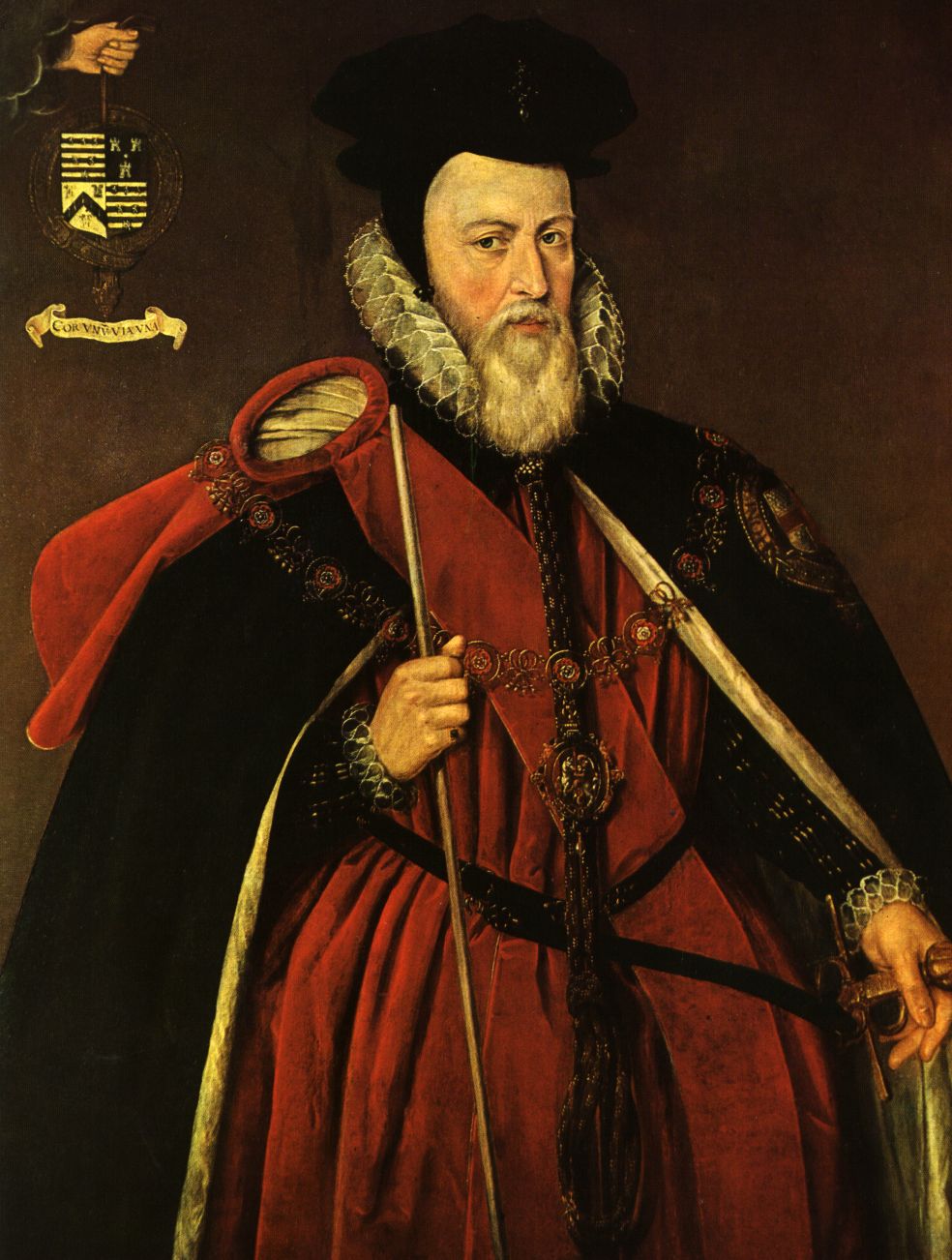
William Cecil, Lord Burghley (1520-1598), depicted in the robes of the Order of the Garter. Elizabeth made Cecil her chief Secretary of State in 1558. He was styled Lord Burghley in 1571, and in 1572 he was made Lord Treasurer, which was the position he held until his death. Elizabeth called this man who was her chief minister for 40 years her "spirit". Picture acquired through Wikimedia Commons. Image public domain.
 At all costs, Elizabeth wished to keep the peace; she really had no interest in rocking the boat on either side; this disappointed the extremist Catholics who were looking for a clear offense that they could use as cause to rise up against her, but it also disappointed  the Puritans and Presbyterians who had hoped that she would be the figurehead for a stricter Protestant church.  

Elizabeth I's Bishop's Bible from 1568. In the collection of the Folger Shakespeare Library. Picture acquired through Wikimedia Commons. Image public domain.

Elizabeth professed that she "wished not to open window's into men's souls", and she expected the same courtesy that she extended to her own subjects to be afforded to her as well. This is perhaps why the details of her own religious convictions remain somewhat of a mystery. Still, no one should doubt that Elizabeth herself was indeed religious; she had studied the Bible and other ancient texts of religion for many years, and she often professed how she believed God had preserved and guided her through the many trials and tribulations of her life to be crowned Queen of England. 

The frontispiece of Queen Elizabeth's prayerbook, showing her kneeling in reverence and prayer. Picture acquired through Wikimedia Commons. Image public domain.

William Camden (1551-1623) lived through Queen Elizabeth's reign, and as her contemporary he had access to original material (Palmer, 29).  He published his Annals of Queen Elizabeth in Latin in 1615, and he made a point to comment on the Queen's religious habits,

"(Queen Elizabeth was)...truly religious, who every day, as soon as she arose, spent sometime in prayers to God and afterwards also at set times in her Private Chapel; every Sunday and Holy day she went into her chapel ; neither was there ever any other prince present at God's service with greater devotion. The sermons in Lent attentively she heard being all in black, after the manner of old although she many times said that she had rather talk with God devoutly by prayer than hear others speak eloquently of God."

The frontispiece and title page of the 1675 edition of William Camden's Annals of Queen Elizabeth. Picture acquired through Wikimedia Commons. Image public domain.

This observation from Camden, published in the reign of Elizabeth's successor James I, shows that while Elizabeth gave nods to the Catholic way of worship (Attending church during Lent season in all black) she still professed and practiced perhaps the most important concept of Protestantism: the ability to converse directly with God rather than rely on the interpretation or intercession of the clergy to communicate with and understand God and His will.

While Queen Elizabeth adopted an extremely moderate religious policy that brought stability to her realm, it should be emphasized that extremism on either side was considered politically dangerous. Zealous Catholics as well as Puritans and Presbyterians were monitored and sometimes severely punished if they threatened the safety of Queen Elizabeth and her realm, or if their prophesying caused civil unrest.

Puritans took issue with Elizabeth's policy not continuing the work of her late brother Edward VI's regime. The Puritan's has hoped that Elizabeth Tudor would completely reform the Church of England, and rid it of  all vestments, icons, Latin verses and other trappings of the Catholic faith. While services continued to include Latin hymns and incense, Queen Elizabeth did promote the Protestant reform of raising the qualifications of the clergy: Elizabeth's bishops were supposed to be well-educated and Bible-literate; still, Elizabeth always remained wary that any religious study group could develop into cells of Presbyterian doctrine.

Detail of the allegorical work Edward VI and the Pope. Picture acquired through Wikimedia Commons. Image public domain.
Presbyterians, another Christian sect, were the biggest Protestant threat to the peace of Elizabeth's realm, since their rejection of the entire ecclesiastical hierarchy of bishops by implication took issue with the institution of royal supremacy (Palmer, 28).

Some ardent Catholics also gave Queen Elizabeth and her government reason to be cautious. A small number of Catholics in England welcomed militant Catholic priests and assassins from abroad who aimed to attack Queen Elizabeth with the blessing of the pope. When Elizabeth was excommunicated from the Roman Catholic faith (which she had never once been a part of), it was declared by the Bishop of Rome that anyone who saw the "English Jezebel" killed would not be committing murder but instead would be doing God's will, and would be welcomed into Paradise. Elizabeth's network of spy's and informants, led by her spymaster Sir Francis Walsingham, monitored the lives of  individuals associated with this Catholic movement closely.

Detail of a portrait of Sir Franics Walsingham (1536-1589). Walsingham succeeded Burghley as Secretary of State in 1573. He acted as Ambassador to Scotland, France and the Netherlands, while acting as Queen Elizabeth I's "spymaster". It was Walsingham's network that uncovered the Mary, the so-called Queen of Scot's treachery and the Babington Plot. Picture acquired through Wikimedia Commons. Image public domain.

Queen Elizabeth had watched from afar with great concern the religious wars which were tearing apart the kingdom's on the Continent. When she became Queen she wisely decided to occupy herself with healing the religious tension in England as best as she could in order to prevent her nation from befalling a similar fate. While some Protestants and some Catholics took issue with aspects of Elizabeth's religious policy, most found it to be remarkably tolerable. If we compare Elizabeth's decisions pertaining to religion to those of her predecessors, contemporaries, and even her successor, it is very clear that her policy was the least oppressive. Queen Elizabeth really did make a conscience effort to appease the majority of her subjects by permitting them their religious convictions, so long as they remained loyal subjects. The Elizabethan Church Settlement would be one of the many ways in which Queen Elizabeth would improve the lives of her people.

Queen Elizabeth captured the matter of Christianity best when she said, "There is but one God, one Jesus Christ; all else is dispute over trifles."


The Great Seal of Queen Elizabeth I, from 1586. Designed by Nicholas Hilliard. Picture acquired through Wikimedia Commons. Image public domain.
Sources:

Palmer, Michael. Reputations: Elizabeth I. Bath Press, 1988. Print.

Prothero, G.W. Statutes and Constitutional Documents 1558-1625. Oxford University Press, 1894. Print.

Camden, William. The Annals of Queen Elizabeth. London, 1615. Electronic.