Friday, May 3, 2013

Bess to Impress: The Coronation Portrait

 
The Coronation Portrait of Queen Elizabeth I. Image public domain through Creative Commons licensing, NPG, London.

The Coronation Portrait of Queen Elizabeth I, now in the collection of  National Portrait Gallery, was painted somewhere around 1600, copied after a now-lost original. Elizabeth I succeeded to the throne of England in 1558 and was crowned in 1559 at the age of twenty-six. In addition to the official coronation portrait, there are several miniature versions, including one attributed to Levina Teerlinc.

A miniature version of The Coronation Portrait of Queen Elizabeth I. Picture acquired through Wikimedia Commons. Image public domain.

Unlike most Tudor and Elizabethan portraits, Queen Elizabeth I is depicted full-face in The Coronation Portrait; this is because the coinage and royal seals for the new regime were to be based off of this image. Her hair hangs loose about her shoulders, as was typical for a queen at her coronation. Elizabeth's heavy coronation robes are decorated with Tudor roses and fleur-de-lis. The fleur-de-lis, which is the heraldic emblem of France, represents the longstanding English claim to the French throne. According to the National Portrait Gallery, these elaborate robes were not custom-made for Queen Elizabeth, but were reused from the coronation of her sister, Queen Mary I just five years before, when England still had possession of its last French territory, Calais. Mary lost Calais in the final year of her reign.

A detail from a portrait of Queen Mary I. By Anthonis Mor, 1554. Picture acquired through Wikimedia Commons. Image public domain.

Queen Elizabeth I's cloak is trimmed in ermine, the fur that sumptuary law dictated was only to be worn by royalty. This is one of the reasons why Alison Weir and other historians have questioned the attribution of the portrait known as Mary Boleyn, as the sitter is wearing ermine, and Mary Boleyn was not of royal birth.

The identity of this portrait is in question, due in part to the sitter wearing a robe trimmed with ermine. Picture acquired through Wikimedia Commons. Image public domain.

In addition to projecting royal majesty in her portrait, Queen Elizabeth also embodies the standards of 16th century beauty. Queen Elizabeth is pale, as only people who had to work outdoors for a living had significant color in their skin. Elizabeth also has an unnaturally high hairline; she and other well-bred women plucked their hairlines to make their faces appear longer and thinner. Queen Elizabeth I would exaggerate these features as she aged in an effort to appear more youthful.
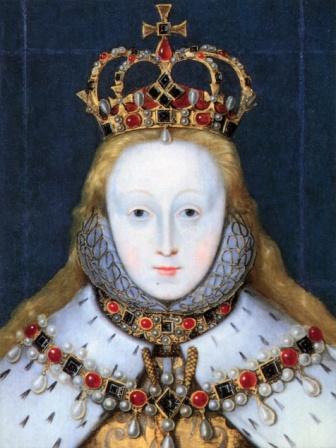
A detail of The Coronation Portrait of Queen Elizabeth I. Image public domain through Creative Commons licensing, NPG, London.

Sources:

Gittings, Clare. Portraits of Queen Elizabeth.  London: National Portrait Gallery Publications, 2003. 
     Print.

 
Weir, Alison. Mary Boleyn: The Mistress of Kings. New York: Ballantine Books, 2011. Print.

Thursday, May 2, 2013

Bess to Impress: The Clopton Portrait

The Clopton Portrait of Queen Elizabeth I. In the private collection of Mr. Peter James Hall. Picture acquired through Wikimedia Commons. Image public domain.

The Clopton Portrait of Queen Elizabeth I dates from early in her reign, circa 1560-65, before she reinvented herself as Gloriana. The portrait, by an unknown artist, is in the private collection of Mr. Peter James Hall, though there are other existent versions.

Another Clopton-esque portrait of Queen Elizabeth I by an unknown artist, circa 1560. Image public domain through Creative Commons licensing, NPG, London.

Queen Elizabeth I has purposefully donned the colors associated with a modest Protestant intellectual, black and white, in her portrait. In the system of heraldry, the tincture of black represents constancy, while the tincture of white/silver represents sincerity. Queen Elizabeth draws attention to her favorite feature, her hands, by wearing multiple rings and holding a book in her right hand and gloves in her left; Elizabeth had a fondness for fine gloves, several pairs of which have gone on display in recent years. 

An exquisite ceremonial pair of Queen Elizabeth I's gloves.

This portrait bares similarities to the portrait of Elizabeth as Princess from around 1546; In addition to being depicted with books again, Elizabeth's haunting gaze is very similar. The Clopton Portrait, painted before Queen Elizabeth's portraits included copious amounts of symbolism and her image became regulated, gives us a very good idea of what the young Queen of England actually looked like.

Other portraits of Queen Elizabeth I from this time include the following: 

A portrait of Queen Elizabeth I by an unknown artist, circa 1565. Picture acquired through Wikimedia Commons. Image public domain.

Recently discovered in 1994 when it went up for auction, this portrait of Queen Elizabeth was painted around 1565 by an unknown artist of the British School. The portrait, sold through Christie's, is now in a private collection. Interestingly, the entire portrait, including the frame, is painted on a single piece of wood (Cody). Once again, Queen Elizabeth I is shown holding a book; below her  hand on the frame is a verse that she purportedly spoke to a Marian priest when questioned about transubstantiation,

'Twas God the word that spake it,
He took the bread and brake it,
And what the word did make it,
That I believe and take it.

A miniature portrait of Queen Elizabeth I, circa 1560-65. Attributed to Levina Teerlinc. Picture acquired through Wikimedia Commons. Image public domain.

A miniature of Queen Elizabeth I, circa 1560-65. Attributed to Levina Teerlinc. Part of The Royal Collection.

Another miniature portrait of Queen Elizabeth I, circa 1560-65. Attributed to Levina Teerlinc. Picture acquired through Wikimedia Commons. Image public domain.

A miniature of Queen Elizabeth I, circa 1560-65. Attributed to Levina Teerlinc. Part of The Royal Collection.

Sources:

Sutherland-Harris, Ann, and Linda Nochlin. Women Artists: 1550-1950. Los Angeles: Museum
     
     Associates of the Los Angeles County Museum of Art, 1976. Print. 

 "Portraits of Queen Elizabeth." Marilee Cody. Web. 4 April. 2013.

Thursday, April 18, 2013

Bess to Impress: Princess Elizabeth, c.1546


Portrait of Princess Elizabeth Tudor, c.1546-47. Formally attributed to William Scrots. Picture acquired through Wikimedia Commons. Image public domain.


The first portrait to be featured in our Bess to Impress series is the captivating portrait of Princess Elizabeth Tudor, aged about 13. The portrait is thought to have been painted between 1546 and 1547, and was formally attributed to William Scrots. Scrots flourished from 1537-53. Part of The Royal Collection, this stunning portrait can be viewed at Her Majesty Queen Elizabeth II's residence of Windsor Castle.

This portrait was a gift from Elizabeth Tudor to her brother, Edward VI. Depending on which date you subscribe to, Edward was either still a prince or recently crowned King of England when he received the portrait. In a letter accompanying the gift, Elizabeth wrote of her desire to see her brother, of whom she was very fond. The young Elizabeth uses a self-deprecating tone when she writes about her own face, though she speaks well of her intellect. Indeed, Queen Elizabeth, though very vain, never thought of her face as her best feature; instead she drew attention to her long, slender fingers, (so aptly on display in this portrait) and her neck, hair, and tiny waist. When her face became permanently scarred due to her bout with smallpox early in her reign, Elizabeth then did even more to draw attention away from her changed visage, wearing heavy white makeup and large, jewel encrusted gowns.

A detail of Princess Elizabeth from the 1546-47 portrait. Picture acquired through Wikimedia Commons. Image public domain.

From a note accompanying the portrait, by the Princess Elizabeth to her brother, Edward VI:

'For the face, I grant, I might well blush to offer, but the mind I shall never be ashamed to present...when you shall look upon my picture you will witsafe to think that as you have but the outward shadow of the body before you, so my inward mind wisheth that the body itself were oftener in your presence.'

The young Princess, who had endured so much in her childhood and would suffer more injustice as a ward of her brother's uncle, Thomas Seymour, gazes back at the viewer intently, conveying with her eyes her wisdom beyond her years. I have discussed the portraits of Queen Elizabeth I with my dear friends Donna and Mia multiple times, and Donna and I are particularly moved by this portrait for the aforementioned reason. This portrait first resonated with me as a preteen when I was navigating a very dangerous childhood with my own father; seeing Elizabeth staring back at me from the pages of the Book Behind the Mask by Jane Resh Thomas, I immediately recognized a kindred spirit. It is a sober, haunting portrait which contrasts sharply with the glorious, triumphant portraits of Queen Elizabeth painted during her mid-to-late reign.

While not laden with symbolism like Elizabeth's portraits after she became Queen of England, this portrait displays a purposefully chosen accessory: books. The books emphasize Elizabeth's commitment to scholarly pursuits, a value that she shared with her brother, the portrait's recipient, and her piety. Perhaps it is a stretch to assume that the French style hood worn by Elizabeth Tudor is a nod to her mother, Anne Boleyn, (especially since the Princess Mary donned one in a portrait dated from about 1544) but given what we know about Elizabeth's defiant statement in the Whitehall Family Portrait, it is possible.

Other confirmed contemporary portraits of Princess Elizabeth from around this time include:

The Family of King Henry VIII, also known as The Whitehall family grouping, c. 1544. From left to right: A female fool, probably the wife of Will Sommers, Mary Tudor, Edward VI, King Henry VIII, Jane Seymour, and Elizabeth, followed by Will Sommers. Picture acquired through Wikimedia Commons. Image public domain.

The Family of King Henry VIII/The Whitehall Family Grouping, c.1543-1547. By an unknown artist, after Hans Holbein. Part of The Royal Collection, this portrait can be viewed at Hampton Court Palace. To learn more about this portrait's significance to the Anne Boleyn/Elizabeth I connection, please see our article Death Could Not Separate Them: How Elizabeth I Connected to Her Deceased Mother.

The Children of King Henry VIII. Picture acquired through Wikimedia Commons. Image public domain.

The Children of Henry VIII, c.1650-80, after a lost original from c.1545-1550. In the collection of the Duke of Buccleuch at Boughton House.

Elizabeth I as Princess, c.1550. Attributed to Levina Teerlinc. Picture acquired through Wikimedia Commons. Image public domain.

Elizabeth I as Princess, c.1550. Portrait miniature attributed to female court artist to the Tudors, Levina Teerlinc.

There are also multiple woodcut style illustrations of the Princess Elizabeth in books and tracts that are not meant to be realistic, but rather depict scenes from her life.

Source:

Gittings, Clare. Portraits of Queen Elizabeth.  London: National Portrait Gallery Publications, 2003. 
     Print.

Wednesday, April 17, 2013

NEW SERIES-Bess to Impress: The Portraits of Queen Elizabeth I

A portrait of Queen Elizabeth I, thought to be painted from life. Attributed to Zuccaro. Picture acquired through Wikimedia Commons. Image public domain.

By the time of her death in 1603, Queen Elizabeth I of England was the most painted person in the entire world. While most of the last Tudor monarch's existent portraits have been conclusively identified and put on display by historic properties and museums, even now new portraits are being discovered. This is a testament not only to the Virgin Queen's popularity in her own time, (there was a demand from loyal subjects to own a portrait of the Queen to hang in their house) but also to our own enduring fascination with her hundreds of years later.

As someone who distinctly remembers getting goose-bumps when I stood before a portrait of Queen Elizabeth I for the first time, I understand the impact that Elizabethan and Tudor portraiture has not only on myself, but on other history and art enthusiasts as well. One need look no further than the last couple of years for examples demonstrating the popularity of 16th century portraits. Multiple exhibits on Tudor portraiture and the fashions shown in the portraits have opened at the National Portrait Gallery, the Victoria and Albert Museum and Buckingham Palace, to name just a few, and have enjoyed considerable foot-traffic and critical acclaim. 

But there is something about Queen Elizabeth I's portraits, specifically. Unlike the portraits of King Henry VIII, which grown increasingly porcine and unflattering as time goes on, Queen Elizabeth's portraits are overwhelmingly appealing. This is due in large part to the fact that so much of the Queen's multifaceted character is conveyed through her eyes and her expressions in her portraits. While Henry VII may have invented Tudor propaganda, Queen Elizabeth I was its master, carefully regulating her image in both official portraits and unofficial renderings. Queen Elizabeth purposefully selected and popularized her chosen personal emblems throughout her reign by including them in her portraits, some of which were adopted from her late mother, Anne Boleyn.

The crowned falcon badge of Queen Anne Boleyn, later adopted by her daughter, Queen Elizabeth I. In addition to adopting her mother's heraldic badge, Elizabeth also used her motto, SEMPER EADEM, which is Latin for "Always the Same." Picture acquired through Wikimedia Commons. Image public domain.

According to the National Portrait Gallery, Queen Elizabeth I's accession to the throne in 1558 "presented her with the traditional symbols of royalty, to which her own unique iconography was added by courtiers, officials and artists working for the court. Her gender, unmarried state, and the effects of her aging were all addressed in the portraits." While many of Queen Elizabeth I's portraits emphasize her admirable qualities and right to rule, some are direct commentaries on societal and political events that occurred during her reign, such as her crushing defeat of the Spanish Armada in 1588. 


The Armada Portrait of Queen Elizabeth I. Attributed to George Gower. This is also the first portrait of Queen Elizabeth I that I saw in person! Picture acquired through Wikimedia Commons. Image public domain.

While most of the existent portraits of Queen Elizabeth I were painted during her 44 year reign, we also have a few posthumous portraits from the 17th century and portraits and representations of her as Princess that survive. 

The Family of King Henry VIII, also known as The Whitehall family grouping, c. 1544. From left to right: A female fool, probably the wife of Will Sommers, Mary Tudor, Edward VI, King Henry VIII, Jane Seymour, and Elizabeth, followed by Will Sommers. To discover why this portrait is one of the first clues that we have that proved Elizabeth I felt positively about her mother, please read our article Death Could Not Separate Them: How Elizabeth I Connected to Her Deceased Mother. Picture acquired through Wikimedia Commons. Image public domain.

When we asked our loyal BeingBess Facebook followers to vote on their favorite portrait of Queen Elizabeth I in order to determine the subject of our first article in the new portrait series, the poll resulted in a tie-twice! Our readers equally favored the portrait of Princess Elizabeth, circa 1546 and the Rainbow Portrait, circa 1601-02. Since it seems fitting to me to progress in chronological order, our new series, Bess to Impress: The Portraits of Queen Elizabeth I will begin this Friday, April 19th with an article on the portrait of the Princess Elizabeth. Stay tuned...

A portrait of Princess Elizabeth Tudor, c. 1546. Picture acquired through Wikimedia Commons. Image public domain.

Saturday, April 6, 2013

On This Day in Elizabethan History: The Death of the Duchess of Somerset

 
A detail from a portrait of Anne Stanhope, the Duchess of Somerset. Picture acquired through Wikimedia Commons. Image public domain.

On this day in Elizabethan history in 1587, Anne Stanhope, the Duchess of Somerset died.

To learn about the controversial wife of Edward Seymour, the Lord Protector, please read our biography of her here.