Thursday, May 17, 2012

On This Day in Elizabethan History: The Death of Archbishop of Canterbury Matthew Parker


A detail of a portrait of Queen Elizabeth I's Archbishop of Canterbury Matthew Parker. Picture acquired through Wikimedia Commons. Image public domain.
 On this Day in Elizabethan History, Matthew Parker, Queen Elizabeth's first Archbishop of Canterbury died. Reformer Matthew Parker (1504-1575) had been entrusted by Queen Anne Boleyn to look out for the spiritual education of her young daughter Elizabeth, before she was executed on trumped-up charges on May 19th, 1536. And Parker would keep his pledge to the late Queen to guide Elizabeth in the ways of the Protestant faith. Elizabeth rewarded Parker for his loyalty to her mother's request by making him Archbishop of Canterbury in 1559. He would serve in this prestigious post until his death, when he was succeeded by Edmund Grindal.

Parker would be responsible for devising the 39 Articles of Faith, one of the three principles all bishops in the Elizabethan Church were expected to subscribe to and uphold (Please see my article Religious Policy under Elizabeth I for more information.)

The path to religious life for Matthew Parker began in 1522, when Parker attended Corpus Christi College, part of Cambridge University; he graduated in 1525. In April of 1527 he was ordained a deacon, and then subsequently a priest in June. In September of the same year he was elected a fellow of Corpus Christi College and began his Master's degree. Parker, an early Anglican reformer, spurned the then-powerful Cardinal Wolsey's support in favor of Anne Boleyn, the intellectual and increasingly influential love-interest of King Henry VIII. 
A 16th century portrait of King Henry VIII's "new man", Cardinal Thomas Wolsey. Picture acquired through Wikimedia Commons. Image public domain.

Anne had long been a supporter of Cambridge intellectuals, and when she became Queen of England, she made Parker her personal chaplain. Anne, who was an active supporter of the reform of the English Church herself, had great faith in Parker's abilities, and it was through her influence that he was made Dean of the College of Secular Canons in 1535.

A Tudor-era miniature of Anne Boleyn wearing her famous "B" necklace. Attributed to Hoskins. Picture acquired through Wikimedia Commons. Image public domain.
Parker's royal patroness was executed in 1536; while many in the Boleyn faction were shunned after the Queen's death, Parker was not, which speaks to his level of religious talent, which the King found indispensable. In 1537, Parker was promoted Chaplain to King Henry VIII. Parker would enjoy a steady rise up the ecclesiastical ladder, accepting various prestigious positions. Then, in 1544 he was elected Master of his alma-mater, Corpus Christi College, and in 1545 he became the Vice-Chancellor.

A modern sign placed in memorial of some of the more famous individuals who lost their lives on the scaffold on Tower Green. Queen Anne Boleyn is the first listed. Picture acquired through Wikimedia Commons. Image public domain.
 That same year, King Henry VIII's parliament passed an act that enabled an investigation of colleges and chantries. Parker was appointed as one of the commissioners for Cambridge, and it is his report that has been credited in saving the institution from being dissolved.

When Edward VI took the throne after his father, many members of the Church of England's clergy chose to take advantage of the institution of marriage. Though it had not yet been legalized by Parliament, it was no longer a felony and the future looked promising. In June of 1547, Parker married Margaret Harlestone, the daughter of a Norfolk squire. Margaret and Matthew had planned to wed since around 1540 (Strype's Life of Parker, 1711). During Kett's Rebellion, an Edwardian uprising over land based in his wife's home county, Parker preached in the rebel camp at Mousehold Hill, begging the rebels to disperse. His appeal was to no avail, but Parker's secretary Alexander Neville wrote one of the two eye-witness accounts of the failed rebellion per his master's instruction, published in Latin in 1575.

Detail from the allegorical painting Edward VI and the Pope. Picture acquired through Wikimedia Commons. Image public domain.
 Parker would enjoy much favor in the brief reign of King Edward VI. The young King's uncle Lord Protector Edward Seymour, Duke of Somerset and John Dudley, the Earl of Northumberland (Robert Dudley's father) saw that he was promoted to various offices. But as was the case of so many who rose to prestige in Edward VI's time on the throne, the ascension of Mary Tudor changed everything.

A portrait of Queen Mary I of England, who earned the nickname "Bloody Mary" for her relentless persecution of English Protestants and the Marian burnings. Picture acquired through Wikimedia Commons. Image public domain.
 Because Parker had been so closely associated with Northumberland, who attempted to usurp the English throne from Mary I and place his son Guilford and daughter-in-law Jane Grey on the throne (per Edward's change in the Succession), and because he was a married member of the clergy, he suffered under Mary's hand. 

A portrait of Jane Grey from the 1590's, after a lost original from the 1550's. Picture acquired through Wikimedia Commons. Image public domain.

Queen Mary took away Parker's lucrative deanery of Lincoln, which he had received in 1552, and his mastership of Corpus Christi College. While most who experienced the wrath of Mary I fled England for the Continent, establishing exiled English-Protestant communities abroad, Parker remained in England. He remarkably escaped the fate of his esteemed colleagues Archbishop Cranmer and Bishop Ridley and Bishop Latimer, who were burned at the stake.

An illustration of Bishop's Latimer and Ridley being burned at the stake, from John Foxe's Book of Martyrs. Picture acquired through Wikimedia Commons. Image public domain.
Upon Elizabeth's ascension to the throne in 1558, she immediately identified Parker as her candidate for Archbishopric of Canterbury, though at first he modestly refused. On August 1, 1559 he was elected, and on December 19th, 1559 he was made Archbishop at Lambeth. Elizabeth's selection of Parker for Archbishop of Canterbury was political as well as personal. While Elizabeth rarely spoke of her mother, she did many things in plain sight to honor Queen Anne's memory; her promotion of Parker was to be the first of many. In the crucial months ahead, where Elizabeth would establish her policy on religion, she needed a temperate, hardworking man to help lay down her doctrine; Parker was that man. 

Still, there were points of religion on which Queen Elizabeth and Parker clashed. Parker was a family man, and Elizabeth was skeptical of the clergy's involvement in the institution of marriage. Once, when taking leave of Lambeth Palace, Elizabeth, in her typical wit, mused on how to bid Mrs. Margaret Parker adieu, saying, "Madam, I may not call you; mistress I am ashamed to call you, so I know not what to call you; but I thank you." (Palmer, 29)

Parker leaves behind a legacy as an honest and faithful servant God, and one of forefather's of the Protestant faith in England. He was also a steadfast, hardworking servant of the queen, undertaking considerable religious responsibilities which Elizabeth preferred to distance herself from. Parker's collection of 55 volumes of religious works, housed in the Parker Library at Corpus Christi, Cambridge, are a priceless resource to those who study Reformation and 16th century history.

Sources:

Palmer, Michael. Reputations: Elizabeth I. The Bath Press, 1988. Print.

Denny, Joanna. Anne Boleyn: A New Life of England's Tragic Queen. Portrait, 2005. Print.

Life of Parker by John Strype, published 1711 and re-edited for Claredon Press in 1821. All three volumes are now available online HERE.

Monday, May 14, 2012

The Timeless Queen Elizabeth I Reincarnated in Banbury's New Mill Theatre Show!

A detail of The Coronation Portrait of Elizabeth I, depicting Elizabeth, aged 25. Picture acquired through Wikimedia Commons. Image public domain.

The new one-woman show I, Elizabeth premiering May 16th at 7:30 in The Mill Theatre in Banbury has caught our attention. Starring actress Rebecca Vaughn in a performance one reviewer says is "worthy of an Oscar", Vaughn, in first person narrative tells the story of Elizabeth I, incorporating the Tudor queen's own letters, speeches and quotes throughout. Vaughn imagines what Elizabeth's personal thoughts may have been on the issues she faced when she became queen at the age of 25, such as marriage, the cold war with Spain and religion.

As a first person interpreter of Elizabeth I, I would relish the chance to see Vaughn's celebrated performance as the illustrious queen. I also find it important to incorporate Elizabeth's actual words into my own performances to give them added authenticity (although I do not for a second delude myself into believing that any of my shows are professional theatre-worthy!) and I deem it necessary to make educated guesses as to what Elizabeth's inner-most thoughts might have been. I applaud Vaughn and The Mill Theatre for running this exciting show that tells Elizabeth's story in such a perspective.

The Banbury Guardian spoke with The Mill Theatre's program manager Deborah Clarke and did a lovely detailed write-up on the show; the article also features a stunning photo of Vaughn dressed as the young Elizabeth, seemingly deep in thought over an agonizing matter. Please read the article at the link included below.

And if anyone is fortunate enough to see the show, I would be interested to know what you thought of it! Living in America limits my ability to see such things :( Please comment below or email me at ERITudor(at)gmail(dot)com !

 
SEMPER EADEM,

Ashlie

Thursday, May 3, 2012

Theatre Thursday: Shakespeare and Ovid

A modern interpretation, after the Roman style, of the poet Ovid. Picture acquired through Wikimedia Commons courtesy the artist, Aureola. Image public domain.

Shakespeare admired Ovid, (43 B.C.-17 A.D.) and he drew a great deal of inspiration from his body of work. Ovid's Metamorphoses was the work that Shakespeare appears to have studied the most; Metamorphoses was a collection of stories from the ancient Greek and Roman myths. The Elizabethan people regarded the knowledge and aesthetic of the classical world as a muse for art, theatre, literature, and even decorative etching on armor. 

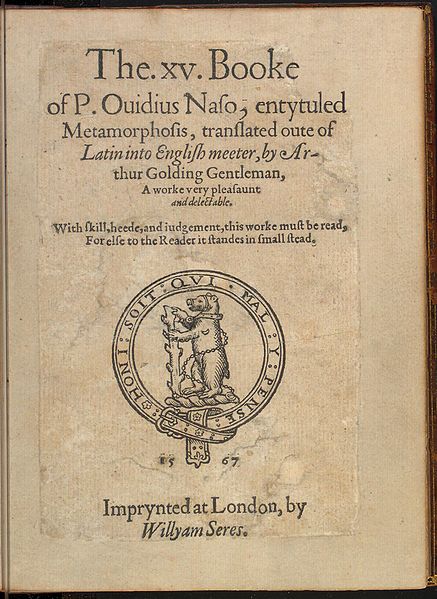
The frontispiece of a 1567 edition of Ovid's Metamorphoses, translated from Latin into English by "Arthur Golding, gentleman." This page also prominently displays the heraldic bear and ragged staff of Robert Dudley, the Earl of Leicester. I have been unable to confirm with certainty that this work was commissioned by him, but all evidence would suggest that it probably was. If anyone has more information on this, please comment or email me! Picture acquired through Wikimedia Commons. Image public domain.

Francis Meres was an Elizabethan author who received his M.A. at Oxford and wrote the Wits Treasury, which was a valuable compendium of information on Elizabethan poets. Wits Treasury is acknowledged in the Shakespeare circle as being the first account with  merit on on the early works of Shakespeare, even establishing some basic chronology of the publications of the works. Meres, who was well acquainted with Shakespeare's gift, compared the Bard's work to Ovid's, saying:

"The sweet witty soul of Ovid lives in mellifluous and honey-tongued Shakespeare."

Sources:  

Francis Meares, Alumni Cantabrigienses, (online edition) Cambridge University Press.

Wednesday, May 2, 2012

May 2nd, 1536: The Arrest of Queen Anne Boleyn

This portrait of Anne Boleyn is probably a later copy of a 1534 original, and it now hangs in the ancestral Boleyn family home, Hever Castle. The Latin inscription above Anne says ANNA.BOLINA ANG.REGINA, or Anne Boleyn, Queen of England. Picture acquired through Wikimedia Commons. Image public domain.

Today in Tudor History, May 2nd, 1536, Anne Boleyn, Queen of England and mother of the future Queen Elizabeth I, was arrested on the orders of her husband, King Henry VIII.

To read a full report of the arrest that shocked Europe, please read the wonderful article To The Tower, written by Claire Ridgeway of the Anne Boleyn File's HERE.

To learn about Anne Boleyn's education and adolescence, please read Part 1 of 3 of my Anne Boleyn article, A Continental Education.

To learn about Anne's courtships, her time in service to Queen Catherine, and political intrigues, read Part 2 of 3 of my Anne Boleyn article, Anne Back in England.

To read about Anne Boleyn's triumph in becoming Queen of England, her accomplishments during her brief reign, her relationship with her only child, and her tragic downfall, read Part 3 of 3 of my Anne Boleyn article, An Honorary Man.

Today is a day of reverence in which we can all reflect on the beginning of the end of the ever-captivating Anne Boleyn.

A plaque to remember the most notable personages who died on the scaffold on the Tower green in the Tower of London; Queen Anne Boleyn is the first listed. Picture acquired through Wikimedia Commons. Image public domain.

Tuesday, May 1, 2012

On This Day in Elizabethan History: Pikemen Demonstrate for Queen Elizabeth

Happy May Day!

"Dancing Around the May-Pole"-A 1767 illustration from A Little Pretty Pocket Book for children. Picture acquired through Wikimedia Commons. Image public domain.

"They rose early to observe the rite of May"
-A Midsummer Night's Dream

On This Day in Elizabethan History, May Day in 1572, a band of London pikemen demonstrated their skill-at-arms for Queen Elizabeth I at Greenwich Palace.

An illustration of an officer of a unit of pikemen from Military Antiquities: Respecting the History of the English Army from Conquest to the Present Time by Francis Grose. Picture acquired through Wikimedia Commons. Image public domain.